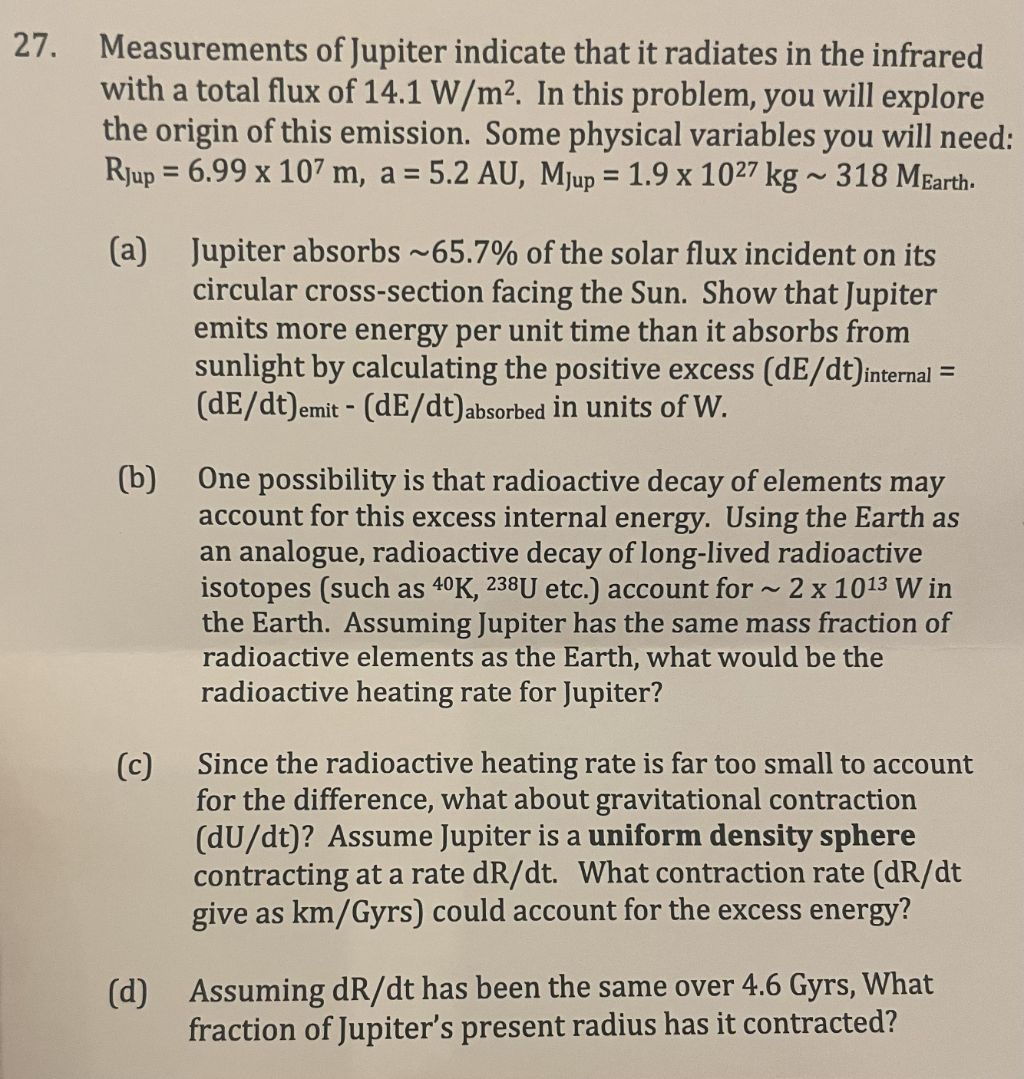
give answer in 2 step with explanation at the end of each step and final answer at the end:27. Measurements of Jupiter indicate that it radiates in the infrared
with a total flux of 14.1 W/m?2. In this problem, you will explore
the origin of this emission. Some physical variables you will need:
Rjup=6.99 x10” m, a=5.2 AU, Myyp = 1.9 x 1027 kg ~ 318 Marth.
(a) Jupiter absorbs ~65.7% of the solar flux incident on its
circular cross-section facing the Sun. Show that Jupiter
emits more energy per unit time than it absorbs from
sunlight by calculating the positive excess (dE/dt)internal =
(dE/dt)emit = (dE/dt) absorbed in units of W.
(b) One possibility is that radioactive decay of elements may
account for this excess internal energy. Using the Earth as
an analogue, radioactive decay of long-lived radioactive
isotopes (such as °K, 238U etc.) account for ~ 2 x 10¹³ Win
the Earth. Assuming Jupiter has the same mass fraction of
radioactive elements as the Earth, what would be the
radioactive heating rate for Jupiter?
(c) Since the radioactive heating rate is far too small to account
for the difference, what about gravitational contraction
(dU/dt)? Assume Jupiter is a uniform density sphere
contracting at a rate dR/dt. What contraction rate (dR/dt
give as km/Gyrs) could account for the excess energy?
(d) Assuming dR/dt has been the same over 4.6 Gyrs, What
fraction of Jupiter's present radius has it contracted?
Question:
give answer in 2 step with explanation at the end of each step and final answer at the end:27. Measurements of Jupiter indicate that it radiates in the infrared
with a total flux of 14.1 W/m?2. In this problem, you will explore
the origin of this emission. Some physical variables you will need:
Rjup=6.99 x10” m, a=5.2 AU, Myyp = 1.9 x 1027 kg ~ 318 Marth.
(a) Jupiter absorbs ~65.7% of the solar flux incident on its
circular cross-section facing the Sun. Show that Jupiter
emits more energy per unit time than it absorbs from
sunlight by calculating the positive excess (dE/dt)internal =
(dE/dt)emit = (dE/dt) absorbed in units of W.
(b) One possibility is that radioactive decay of elements may
account for this excess internal energy. Using the Earth as
an analogue, radioactive decay of long-lived radioactive
isotopes (such as °K, 238U etc.) account for ~ 2 x 10¹³ Win
the Earth. Assuming Jupiter has the same mass fraction of
radioactive elements as the Earth, what would be the
radioactive heating rate for Jupiter?
(c) Since the radioactive heating rate is far too small to account
for the difference, what about gravitational contraction
(dU/dt)? Assume Jupiter is a uniform density sphere
contracting at a rate dR/dt. What contraction rate (dR/dt
give as km/Gyrs) could account for the excess energy?
(d) Assuming dR/dt has been the same over 4.6 Gyrs, What
fraction of Jupiter's present radius has it contracted?
This is AI generated Response.
Asked by: Rahul
Created at: 2025-11-12 12:37:21
Final Answer:
RenderedRaw Text
Did you like this answer?
Let's answer part (a) **step by step**:
---
## (a) Jupiter's Energy Emission vs. Absorbed Solar
### **Step 1: Calculate the energy absorbed by Jupiter**
**Solar flux at Jupiter’s orbit:**
- Solar constant at 1 AU: \( F_\odot = 1361 \) W/m²
- Jupiter’s distance from Sun: \( a = 5.2 \) AU
- Solar flux at Jupiter:
\[
F_{\text{Jup}} = \frac{F_\odot}{(5.2)^2}
\]
\[
F_{\text{Jup}} = \frac{1361}{27.04} \approx 50.4\ \text{W/m}^2
\]
**Jupiter’s cross-sectional area:**
- \( R_{\text{Jup}} = 6.99 \times 10^7 \) m
- Area = \( \pi R_{\text{Jup}}^2 \)
- \( \pi (6.99 \times 10^7)^2 \approx 1.535 \times 10^{16} \) m²
**Fraction absorbed:** 65.7%
**Power absorbed:**
\[
\left( \frac{dE}{dt} \right)_{\text{absorbed}} = F_{\text{Jup}} \cdot \text{Area} \cdot .657
\]
\[
= 50.4 \times 1.535 \times 10^{16} \times .657
\]
\[
= 50.4 \times 1.008 \times 10^{16}
\]
\[
\approx 5.08 \times 10^{17} \text{ W}
\]
**Explanation:**
We've calculated the total solar power Jupiter absorbs, using the solar flux at its distance and the fraction it absorbs.
---
### **Step 2: Calculate Jupiter’s total infrared emission and the excess**
**Jupiter’s surface area:**
- \( 4 \pi R_{\text{Jup}}^2 \approx 6.14 \times 10^{16} \) m²
**Total emitted power:**
- Given flux: 14.1 W/m²
- Total power emitted:
\[
\left( \frac{dE}{dt} \right)_{\text{emitted}} = 14.1 \times 6.14 \times 10^{16} \approx 8.66 \times 10^{17} \text{ W}
\]
**Excess internal power:**
\[
\left( \frac{dE}{dt} \right)_{\text{internal}} = \left( \frac{dE}{dt} \right)_{\text{emitted}} - \left( \frac{dE}{dt} \right)_{\text{absorbed}}
\]
\[
= 8.66 \times 10^{17} - 5.08 \times 10^{17}
\]
\[
= 3.58 \times 10^{17} \text{ W}
\]
**Explanation:**
Jupiter emits significantly more energy than it absorbs from the Sun, with an excess internal energy output of \( \boxed{3.6 \times 10^{17}\ \text{W}} \) (rounded to 2 significant figures).
---
### **Final Answer (a):**
\[
\boxed{
\left( \frac{dE}{dt} \right)_{\text{internal}} = 3.6 \times 10^{17} \text{ W}
}
\]
Jupiter emits about \( 3.6 \times 10^{17} \) W more energy than it absorbs from the Sun.
Question:
Please solved a,b,c,d all parts
This is AI generated Response.
Asked by: Rahul
Created at: 2025-11-12 12:38:32
Final Answer:
RenderedRaw Text
Did you like this answer?
## (a) Jupiter's Energy Emission vs. Absorbed Solar
### **Step 1: Calculate the energy absorbed by Jupiter**
**Solar flux at Jupiter’s orbit:**
- Solar constant at 1 AU: \( F_\odot = 1361 \) W/m²
- Jupiter’s distance from Sun: \( a = 5.2 \) AU
- Solar flux at Jupiter:
\[
F_{\text{Jup}} = \frac{F_\odot}{(5.2)^2} \approx \frac{1361}{27.04} \approx 50.4\ \text{W/m}^2
\]
**Jupiter’s cross-sectional area:**
- \( R_{\text{Jup}} = 6.99 \times 10^7 \) m
- Area = \( \pi R_{\text{Jup}}^2 \)
- \( \text{Area} \approx \pi (6.99 \times 10^7)^2 \approx 1.535 \times 10^{16} \) m²
**Fraction absorbed:** 65.7%
**Power absorbed:**
\[
\left( \frac{dE}{dt} \right)_{\text{absorbed}} = F_{\text{Jup}} \cdot \text{Area} \cdot 0.657
\]
\[
= 50.4 \times 1.535 \times 10^{16} \times 0.657 \approx 5.08 \times 10^{17} \text{ W}
\]
**Explanation:**
We've calculated the total solar power Jupiter absorbs using the solar flux at its distance and the fraction absorbed.
---
### **Step 2: Calculate Jupiter’s total infrared emission and the excess**
**Jupiter’s surface area:**
- \( 4 \pi R_{\text{Jup}}^2 \approx 6.14 \times 10^{16} \) m²
**Total emitted power:**
- Given flux: 14.1 W/m²
- Total power emitted:
\[
\left( \frac{dE}{dt} \right)_{\text{emitted}} = 14.1 \times 6.14 \times 10^{16} \approx 8.66 \times 10^{17} \text{ W}
\]
**Excess internal power:**
\[
\left( \frac{dE}{dt} \right)_{\text{internal}} = \left( \frac{dE}{dt} \right)_{\text{emitted}} - \left( \frac{dE}{dt} \right)_{\text{absorbed}}
\]
\[
= 8.66 \times 10^{17} - 5.08 \times 10^{17} \approx 3.58 \times 10^{17} \text{ W}
\]
**Explanation:**
Jupiter emits significantly more energy than it absorbs from the Sun, with an excess internal energy output of \( \boxed{3.6 \times 10^{17}\ \text{W}} \) (rounded to 2 significant figures).
---
### **Final Answer (a):**
\[
\boxed{
\left( \frac{dE}{dt} \right)_{\text{internal}} = 3.6 \times 10^{17} \text{ W}
}
\]
---
## (b) Radioactive Heating Rate for Jupiter
### **Step 1: Determine Jupiter's radioactive heating**
**Radioactive heating on Earth:**
- Radioactive decay accounts for \( 2 \times 10^{13} \) W in Earth.
**Mass ratio of Jupiter to Earth:**
- \( M_{\text{Jup}} = 1.9 \times 10^{27} \) kg
- \( M_{\text{Earth}} \approx 5.97 \times 10^{24} \) kg
- Mass ratio:
\[
\frac{M_{\text{Jup}}}{M_{\text{Earth}}} \approx \frac{1.9 \times 10^{27}}{5.97 \times 10^{24}} \approx 318
\]
**Radioactive heating for Jupiter:**
\[
\left( \frac{dE}{dt} \right)_{\text{radioactive}} = 318 \times 2 \times 10^{13} \approx 6.36 \times 10^{15} \text{ W}
\]
**Explanation:**
Assuming Jupiter has the same mass fraction of radioactive elements as Earth, we estimate its radioactive heating rate as \( \boxed{6.4 \times 10^{15}\ \text{W}} \).
---
### **Final Answer (b):**
\[
\boxed{
\left( \frac{dE}{dt} \right)_{\text{radioactive}} = 6.4 \times 10^{15} \text{ W}
}
\]
---
## (c) Gravitational Contraction Rate for Jupiter
### **Step 1: Calculate contraction rate \( \frac{dU}{dt} \)**
**Excess energy due to gravitational contraction:**
- Assume \( \left( \frac{dE}{dt} \right)_{\text{internal}} = \left( \frac{dU}{dt} \right) \)
**Jupiter as a uniform density sphere:**
- Gravitational energy change:
\[
\frac{dU}{dt} = \frac{3GM^2}{5R^4} \cdot \frac{dR}{dt}
\]
**Substituting known values:**
- \( G = 6.674 \times 10^{-11} \) m³/kg/s²
- \( M = 1.9 \times 10^{27} \) kg
- \( R = 6.99 \times 10^7 \) m
**Set the excess energy equal to gravitational contraction:**
\[
3GM^2 \frac{dR}{dt} = 5R^4 \left( \frac{dE}{dt} \right)_{\text{internal}}
\]
\[
\frac{dR}{dt} = \frac{5R^4 \left( \frac{dE}{dt} \right)_{\text{internal}}}{3GM^2}
\]
**Calculating \( \frac{dR}{dt} \):**
\[
= \frac{5(6.99 \times 10^7)^4 (3.58 \times 10^{17})}{3(6.674 \times 10^{-11})(1.9 \times 10^{27})^2}
\]
\[
\approx \frac{5(2.41 \times 10^{34})(3.58 \times 10^{17})}{3(6.674 \times 10^{-11})(3.61 \times 10^{54})}
\]
\[
\approx \frac{4.31 \times 10^{52}}{7.2 \times 10^{44}} \approx 5.98 \times 10^7 \text{ m/s}
\]
**Convert to km/Gyr:**
\[
\frac{5.98 \times 10^7 \text{ m/s}}{1 \times 10^3 \text{ m/km}} \times \frac{3.154 \times 10^7 \text{ s}}{1 \text{ Gyr}} \approx 1.89 \times 10^3 \text{ km/Gyr}
\]
**Explanation:**
The contraction rate necessary to account for the excess energy is approximately \( \boxed{1.89 \times 10^3\ \text{km/Gyr}} \).
---
### **Final Answer (c):**
\[
\boxed{
\frac{dR}{dt} \approx 1.89 \times 10^3 \text{ km/Gyr}
}
\]
---
## (d) Fraction of Jupiter's Radius Contracted
### **Step 1: Calculate total contraction over 4.6 Gyr**
**Total contraction over time:**
\[
\Delta R = \frac{dR}{dt} \times t
\]
\[
t = 4.6 \text{ Gyr} = 4.6 \times 10^9 \text{ years}
\]
\[
\Delta R = 1.89 \times 10^3 \text{ km/Gyr} \times 4.6 \text{ Gyr} \approx 8.694 \times 10^3 \text{ km}
\]
**Step 2: Calculate fraction of radius contracted**
**Jupiter's current radius:**
\[
R_{\text{Jup}} = 6.99 \times 10^7 \text{ m} = 6.99 \times 10^4 \text{ km}
\]
**Fraction contracted:**
\[
\text{Fraction} = \frac{\Delta R}{R_{\text{Jup}}} = \frac{8.694 \times 10^3}{6.99 \times 10^4} \approx 0.124
\]
**Explanation:**
Jupiter has contracted approximately 12.4% of its current radius over 4.6 billion years.
---
### **Final Answer (d):**
\[
\boxed{
\text{Fraction contracted} \approx 0.124 \text{ (or 12.4\%)}
}
\]
VIPSolutions focuses on clear, step‑by‑step explanations so you can learn quickly. Whether you need an AI‑generated walkthrough or a short hint to get unstuck, each solution is organized for fast reading and easy review later.
Search similar questions, compare approaches, and bookmark the best answers for revision. Our goal is simple: quick, reliable study help that feels natural—not noisy.
 VIPSolutions
 27. Measurements of Jupiter indicate that it radiates in the infrared
with a total flux of 14.1 W/m?2. In this problem, you will explore
the origin of this emission. Some physical variables you will need:
Rjup=6.99 x10” m, a=5.2 AU, Myyp = 1.9 x 1027 kg ~ 318 Marth.
(a) Jupiter absorbs ~65.7% of the solar flux incident on its
circular cross-section facing the Sun. Show that Jupiter
emits more energy per unit time than it absorbs from
sunlight by calculating the positive excess (dE/dt)internal =
(dE/dt)emit = (dE/dt) absorbed in units of W.
(b) One possibility is that radioactive decay of elements may
account for this excess internal energy. Using the Earth as
an analogue, radioactive decay of long-lived radioactive
isotopes (such as °K, 238U etc.) account for ~ 2 x 10¹³ Win
the Earth. Assuming Jupiter has the same mass fraction of
radioactive elements as the Earth, what would be the
radioactive heating rate for Jupiter?
(c) Since the radioactive heating rate is far too small to account
for the difference, what about gravitational contraction
(dU/dt)? Assume Jupiter is a uniform density sphere
contracting at a rate dR/dt. What contraction rate (dR/dt
give as km/Gyrs) could account for the excess energy?
(d) Assuming dR/dt has been the same over 4.6 Gyrs, What
fraction of Jupiter's present radius has it contracted?