 VIPSolutions
please solve this question step by stepFind the Fourier series for the following periodic function shown in Figure 2. v(t) A 0 -T/2 T/2 3r/2\ t BY »
Question:
please solve this question step by step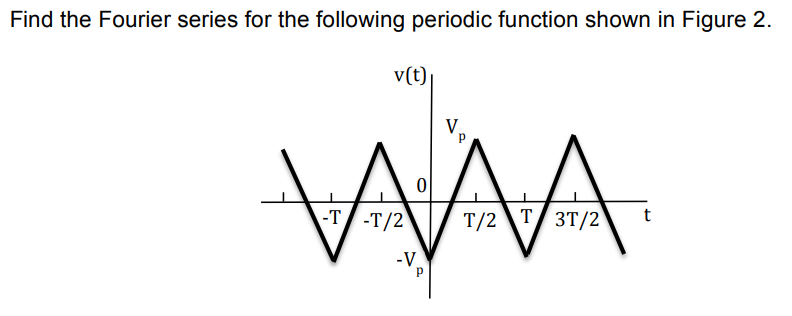 Find the Fourier series for the following periodic function shown in Figure 2.
v(t)
A
0
-T/2 T/2 3r/2\ t
BY
»
This is AI generated Response.
Asked by: Jaswanth Karri
Created at: 2025-08-01 20:49:25
Asked by: Jaswanth Karri
Created at: 2025-08-01 20:49:25
Final Answer:
Rendered
Raw Text
Did you like this answer?
Let's solve the **Fourier Series** for the given periodic function step by step.
## **Step 1: Analyze the Function**
The waveform shown is a **triangular wave** symmetric about the y-axis (even function). Its period \( T \), amplitude \( V_p \).
### **Key properties:**
- **Period (\(T\))**
- **Amplitude (\(V_p\))**
- **Even function:** Only cosine terms (\(a_n\)), no sine terms (\(b_n = 0\)).
---
## **Step 2: Fourier Series Form**
For a periodic function \( v(t) \) with period \( T \):
\[
v(t) = a_0 + \sum_{n=1}^{\infty} a_n \cos\left(\frac{2\pi n t}{T}\right)
\]
where:
\[
a_0 = \frac{1}{T} \int_{-T/2}^{T/2} v(t) \, dt
\]
\[
a_n = \frac{2}{T} \int_{-T/2}^{T/2} v(t) \cos\left(\frac{2\pi n t}{T}\right) dt
\]
\[
b_n = \frac{2}{T} \int_{-T/2}^{T/2} v(t) \sin\left(\frac{2\pi n t}{T}\right) dt = 0 \quad \text{(since even function)}
\]
---
## **Step 3: Express the Function Mathematically**
The triangle wave over one period (\(-T/2 \leq t < T/2\)):
\[
v(t) =
\begin{cases}
\frac{4 V_p}{T} t, & -\frac{T}{2} \leq t < 0 \\
-\frac{4 V_p}{T} t, & 0 \leq t < \frac{T}{2}
\end{cases}
\]
Or, more compactly (for even function):
\[
v(t) = \frac{4V_p}{T} |t| \quad \text{for } -\frac{T}{2} \leq t < \frac{T}{2}
\]
But as per the graph, it reaches \(-V_p\) at \( t=0 \), so let's re-express accordingly:
\[
v(t) = -\frac{4V_p}{T} |t| + V_p \quad \text{for } -\frac{T}{2} \leq t \leq \frac{T}{2}
\]
---
## **Step 4: Compute Fourier Coefficients**
### **a. \( a_0 \) (DC component):**
\[
a_0 = \frac{1}{T} \int_{-T/2}^{T/2} v(t) \, dt
\]
Since the positive and negative areas cancel (triangle centered at zero):
\[
a_0 = 0
\]
(The average value is zero.)
---
### **b. \( a_n \) (Cosine coefficients):**
\[
a_n = \frac{2}{T} \int_{-T/2}^{T/2} v(t) \cos\left( \frac{2\pi n t}{T} \right) dt
\]
Because \( v(t) \) is even, we can write:
\[
a_n = \frac{4}{T} \int_{0}^{T/2} v(t) \cos\left( \frac{2\pi n t}{T} \right) dt
\]
From \( 0 \leq t \leq T/2 \):
\[
v(t) = -\frac{4V_p}{T} t + V_p
\]
So,
\[
a_n = \frac{4}{T} \int_{0}^{T/2} \left[ -\frac{4V_p}{T} t + V_p \right] \cos\left( \frac{2\pi n t}{T} \right) dt
\]
\[
= \frac{4}{T} \left[ -\frac{4V_p}{T} \int_{0}^{T/2} t \cos\left( \frac{2\pi n t}{T} \right) dt + V_p \int_{0}^{T/2} \cos\left( \frac{2\pi n t}{T} \right) dt \right]
\]
#### **First Integral: \( \int_{0}^{T/2} t \cos\left( \frac{2\pi n t}{T} \right) dt \)**
Let \( \omega_0 = \frac{2\pi}{T} \), so \( \omega_0 n = \frac{2\pi n}{T} \):
Use integration by parts:
Let \( u = t \), \( dv = \cos(\omega_0 n t) dt \)
- \( du = dt \)
- \( v = \frac{1}{\omega_0 n} \sin(\omega_0 n t) \)
So,
\[
\int t \cos(\omega_0 n t) dt = \frac{t}{\omega_0 n} \sin(\omega_0 n t) - \int \frac{1}{\omega_0 n} \sin(\omega_0 n t) dt
\]
\[
= \frac{t}{\omega_0 n} \sin(\omega_0 n t) + \frac{1}{(\omega_0 n)^2} \cos(\omega_0 n t) + C
\]
Evaluate from \( 0 \) to \( T/2 \):
- At \( t = 0 \), both terms are zero except the cosine term, which is 1.
- At \( t = T/2 \):
\( \omega_0 n t = \frac{2\pi n}{T} \cdot \frac{T}{2} = n\pi \)
- \( \sin(n\pi) = 0 \)
- \( \cos(n\pi) = (-1)^n \)
So,
\[
\int_{0}^{T/2} t \cos(\omega_0 n t) dt = \left[ \frac{t}{\omega_0 n} \sin(\omega_0 n t) + \frac{1}{(\omega_0 n)^2} \cos(\omega_0 n t) \right]_{0}^{T/2}
\]
\[
= \left( 0 + \frac{1}{(\omega_0 n)^2} (-1)^n \right) - \left( 0 + \frac{1}{(\omega_0 n)^2} (1) \right)
\]
\[
= \frac{1}{(\omega_0 n)^2} \left( (-1)^n - 1 \right)
\]
---
#### **Second Integral: \( \int_{0}^{T/2} \cos(\omega_0 n t) dt \)**
\[
\int \cos(\omega_0 n t) dt = \frac{1}{\omega_0 n} \sin(\omega_0 n t)
\]
From \( 0 \) to \( T/2 \):
- At \( t = T/2 \), \( \sin(n\pi) = 0 \)
- At \( t = 0 \), \( \sin(0) = 0 \)
So, this integral is zero.
---
### **Combining the results:**
\[
a_n = \frac{4}{T} \left[ -\frac{4V_p}{T} \cdot \frac{1}{(\omega_0 n)^2} \left( (-1)^n - 1 \right) \right]
\]
\[
= -\frac{16 V_p}{T^2} \cdot \frac{1}{(\omega_0 n)^2} \left( (-1)^n - 1 \right)
\]
Recall \( \omega_0 = \frac{2\pi}{T} \Rightarrow (\omega_0 n)^2 = \left(\frac{2\pi n}{T}\right)^2 = \frac{4\pi^2 n^2}{T^2} \)
So,
\[
a_n = -\frac{16 V_p}{T^2} \cdot \frac{T^2}{4\pi^2 n^2} \left( (-1)^n - 1 \right)
\]
\[
= -\frac{16 V_p}{4\pi^2 n^2} \left( (-1)^n - 1 \right)
\]
\[
= -\frac{4 V_p}{\pi^2 n^2} \left( (-1)^n - 1 \right)
\]
Notice:
- For **even \( n \)**: \( (-1)^n - 1 = 1 - 1 = 0 \)
- For **odd \( n \)**: \( (-1)^n - 1 = -1 - 1 = -2 \)
So for **odd \( n \)** only:
\[
a_n = -\frac{4 V_p}{\pi^2 n^2} \cdot (-2) = \frac{8 V_p}{\pi^2 n^2}
\]
For **even \( n \)**, \( a_n = 0 \).
---
## **Step 5: **Final Fourier Series**
\[
\boxed{
v(t) = \sum_{n=1,\, n\, \text{odd}}^{\infty} \frac{8 V_p}{\pi^2 n^2} \cos\left(\frac{2\pi n t}{T}\right)
}
\]
where the sum is over **odd values of \( n \)** (i.e., \( n = 1, 3, 5, \ldots \)).
---
### **Summary of Steps**
1. Identified the function as an even triangular wave.
2. Wrote the general Fourier cosine series.
3. Calculated the coefficients using integration.
4. Noted that only odd harmonics are present.
5. Wrote the final result.
---
### **Final Answer:**
\[
\boxed{
v(t) = \sum_{n=1,3,5,\ldots}^{\infty} \frac{8 V_p}{\pi^2 n^2} \cos\left(\frac{2\pi n t}{T}\right)
}
\]
---
**If you want me to show the first few terms or plot the Fourier approximation, let me know!**
📢 Instructions:
- Ask anything relatd to above question only.
- For new Question goto :