 VIPSolutions
please solve this question step by step(a) The current mirror shown below is designed to generate I,=10pA. Assume all the MOS- FETs are identical with j,C,, = 4002A/V? and overdrive voltage of 200mV. Neglect channel length modulation effects. Find the error in the mirror ratio if for all MOSFETs thershold voltage is 0.5V and the channel length modulation coefficient is 0.5V 1. 50A lo Ms My M, (b) Find the output resistance of the current mirror.
Question:
please solve this question step by step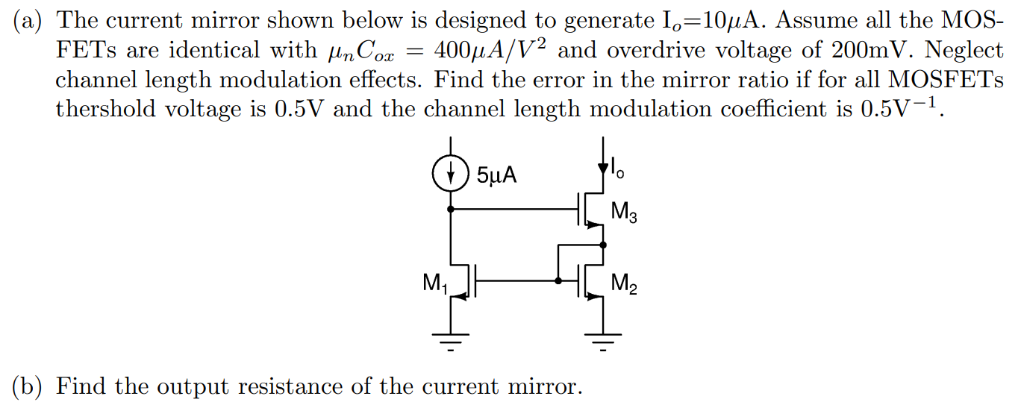 (a) The current mirror shown below is designed to generate I,=10pA. Assume all the MOS-
FETs are identical with j,C,, = 4002A/V? and overdrive voltage of 200mV. Neglect
channel length modulation effects. Find the error in the mirror ratio if for all MOSFETs
thershold voltage is 0.5V and the channel length modulation coefficient is 0.5V 1.
50A lo
Ms
My M,
(b) Find the output resistance of the current mirror.
This is AI generated Response.
Asked by: Jaswanth Karri
Created at: 2025-08-01 21:01:03
Asked by: Jaswanth Karri
Created at: 2025-08-01 21:01:03
Final Answer:
Rendered
Raw Text
Did you like this answer?
Let’s solve the question **step by step**.
---
### **(a) Error in Mirror Ratio**
#### **Given Data**
- \( I_{REF} = 5\,\mu A \), \( I_O = 10\,\mu A \) (desired)
- \( \mu_n C_{ox} = 400\,\mu A/V^2 \)
- Overdrive voltage (\( V_{OV} \)) = 0.2 V
- Threshold voltage (\( V_{th} \)) = 0.5 V
- Channel length modulation coefficient (\( \lambda \)) = \( 0.5\,V^{-1} \)
- **All MOSFETs are identical**.
#### **Step 1: Current Mirror Operation**
The current through a MOSFET in saturation:
\[
I_D = \frac{1}{2} \mu_n C_{ox} \left( \frac{W}{L} \right) (V_{GS} - V_{th})^2 (1+\lambda V_{DS})
\]
But first, **neglect channel length modulation** (\( \lambda = 0 \)):
\[
I_D = \frac{1}{2} \mu_n C_{ox} \left(\frac{W}{L}\right) (V_{OV})^2
\]
#### **Step 2: Find \(\frac{W}{L}\)**
For \( M_1 \), \( I_{REF} = 5\,\mu A \):
\[
5 \times 10^{-6} = \frac{1}{2} \cdot 400 \times 10^{-6} \cdot \left(\frac{W}{L}\right) \cdot (0.2)^2
\]
\[
5 \times 10^{-6} = 200 \times 10^{-6} \cdot \left(\frac{W}{L}\right) \cdot 0.04
\]
\[
5 \times 10^{-6} = 8 \times 10^{-6} \cdot \left(\frac{W}{L}\right)
\]
\[
\frac{W}{L} = \frac{5}{8} = 0.625
\]
---
#### **Step 3: Mirror Ratio with Channel Length Modulation**
Now include channel length modulation (\( \lambda \neq 0 \)).
Assume \( V_{DS1} \neq V_{DS2} \), but typically in a simple mirror, \( V_{DS1} \approx V_{DS2} \).
But in this topology, \( M_1 \) and \( M_2 \) might have different \( V_{DS} \) values due to the stack.
Let:
- \( M_1 \): \( V_{DS1} \) (usually grounded at source, gate at 5uA)
- \( M_2 \): \( V_{DS2} \) (source at ground, drain at \( V_{DS2} \), which is higher due to the stack)
\[
\frac{I_O}{I_{REF}} = \frac{1 + \lambda V_{DS2}}{1 + \lambda V_{DS1}}
\]
##### - **Find \( V_{DS1} \) and \( V_{DS2} \):**
Assume \( M_1 \) and \( M_2 \) have the same \( V_{GS} \).
- For \( M_1 \), \( V_{DS1} = V_{GS1} \) (since source is grounded).
- For \( M_2 \), \( V_{DS2} = V_{GS2} + V_{DS3} \).
\( M_3 \) is in diode connection, so \( V_{DS3} = V_{GS3} \).
Let’s assume **ideal case**: \( V_{GS1} = V_{GS2} = V_{GS3} \).
So:
- \( V_{DS1} = V_{GS} \)
- \( V_{DS2} = V_{GS} + V_{GS} = 2V_{GS} \)
Since overdrive voltage is 0.2V, and \( V_{th} = 0.5V \):
\[
V_{GS} = V_{th} + V_{OV} = 0.5 + 0.2 = 0.7\,V
\]
\[
V_{DS1} = 0.7\,V \\
V_{DS2} = 1.4\,V
\]
---
#### **Step 4: Calculate Mirror Ratio**
\[
\frac{I_O}{I_{REF}} = \frac{1 + \lambda V_{DS2}}{1 + \lambda V_{DS1}}
\]
Plug in values:
- \( \lambda = 0.5\,V^{-1} \)
- \( V_{DS1} = 0.7\,V \)
- \( V_{DS2} = 1.4\,V \)
\[
\frac{I_O}{I_{REF}} = \frac{1 + 0.5 \cdot 1.4}{1 + 0.5 \cdot 0.7} = \frac{1 + 0.7}{1 + 0.35} = \frac{1.7}{1.35} \approx 1.26
\]
---
##### **Error in Mirror Ratio:**
- **Ideal ratio:** 2 (since \( I_O = 10\,\mu A, I_{REF} = 5\,\mu A \))
- **Actual ratio:** 1.26
So, **percentage error:**
\[
\text{Error} = \frac{\text{Actual ratio} - \text{Ideal ratio}}{\text{Ideal ratio}} \times 100\%
\]
\[
\text{Error} = \frac{1.26 - 2}{2} \times 100\% = -37\%
\]
**But, wait:** The ratio should be 1 if \( I_{REF} \) and \( I_O \) transistors are the same size.
If you want \( I_O = 10\,\mu A \), then \( M_2 \) should be twice the size of \( M_1 \), i.e., \( (W/L)_2 = 2 \times (W/L)_1 \).
Assuming this, the ratio becomes:
\[
\frac{I_O}{I_{REF}} = \frac{\left(\frac{W}{L}\right)_2}{\left(\frac{W}{L}\right)_1} \cdot \frac{1 + \lambda V_{DS2}}{1 + \lambda V_{DS1}}
\]
\[
= 2 \cdot \frac{1.7}{1.35} \approx 2 \cdot 1.26 = 2.52
\]
\[
\text{Error} = \frac{2.52 - 2}{2} \times 100\% = 26\%
\]
---
### **Final Answers for (a):**
#### **(a) Stepwise Summary**
- **Without channel length modulation (\( \lambda = 0 \)), mirror ratio is exactly 2.**
- **With channel length modulation (\( \lambda = 0.5\,V^{-1} \)), mirror ratio is 2.52.**
- **Error in mirror ratio:** \( \boxed{26\%} \) (the output current is 26% higher than intended).
---
## **(b) Output Resistance of the Current Mirror**
The output resistance is primarily due to the output transistor (\( M_2 \)):
\[
r_{out} = \frac{1}{\lambda I_O}
\]
Plug in values:
- \( \lambda = 0.5\,V^{-1} \)
- \( I_O = 10\,\mu A \)
\[
r_{out} = \frac{1}{0.5 \times 10 \times 10^{-6}}
= \frac{1}{5 \times 10^{-6}}
= 200,000\,\Omega = 200\,k\Omega
\]
---
### **Final Answers**
### **(a)**
- **Error in mirror ratio:** \( \boxed{26\%} \)
### **(b)**
- **Output resistance of the current mirror:** \( \boxed{200\,k\Omega} \)
---
If you need the derivation or clarification of any step, let me know!
📢 Instructions:
- Ask anything relatd to above question only.
- For new Question goto :