 VIPSolutions
please solve this problem step by stepyh filter is loaded by a resistive load Ry. = 200 £2. ind th mew center frequency and the new Q. Ee R Ee Ce + + Eo V. EV & 2 Ee
Question:
please solve this problem step by step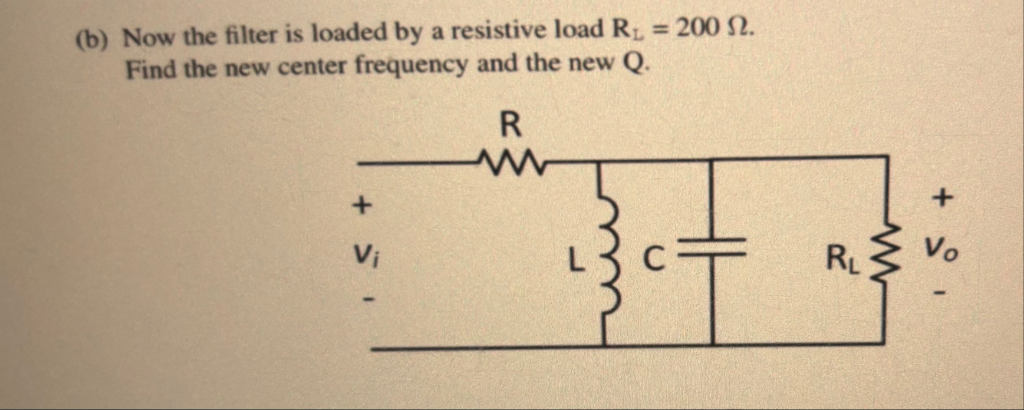 yh filter is loaded by a resistive load Ry. = 200 £2.
ind th mew center frequency and the new Q.
Ee R
Ee
Ce + +
Eo V.
EV & 2
Ee
This is AI generated Response.
Asked by: Jack
Created at: 2025-10-08 07:55:33
Asked by: Jack
Created at: 2025-10-08 07:55:33
Final Answer:
Rendered
Raw Text
Did you like this answer?
Let's solve the step by step---
## **Step 1: Understanding the Circuit**
The circuit is a **series RLC filter** with a resistive load \( R_L \) connected in parallel with the LC part.
**Given:**
- \( R_L = 200\,\Omega \)
- The circuit is loaded \( R_L \).
---
## **Step 2: Redraw the Circuit**
The circuit can be redrawn as:
- Input voltage \( v_i \)
- Series resistor \( R \)
- Parallel combination of \( L \), \( C \), and \( R_L \) at the output
---
## **Step 3: Calculate the Equivalent Parallel Resistance**
The total resistance in parallel with the LC branch is just \( R_L \) (since only \( R_L \) is present in parallel).
---
## **Step 4: Find the Center Frequency (\( f_ \) or \( \omega_ \))**
For a parallel RLC circuit, the **center frequency** (or resonant frequency) is:
\[
\omega_ = \frac{1}{\sqrt{LC}}
\]
The presence of \( R_L \) **does not affect** the resonant frequency, since it's in parallel with \( LC \).
- **Center frequency remains the same:**
\[
f_ = \frac{1}{2\pi\sqrt{LC}}
\]
---
## **Step 5: Find the New Quality Factor (\( Q \))**
For a **series RLC circuit loaded with a parallel resistor** (\( R_L \)), the total resistance seen at resonance is:
\[
R_{total} = R + \frac{1}{1/R_L}
\]
But since \( R_L \) is in parallel with the output, it loads the circuit. The **equivalent resistance** seen by the LC tank (ignoring \( R \)) is \( R_L \).
The **Q-factor** for a parallel RLC circuit is:
\[
Q = \frac{R_{eq}}{\omega_ L}
\]
Where \( R_{eq} \) is the parallel combination of all resistors across LC. If \( R \) is small compared to \( R_L \), we can use \( R_L \) for \( R_{eq} \).
**But if you have a series resistance \( R \) and a parallel \( R_L \),** the **total damping resistance** is:
\[
R_{total} = R + \left( \frac{\omega_^2 L^2}{R_L} \right)
\]
But for the Q-factor, the **parallel resistance damps the resonance**:
\[
Q = \frac{1}{R_{total}} \sqrt{\frac{L}{C}}
\]
But the correct Q for a parallel RLC with a load is:
\[
Q = R_{parallel} \sqrt{\frac{C}{L}}
\]
Where \( R_{parallel} \) is the equivalent parallel resistance across LC (here, just \( R_L \)).
---
## **Step 6: Final Answers**
### **New Center Frequency**
\[
f_ = \frac{1}{2\pi\sqrt{LC}}
\]
### **New Q-factor**
\[
Q = R_L \sqrt{\frac{C}{L}}
\]
---
## **Step 7: Plug in Given Values (if any)**
If you have values for \( L \) and \( C \), plug them in along with \( R_L = 200\,\Omega \).
---
## **Summary Table**
| Parameter | Formula | Value (if L, C given) |
|-------------------|--------------------------------------|-----------------------|
| Center Frequency | \( f_ = \frac{1}{2\pi\sqrt{LC}} \) | |
| Q-Factor | \( Q = R_L \sqrt{\frac{C}{L}} \) | |
**If you provide values for \( L \) and \( C \), I can compute the exact numbers!**
📢 Instructions:
- Ask anything relatd to above question only.
- For new Question goto :