 VIPSolutions
please solve this problem step by step , solve all partsIn Fig. 6-29, solve for a. Rr. b. Ir. c. Vi, Va, and Vs. d. Land I5 Figure 6-29 R, = 1.2k0 + oo Ea )
Question:
please solve this problem step by step , solve all parts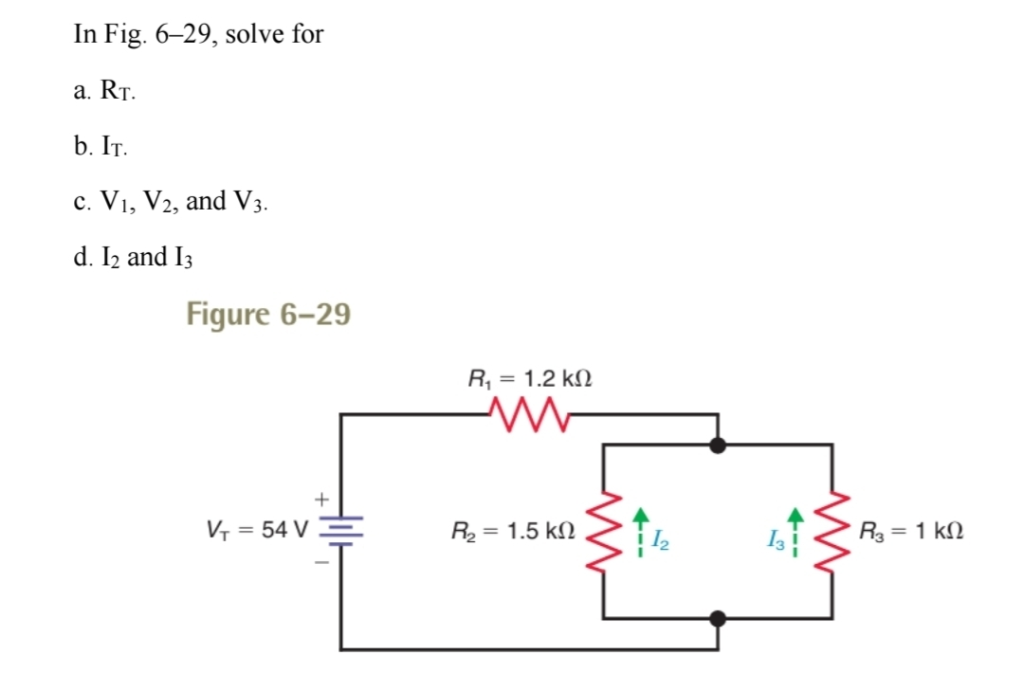 In Fig. 6-29, solve for
a. Rr.
b. Ir.
c. Vi, Va, and Vs.
d. Land I5
Figure 6-29
R, = 1.2k0
+
oo Ea )
This is AI generated Response.
Asked by: Jack
Created at: 2025-10-20 10:30:56
Asked by: Jack
Created at: 2025-10-20 10:30:56
Final Answer:
Rendered
Raw Text
Did you like this answer?
Let's solve the circuit step by step.
---
# Given Data:
| Resistors | Resistance |
|-------------|--------------|
| \( R_1 \) | 1.2 kΩ |
| \( R_2 \) | 1.5 kΩ |
| \( R_3 \) | 1 kΩ |
| Voltage Source | \( V_T \) | 54 V |
---
# Step 1: Find the equivalent resistance \( R_T \)
**Note**: \( R_T \) is usually the total equivalent resistance seen from the source.
### Since the resistors \( R_2 \) and \( R_3 \) are in parallel:
\[
\frac{1}{R_{23}} = \frac{1}{R_2} + \frac{1}{R_3}
\]
\[
\frac{1}{R_{23}} = \frac{1}{150} + \frac{1}{100} \quad \text{(values in ohms)}
\]
\[
\frac{1}{R_{23}} = \frac{2}{300} + \frac{3}{300} = \frac{5}{300}
\]
\[
R_{23} = \frac{300}{5} = 600\, \Omega
\]
### Now, \( R_{23} \) is in series with \( R_1 \):
\[
R_T = R_1 + R_{23} = 120\, \Omega + 600\, \Omega = 180\, \Omega
\]
---
# **Part a: \( R_T \)**
\[
\boxed{
R_T = 1.8\, \text{k}\Omega
}
\]
---
# Step 2: Find the total current \( I_T \)
The total current from the source:
\[
I_T = \frac{V_T}{R_T} = \frac{54\,V}{180\, \Omega}
\]
\[
I_T = .03\, \text{A} = 30\, \text{mA}
\]
---
# **Part b: \( I_T \)**
\[
\boxed{
I_T = 30\, \text{mA}
}
\]
---
# Step 3: Find the voltages across \( R_1 \), \( R_2 \), and \( R_3 \)
Since \( R_2 \) and \( R_3 \) are in parallel, the voltage across them is the same and equal to the voltage across \( R_{23} \):
\[
V_{R_{23}} = I_{R_{23}} \times R_{23}
\]
But first, find the current through \( R_1 \):
\[
I_{R_1} = \frac{V_{R_1}}{R_1}
\]
Total current:
\[
I_T = I_{R_1} + I_{R_{23}}
\]
Since the total current splits between \( R_2 \) and \( R_3 \), the voltage across the parallel combination:
\[
V_{R_{23}} = V_{R_2} = V_{R_3}
\]
And:
\[
V_{R_{23}} = V_T - V_{R_1}
\]
But because the resistors are in series with the total:
\[
V_{R_1} = I_T \times R_1 = .03\,A \times 120\, \Omega = 36\,V
\]
Hence,
\[
V_{R_{23}} = V_T - V_{R_1} = 54\,V - 36\,V = 18\,V
\]
---
# Part c: Voltages \( V_1, V_2, V_3 \)
- \( V_1 \): Voltage across \( R_1 \): **36 V**
- \( V_2 \) and \( V_3 \): Voltage across \( R_2 \) and \( R_3 \):
\[
V_2 = V_3 = V_{R_{23}} = 18\,V
\]
---
# Step 4: Find the currents \( I_2 \) and \( I_3 \)
- Current through \( R_2 \):
\[
I_2 = \frac{V_{R_2}}{R_2} = \frac{18\,V}{150\, \Omega} = .012\,A = 12\,mA
\]
- Current through \( R_3 \):
\[
I_3 = \frac{V_{R_3}}{R_3} = \frac{18\,V}{100\, \Omega} = .018\,A = 18\,mA
\]
---
# **Part d: Currents \( I_2 \) and \( I_3 \)**
\[
\boxed{
I_2 = 12\, \text{mA}, \quad I_3 = 18\, \text{mA}
}
\]
---
# **Summary:**
| Part | Result |
|---------|--------|
| a. \( R_T \) | 1.8 kΩ |
| b. \( I_T \) | 30 mA |
| c. \( V_1, V_2, V_3 \) | 36 V, 18 V, 18 V |
| d. \( I_2, I_3 \) | 12 mA, 18 mA |
Let me know if you'd like additional details or clarification!
📢 Instructions:
- Ask anything relatd to above question only.
- For new Question goto :