 VIPSolutions
please solve this problem step by stepshow work for full credit. pes Jive Sh Your answers are to be expr aed SRE AS Eg 0 a ee that vou cas In terms of the Volta final answers. tages and/or additional upyei gt Solution muss 5 draw, a2 boy around your y Ry R; R3 Ry Ro rs . © é Uo Gi i= ¢
Question:
please solve this problem step by step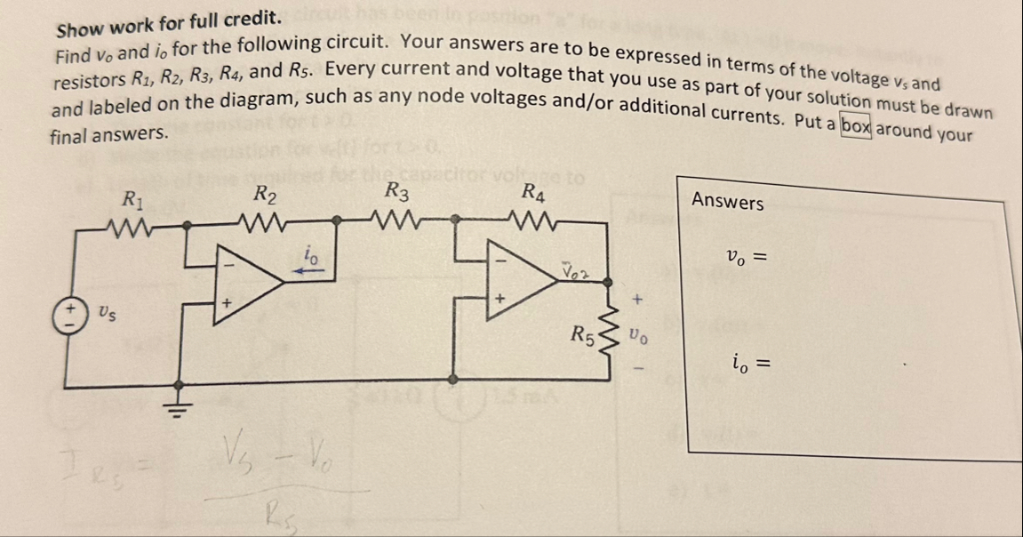 show work for full credit.
pes Jive Sh Your answers are to be expr
aed SRE AS Eg 0 a ee that vou cas In terms of the Volta
final answers. tages and/or additional upyei gt Solution muss 5 draw,
a2 boy around your y
Ry R; R3 Ry Ro
rs .
© é
Uo
Gi i= ¢
This is AI generated Response.
Asked by: Mohin
Created at: 2025-10-30 09:41:20
Asked by: Mohin
Created at: 2025-10-30 09:41:20
Final Answer:
Rendered
Raw Text
Did you like this answer?
Let's solve the circuit **step by step** using nodal analysis and op-amp properties.
---
## **Step 1: Label Node Voltages**
- Let the non-inverting input of the first op-amp be at ground ( V).
- Let the voltage at the output of the first op-amp be \( v_{o1} \).
- The voltage at the inverting input of the second op-amp is at the node between \( R_3 \) and \( R_4 \) (call it \( v_x \)).
- The output of the second op-amp is \( v_o \).
---
## **Step 2: First Op-Amp (Ideal Op-Amp, Negative Feedback)**
The non-inverting input is grounded, so by virtual short, the inverting input is also at ** V**.
**Apply KCL at the inverting input:**
\[
\frac{v_s - }{R_1} = \frac{ - v_{o1}}{R_2}
\]
\[
\frac{v_s}{R_1} = -\frac{v_{o1}}{R_2}
\]
\[
v_{o1} = -\frac{R_2}{R_1} v_s
\]
---
## **Step 3: Second Op-Amp (Negative Feedback)**
The non-inverting input is at ground ( V), so by virtual short, the inverting input is also at ** V**.
- The current through \( R_3 \): \(\frac{v_{o1} - }{R_3}\)
- The current through \( R_4 \): \(\frac{ - v_o}{R_4}\)
- The current through \( R_5 \): \(\frac{ - v_o}{R_5}\)
**Apply KCL at the inverting input of the second op-amp:**
\[
\frac{v_{o1} - }{R_3} = \frac{ - v_o}{R_4} + \frac{ - v_o}{R_5}
\]
\[
\frac{v_{o1}}{R_3} = -v_o \left( \frac{1}{R_4} + \frac{1}{R_5} \right)
\]
\[
v_o = -\frac{v_{o1}}{R_3 \left( \frac{1}{R_4} + \frac{1}{R_5} \right)}
\]
\[
v_o = -\frac{v_{o1}}{R_3} \cdot \left( \frac{R_4 R_5}{R_4 + R_5} \right)
\]
Now substitute \(v_{o1}\):
\[
v_{o} = -\frac{1}{R_3} \left( \frac{R_4 R_5}{R_4 + R_5} \right) \left( -\frac{R_2}{R_1} v_s \right)
\]
\[
v_o = \frac{R_2}{R_1 R_3} \left( \frac{R_4 R_5}{R_4 + R_5} \right) v_s
\]
---
## **Step 4: Output Current \( i_o \) through \( R_5 \)**
\[
i_o = \frac{ - v_o}{R_5} = -\frac{v_o}{R_5}
\]
Plug in the expression for \( v_o \):
\[
i_o = -\frac{1}{R_5} \cdot \frac{R_2}{R_1 R_3} \left( \frac{R_4 R_5}{R_4 + R_5} \right) v_s
\]
\[
i_o = -\frac{R_2 R_4}{R_1 R_3 (R_4 + R_5)} v_s
\]
---
## **Step 5: Boxed Answers**
\[
\boxed{
v_o = \frac{R_2}{R_1 R_3} \left( \frac{R_4 R_5}{R_4 + R_5} \right) v_s
}
\]
\[
\boxed{
i_o = -\frac{R_2 R_4}{R_1 R_3 (R_4 + R_5)} v_s
}
\]
---
### **Summary Table**
| Quantity | Expression (in terms of \( v_s, R_1, R_2, R_3, R_4, R_5 \)) |
|:--------:|:----------------------------------------------------------:|
| \( v_o \) | \( \dfrac{R_2}{R_1 R_3} \left( \dfrac{R_4 R_5}{R_4 + R_5} \right) v_s \) |
| \( i_o \) | \( -\dfrac{R_2 R_4}{R_1 R_3 (R_4 + R_5)} v_s \) |
📢 Instructions:
- Ask anything relatd to above question only.
- For new Question goto :