 VIPSolutions
please solve this problem step by stepQ5. Calculate the S11 parameter at the location shown in Fig. 5. The load is a 10.61 pF capacitor and is connected to a 0.5-A long transmission line. Operating frequency is 300 MHz and the system characteristic impedance Z, is 50 Q. (=0.51 Si Z Ny Z 10.61 pF Zin Fig. 5.
Question:
please solve this problem step by step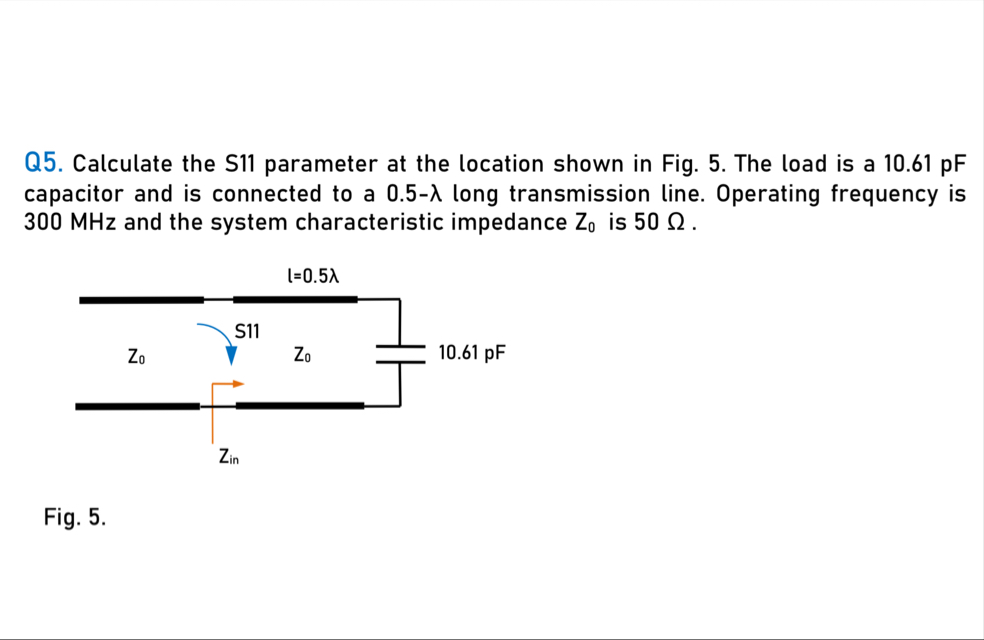 Q5. Calculate the S11 parameter at the location shown in Fig. 5. The load is a 10.61 pF
capacitor and is connected to a 0.5-A long transmission line. Operating frequency is
300 MHz and the system characteristic impedance Z, is 50 Q.
(=0.51
Si
Z Ny Z 10.61 pF
Zin
Fig. 5.
This is AI generated Response.
Asked by: Jack
Created at: 2025-10-25 15:58:01
Asked by: Jack
Created at: 2025-10-25 15:58:01
Final Answer:
Rendered
Raw Text
Did you like this answer?
Let's solve the step-by-step---
## Given:
- **Capacitance \( C \) = 10.61 pF**
- **Transmission line length \( l = .5 \lambda \)**
- **Operating frequency \( f = 300\, \text{MHz} \)**
- **Characteristic impedance \( Z_ = 50\, \Omega \)**
- **Load impedance \( Z_L = Z_{in} \) (to be calculated)**
---
## Step 1: Find the wavelength (\( \lambda \))
\[
\lambda = \frac{v}{f}
\]
where \( v \) is the speed of light in the medium; assuming the transmission line is in free space or an environment where \( v \approx c = 3 \times 10^8\, \text{m/s} \).
\[
\lambda = \frac{3 \times 10^{8}\, \text{m/s}}{300 \times 10^{6}\, \text{Hz}} = 1\, \text{m}
\]
---
## Step 2: Find the length of the transmission line \( l \)
Given \( l = .5 \lambda \):
\[
l = .5 \times 1\, \text{m} = .5\, \text{m}
\]
---
## Step 3: Calculate the electrical length in radians
The electrical length \( \beta l \):
\[
\beta = \frac{2\pi}{\lambda}
\]
\[
\beta = \frac{2\pi}{1\, \text{m}} = 2\pi\, \text{rad/m}
\]
Therefore, for \( l = .5\, \text{m} \):
\[
\beta l = 2\pi \times .5 = \pi\, \text{rad}
\]
---
## Step 4: Use the transmission line impedance transformation formula
The input impedance \( Z_{in} \) for a lossless transmission line terminated with \( Z_{L} \):
\[
Z_{in} = Z_ \frac{Z_L + j Z_ \tan(\beta l)}{Z_ + j Z_L \tan(\beta l)}
\]
Given \( Z_L \) (the load impedance) is purely reactive (since it is a capacitor in parallel with the transmission line), we need to find \( Z_L \).
---
## Step 5: Find the load impedance \( Z_{load} \)
The load is a capacitor:
\[
Z_C = \frac{1}{j \omega C}
\]
Where:
\[
\omega = 2 \pi f = 2 \pi \times 300 \times 10^6 = 1.884 \times 10^9\, \text{rad/sec}
\]
Calculate:
\[
Z_C = \frac{1}{j \times 1.884 \times 10^9 \times 10.61 \times 10^{-12}}
\]
\[
Z_C = \frac{1}{j \times 1.884 \times 10^9 \times 10.61 \times 10^{-12}}
\]
\[
Z_C = \frac{1}{j \times 20.02} \approx -j \times .0499\, \Omega
\]
---
## Step 6: Determine \( Z_{in} \)
Since the load is purely reactive:
\[
Z_L = Z_C = -j .0499\, \Omega
\]
Using the impedance transformation formula:
\[
Z_{in} = Z_ \frac{Z_L + j Z_ \tan(\beta l)}{Z_ + j Z_L \tan(\beta l)}
\]
Substitute the known values:
\[
Z_{in} = 50 \frac{-j .0499 + j 50 \times \tan(\pi)}{50 + j (-j .0499) \times \tan(\pi)}
\]
Recall:
\[
\tan(\pi) =
\]
So:
\[
Z_{in} = 50 \times \frac{-j .0499 + }{50 + } = 50 \times \frac{-j .0499}{50} = -j .0499\, \Omega
\]
---
## **Final Result:**
\[
\boxed{
Z_{in} \approx -j .0499\, \Omega
}
\]
This is the input impedance at the specified location.
---
## **Summary:**
- The input impedance \( Z_{in} \) at the specified location is approximately **\(-j .0499\, \Omega\)**, primarily reactive and very small in magnitude.
If further clarification or calculations are needed, please let me know!
📢 Instructions:
- Ask anything relatd to above question only.
- For new Question goto :