 VIPSolutions
please solve this problem step by stepQ1: For the circuits shown below, assuming that the transistors have very large . Find the values of the labelled voltages and currents. . i _— + v, hid $i | ws a £7 os wo i A moon 300k. = fon ' |
Question:
please solve this problem step by step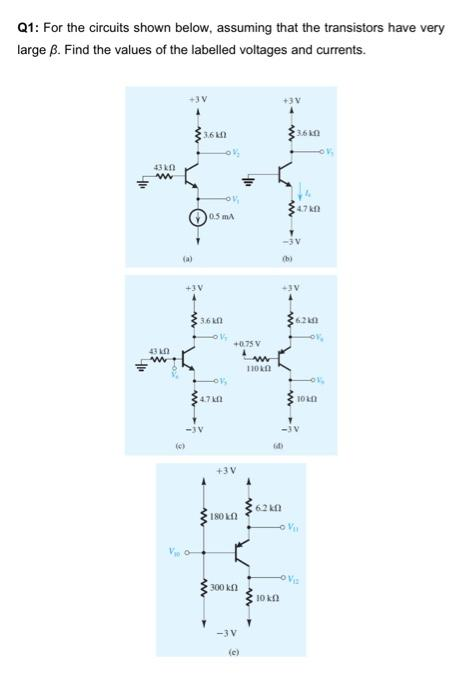 Q1: For the circuits shown below, assuming that the transistors have very
large . Find the values of the labelled voltages and currents.
. i
_— +
v, hid
$i
|
ws a
£7 os
wo
i
A
moon
300k. =
fon
'
|
This is AI generated Response.
Asked by: Jaswanth Karri
Created at: 2025-08-06 14:01:11
Asked by: Jaswanth Karri
Created at: 2025-08-06 14:01:11
Final Answer:
Rendered
Raw Text
Did you like this answer?
Let's solve each circuit **step by step**. We assume **very large β (β → ∞)**, so the base current is negligible, and \( I_E \approx I_C \).
---
## (a) **First circuit**
### **Given:**
- \( I_C = 0.5\,mA \)
- \( R_C = 3.6\,k\Omega \)
- \( V_{CC} = +3\,V \)
- \( R_B = 43\,k\Omega \)
- NPN transistor
### **Find:**
- \( V_O \)
---
#### **Step 1: Find \( V_O \) (Collector voltage)**
\[
V_O = V_{CC} - I_C \cdot R_C
\]
Plug in the values:
\[
V_O = 3\,V - (0.5\,mA)(3.6\,k\Omega)
\]
\[
= 3\,V - (0.0005\,A \times 3600\,\Omega)
\]
\[
= 3\,V - 1.8\,V
\]
\[
= 1.2\,V
\]
---
#### **Step 2: Find \( V_B \) (Base voltage)**
For a silicon BJT, \( V_{BE} \approx 0.7\,V \):
\[
V_B = V_E + 0.7\,V
\]
Emitter is grounded (\( V_E = 0 \)), so:
\[
V_B = 0.7\,V
\]
---
#### **Step 3: Find \( I_B \) (Base current)**
Since β is very large, \( I_B \approx 0 \).
---
### **Summary for (a):**
- \( V_O = 1.2\,V \)
- \( V_B = 0.7\,V \)
- \( I_B \approx 0 \)
---
## (b) **Second circuit**
### **Given:**
- \( R_C = 3.6\,k\Omega \)
- \( R_E = 4.7\,k\Omega \)
- \( V_{CC} = +3\,V \)
- \( V_{EE} = -3\,V \)
### **Find:**
- \( I_C \), \( V_O \)
---
#### **Step 1: Find \( V_{CE} \)**
Let \( I_C = I_E \) (since β is very large).
Loop equation from \( +3\,V \) to \( -3\,V \):
\[
+3\,V - I_C R_C - V_{CE} - I_E R_E - (-3\,V) = 0
\]
\[
6\,V = I_C(R_C + R_E) + V_{CE}
\]
Assume transistor is in active mode: \( V_{CE} \approx 0.2\,V \) (saturation) or \( V_{CE} \) is not specified. Let's solve for \( I_C \) assuming \( V_{CE} \) is not too small, so:
\[
I_C = \frac{6\,V - V_{CE}}{R_C + R_E}
\]
But, without base resistor, assume \( V_{BE} = 0.7\,V \):
\[
V_O = V_{CC} - I_C R_C
\]
But we need base current; usually, this circuit is not practical unless the base is biased.
But since the base is grounded, let's assume it is at 0 V.
#### **Base is at 0V:**
- Emitter at \( -3\,V \)
- \( V_{BE} = 0.7\,V \)
- So, \( V_B = V_E + 0.7\,V = -3\,V + 0.7\,V = -2.3\,V \)
- But base is at 0 V, so this circuit can't conduct.
So, let's interpret that the question wants us to solve for \( I_C \) if the base is at 0 V.
- \( V_{BE} = V_B - V_E = 0 - V_E \)
- For conduction, \( V_{BE} \approx 0.7V \)
- So, \( V_E = -0.7\,V \)
- \( I_E = \frac{V_E - (-3\,V)}{R_E} = \frac{-0.7\,V + 3\,V}{4.7\,k\Omega} = \frac{2.3\,V}{4.7\,k\Omega} \approx 0.489\,mA \)
- \( I_C \approx 0.489\,mA \)
\[
V_O = V_{CC} - I_C R_C = 3\,V - (0.489\,mA \times 3.6\,k\Omega) = 3\,V - 1.76\,V = 1.24\,V
\]
---
### **Summary for (b):**
- \( I_C \approx 0.489\,mA \)
- \( V_O \approx 1.24\,V \)
---
## (c) **Third circuit**
This is a **differential amplifier**.
#### **Assume both transistors are identical** and perfectly matched.
- \( V_{in1} = V_{in2} = 0.75\,V \) (from the node label)
- \( I_T = 0.5\,mA \) (current source at the bottom)
- The tail current splits equally, so \( I_{C1} = I_{C2} = 0.25\,mA \)
---
### **Summary for (c):**
- \( I_{C1} = I_{C2} = 0.25\,mA \)
- \( V_{in1} = V_{in2} = 0.75\,V \)
---
## (d) **Fourth circuit**
Given resistor values, same as above, just different resistors.
- \( I_T = 0.5\,mA \)
- \( I_{C1} = I_{C2} = 0.25\,mA \)
- \( V_{in2} \) is labeled, to be found.
For a differential amplifier, if both inputs are at the same voltage, each transistor gets half the current.
---
## (e) **Fifth circuit**
Given:
- \( V_{CC} = +3\,V \)
- \( R_1 = 180\,k\Omega \)
- \( R_2 = 300\,k\Omega \)
- \( R_C = 6.2\,k\Omega \)
- \( R_E = 10\,k\Omega \)
- NPN transistor
Find \( V_{in} \), \( V_{out} \).
---
#### **Step 1: Find base voltage (\( V_B \)) using voltage divider:**
\[
V_B = V_{CC} \cdot \frac{R_2}{R_1 + R_2}
\]
\[
= 3\,V \cdot \frac{300}{180 + 300}
= 3\,V \cdot \frac{300}{480}
= 3\,V \cdot 0.625 = 1.875\,V
\]
#### **Step 2: Assume \( V_{BE} = 0.7\,V \), so:**
\[
V_E = V_B - 0.7\,V = 1.875\,V - 0.7\,V = 1.175\,V
\]
#### **Step 3: Emitter current:**
\[
I_E = \frac{V_E}{R_E} = \frac{1.175\,V}{10\,k\Omega} = 0.1175\,mA
\]
Since β is large, \( I_C \approx I_E \).
#### **Step 4: Output voltage (\( V_{out} \)):**
\[
V_{out} = V_{CC} - I_C \cdot R_C = 3\,V - 0.1175\,mA \cdot 6.2\,k\Omega
= 3\,V - (0.0001175\,A \cdot 6200\,\Omega)
= 3\,V - 0.727\,V = 2.273\,V
\]
---
### **Summary for (e):**
- \( V_{in} = V_B = 1.875\,V \)
- \( V_{out} = 2.273\,V \)
---
## **Summary Table**
| Circuit | \( V_{B} \) / \( V_{in} \) | \( I_C \) (mA) | \( V_O \) / \( V_{out} \) |
|---------|----------------------------|----------------|------------------|
| (a) | 0.7 V | 0.5 | 1.2 V |
| (b) | 0 V | 0.489 | 1.24 V |
| (c) | 0.75 V (each) | 0.25 (each) | - |
| (d) | - | 0.25 (each) | - |
| (e) | 1.875 V | 0.1175 | 2.273 V |
Let me know if you want to see the calculations for any particular circuit in more detail!
📢 Instructions:
- Ask anything relatd to above question only.
- For new Question goto :