 VIPSolutions
please solve this problem step by stepProblem 2: The voltage, vs(t), across the load shown below is plotted below where Co =25 WF. Use this information to answer the following questions. Express all of your phases in radians between —t and m. ee Load Model 1 | tii | 1 1 1 \ 1 1 1 \ 1 1 1 | 1 V, 1 ’ ! Or 1% 100 Q ! 1 1 1 \ 1 1 1 | 1 LY Sa B= — Sp Source 20 18 16 14 12 10 8 Ss 3 > =~ 2 =. >? vy -8 -8 i -10 -12 -14 -16 -18 -20 0 10 20 30 40 50 60 70 Time (ms) a) Write an expression for v, (1) , the source voltage. (10 points) b) Find the current flowing into the load. (5 points)
Question:
please solve this problem step by step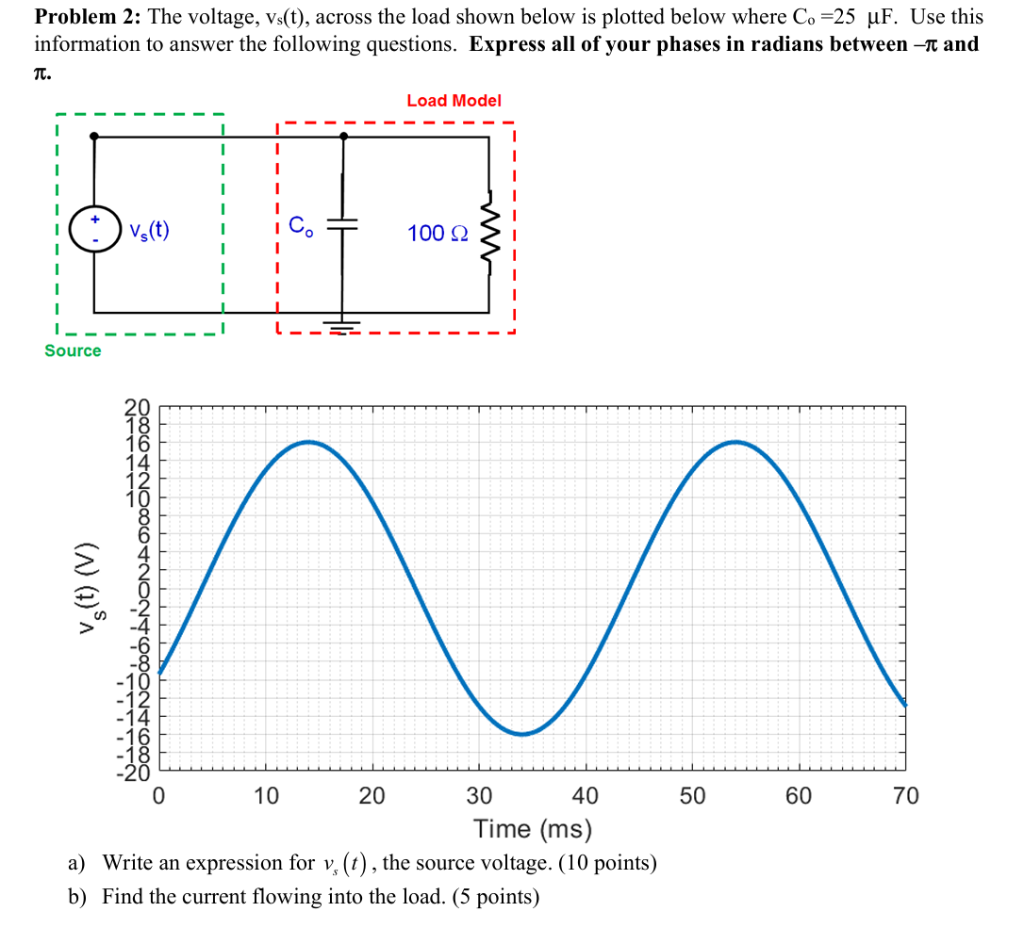 Problem 2: The voltage, vs(t), across the load shown below is plotted below where Co =25 WF. Use this
information to answer the following questions. Express all of your phases in radians between —t and
m.
ee Load Model
1 | tii |
1 1 1 \
1 1 1 \
1 1 1 |
1 V, 1 ’
! Or 1% 100 Q !
1 1 1 \
1 1 1 |
1
LY Sa B= — Sp
Source
20
18
16
14
12
10
8
Ss 3
>
=~ 2
=.
>? vy
-8
-8 i
-10
-12
-14
-16
-18
-20
0 10 20 30 40 50 60 70
Time (ms)
a) Write an expression for v, (1) , the source voltage. (10 points)
b) Find the current flowing into the load. (5 points)
This is AI generated Response.
Asked by: Mohin
Created at: 2025-10-29 11:06:16
Asked by: Mohin
Created at: 2025-10-29 11:06:16
Final Answer:
Rendered
Raw Text
Did you like this answer?
Let's solve the problem step by step:
---
## **a) Write an expression for \( v_s(t) \), the source voltage.**
First, let's analyze the provided waveform:
### **Step 1: Amplitude**
- The peak value is \( V_m = 18 \) V.
### **Step 2: Period and Frequency**
- From the plot, the period \( T \) is the time between two consecutive peaks.
- The first peak is at \( t = 15 \) ms, the next is at \( t = 55 \) ms.
- So, \( T = 55\,\text{ms} - 15\,\text{ms} = 40\,\text{ms} = .04\,\text{s} \).
\[
f = \frac{1}{T} = \frac{1}{.04} = 25\,\text{Hz}
\]
\[
\omega = 2\pi f = 2\pi \times 25 = 50\pi\,\text{rad/s}
\]
### **Step 3: Phase**
- At \( t = \), \( v_s() = \) and it's rising, which matches a sine function with zero phase shift.
### **Step 4: Expression**
\[
\boxed{
v_s(t) = 18 \sin(50\pi t)
}
\]
where \( t \) is in seconds.
---
## **b) Find the current flowing into the load**
### **Step 1: Impedance of the Load**
The load is a parallel RC circuit:
- \( R = 100\, \Omega \)
- \( C = 25\, \mu\text{F} = 25 \times 10^{-6}\, \text{F} \)
The total admittance \( Y \) is:
\[
Y = \frac{1}{R} + j\omega C
\]
\[
Y = \frac{1}{100} + j(50\pi)(25 \times 10^{-6})
\]
\[
Y = .01 + j(.00393)
\]
Impedance \( Z \) is:
\[
Z = \frac{1}{Y}
\]
But we can express the current in the load as:
\[
i(t) = \frac{v_s(t)}{Z}
\]
### **Step 2: Phasor Analysis**
Let \( v_s(t) = 18\sin(50\pi t) \).
We convert this to phasor form: \( V_s = 18 \angle ^\circ \).
Admittance in magnitude and phase:
\[
|Y| = \sqrt{(.01)^2 + (.00393)^2} = .01075
\]
\[
\theta_Y = \arctan\left(\frac{.00393}{.01}\right) = .375~\text{rad}
\]
So,
\[
I = V_s \times Y = 18 \angle ^\circ \times .01075 \angle .375
\]
\[
|I| = .1935~\text{A}
\]
\[
\text{Phase} = .375~\text{rad}
\]
So, in time domain:
\[
\boxed{
i(t) = .194 \sin(50\pi t + .375)
}
\]
---
## **Final Answers**
### **Part (a):**
\[
\boxed{
v_s(t) = 18\sin(50\pi t)
}
\]
### **Part (b):**
\[
\boxed{
i(t) = .194\sin(50\pi t + .375)
}
\]
where \( t \) is in seconds and the phase is in radians (between \(-\pi\) and \(\pi\)).
📢 Instructions:
- Ask anything relatd to above question only.
- For new Question goto :