 VIPSolutions
please solve this problem step by stepIncorrect Question 9 0/5pts The constant voltage bias for JFET transistors is similar to: common base bias in BJTs common collector bias in BJTs common emitter bias in BJTs there is no similarity
Question:
please solve this problem step by step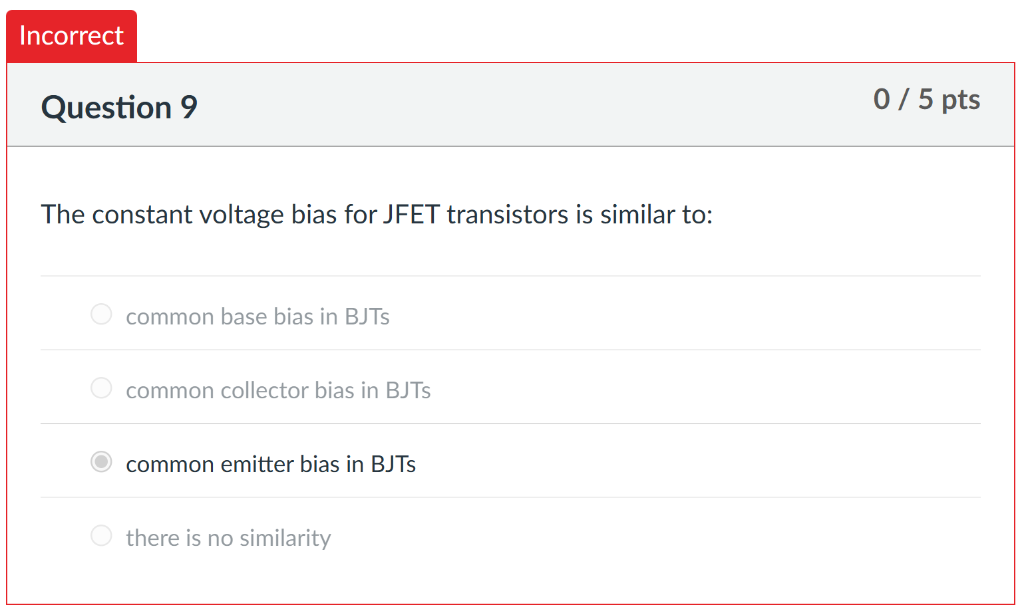 Incorrect
Question 9 0/5pts
The constant voltage bias for JFET transistors is similar to:
common base bias in BJTs
common collector bias in BJTs
common emitter bias in BJTs
there is no similarity
This is AI generated Response.
Asked by: Jaswanth Karri
Created at: 2025-08-25 10:15:22
Asked by: Jaswanth Karri
Created at: 2025-08-25 10:15:22
Final Answer:
Rendered
Raw Text
Did you like this answer?
Let's break down the problem step by step:
### Question:
**The constant voltage bias for JFET transistors is similar to:**
- common base bias in BJTs
- common collector bias in BJTs
- common emitter bias in BJTs
- there is no similarity
You selected: **common emitter bias in BJTs** (which was marked incorrect).
---
## Step 1: Understand Constant Voltage Bias in JFETs
**JFET (Junction Field Effect Transistor):**
- A common way to bias a JFET is to apply a constant voltage to the gate terminal with respect to the source, which is called "constant voltage bias."
- This is often done by connecting a resistor between the gate and the ground (for n-channel JFETs), and the gate current is essentially zero.
---
## Step 2: Understand Bias Configurations in BJTs
**BJT (Bipolar Junction Transistor) Biasing Types:**
- **Common Base Bias:** The base is common to both input and output; the input is at the emitter.
- **Common Collector Bias:** The collector is common to both input and output; also known as emitter follower.
- **Common Emitter Bias:** The emitter is common to both input and output; widely used for amplifiers.
---
## Step 3: Identify the Similarity
### **Constant Voltage Bias for JFETs**
- In JFETs, the gate is biased at a fixed voltage (often negative with respect to source for n-channel).
- This is similar to how, in **BJTs**, the **base is biased at a fixed voltage** with respect to emitter in the **common base configuration**.
### **Detailed Comparison:**
- **Constant voltage bias in JFETs = Gate at fixed voltage w.r.t source**
- **Common base bias in BJTs = Base at fixed voltage w.r.t emitter**
Both methods involve setting the control terminal (gate or base) at a constant voltage with respect to the emitter/source, which controls the device's operation.
---
## Step 4: Conclusion
**Correct Answer:**
The constant voltage bias for JFET transistors is similar to **common base bias in BJTs**.
---
## **Summary Table**
| JFET Bias Method | Similar BJT Bias Method |
|-----------------------------|----------------------------|
| Constant voltage (gate-source) | Constant voltage (base-emitter) in **common base** configuration |
---
### **Final Answer:**
> The constant voltage bias for JFET transistors is similar to: **common base bias in BJTs**.
---
**If you have more questions or need an explanation about why the "common emitter bias" is not correct, feel free to ask!**
📢 Instructions:
- Ask anything relatd to above question only.
- For new Question goto :