 VIPSolutions
Please solve this problem step by step in englishSekilde verilen devre iin Vs =-8+16.coswt volt ise; a- Vro'nin ortalama degerini hesaplayiniz. b- Vrs’nin tepe degerini hesaplayiniz. c- Vgs’nin tepe degerini hesaplayiniz. RS D1 == ) ® 2k IDEAL j RL VS 8k O
Question:
Please solve this problem step by step in english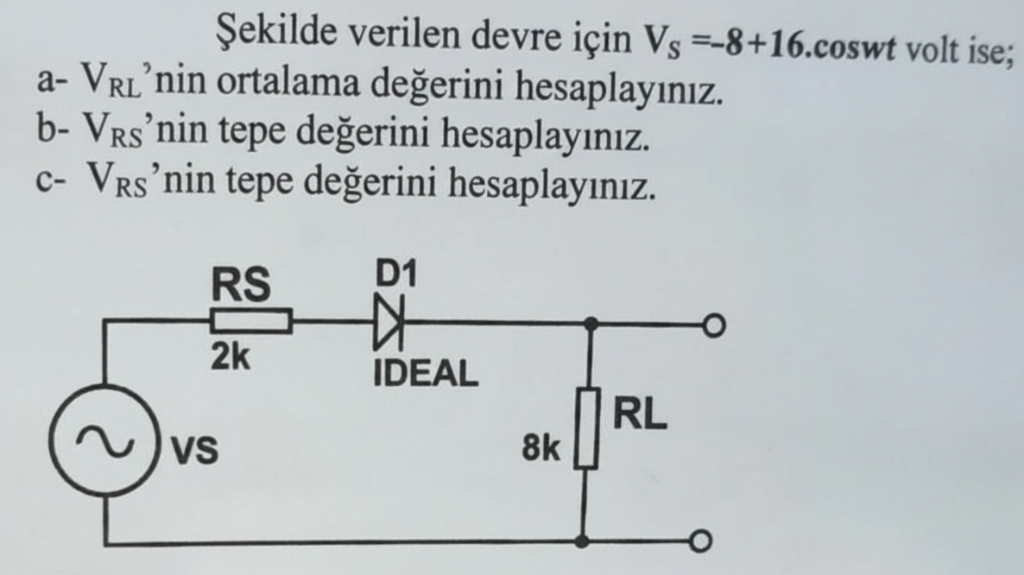 Sekilde verilen devre iin Vs =-8+16.coswt volt ise;
a- Vro'nin ortalama degerini hesaplayiniz.
b- Vrs’nin tepe degerini hesaplayiniz.
c- Vgs’nin tepe degerini hesaplayiniz.
RS D1
== ) ®
2k IDEAL
j RL
VS 8k
O
This is AI generated Response.
Asked by: Mohin
Created at: 2025-11-10 08:29:35
Asked by: Mohin
Created at: 2025-11-10 08:29:35
Final Answer:
Rendered
Raw Text
Did you like this answer?
Let's solve the step by step:
## Given Data- **Source:** \( V = -8 16\cos(\omega t) \) V
- **RS (series resistor):** 2kΩ
- **RL (load resistor):** 8kΩ
- **D1:** Ideal diode---
## 1. **Analyzing the Circuit**
### **Source Voltage**
\( V_S = -8 + 16\cos(\omega t) \)
- This is a cosine wave with an offset of \(-8\) V and amplitude \(16\) V.
### **Operation of the Diode**
- The diode conducts only when its anode (left side) is more positive than its cathode (right side, connected to RL).
- When \( V_S > \), the diode conducts.
- When \( V_S < \), the diode is off.
---
## 2. **Finding Conduction Interval**
Set \( V_S = \) to find when the diode starts/stops conducting:
\[
-8 + 16\cos(\omega t) = \implies \cos(\omega t) = .5
\]
\[
\omega t = \pm\cos^{-1}(.5) = \pm \frac{\pi}{3}
\]
So, the diode conducts from \( \omega t = -\frac{\pi}{3} \) to \( +\frac{\pi}{3} \) in each cycle.
---
## 3. **a. Average Value of \( V_{RL} \)**
When the diode conducts, \( V_{RL} \) is the voltage across RL in the voltage divider:
\[
V_{RL} = V_S \cdot \frac{R_L}{R_S + R_L}
\]
Plug in values:
\[
\frac{R_L}{R_S + R_L} = \frac{8k}{2k + 8k} = \frac{8}{10} = .8
\]
So,
\[
V_{RL} = .8 V_S = .8(-8 + 16\cos(\omega t)) = -6.4 + 12.8\cos(\omega t)
\]
But this is valid **only when the diode conducts** (\( -\frac{\pi}{3} < \omega t < \frac{\pi}{3} \)).
### **Average Value Calculation**
The average over one period \( T \) is:
\[
V_{RL,avg} = \frac{1}{T} \int_{-\frac{\pi}{3\omega}}^{+\frac{\pi}{3\omega}} (-6.4 + 12.8\cos(\omega t))\,dt
\]
But it's easier to use the symmetry and period \( T = 2\pi/\omega \):
\[
V_{RL,avg} = \frac{1}{2\pi} \int_{-\frac{\pi}{3}}^{+\frac{\pi}{3}} (-6.4 + 12.8\cos(\theta))\,d\theta
\]
Evaluate:
\[
= \frac{1}{2\pi} \left[ -6.4\theta + 12.8\sin(\theta) \right]_{-\frac{\pi}{3}}^{+\frac{\pi}{3}}
\]
\[
= \frac{1}{2\pi} \left[ -6.4\left(\frac{\pi}{3} - \left(-\frac{\pi}{3}\right)\right) + 12.8\left(\sin\left(\frac{\pi}{3}\right) - \sin\left(-\frac{\pi}{3}\right)\right) \right]
\]
\[
= \frac{1}{2\pi} \left[ -6.4\left(\frac{2\pi}{3}\right) + 12.8\left(2\sin\left(\frac{\pi}{3}\right)\right) \right]
\]
\[
\sin\left(\frac{\pi}{3}\right) = \frac{\sqrt{3}}{2}
\]
\[
= \frac{1}{2\pi} \left[ -6.4 \cdot \frac{2\pi}{3} + 12.8 \cdot 2 \cdot \frac{\sqrt{3}}{2} \right]
\]
\[
= \frac{1}{2\pi} \left[ -\frac{12.8\pi}{3} + 12.8\sqrt{3} \right]
\]
\[
= \frac{1}{2\pi} \left[ 12.8\sqrt{3} - \frac{12.8\pi}{3} \right]
\]
\[
= \frac{12.8}{2\pi} \left[ \sqrt{3} - \frac{\pi}{3} \right]
\]
\[
= \frac{6.4}{\pi} \left[ \sqrt{3} - \frac{\pi}{3} \right] \quad \boxed{\text{(final answer in symbolic form)}}
\]
If you want a **numerical value**:
- \(\sqrt{3} \approx 1.732\)
- \(\pi \approx 3.142\)
\[
V_{RL,avg} = \frac{6.4}{3.142} \left(1.732 - \frac{3.142}{3}\right)
\]
\[
= 2.037 \cdot (1.732 - 1.047)
\]
\[
= 2.037 \cdot .685 = 1.396 \ \text{V (rounded)}
\]
---
## 4. **b. Peak Value of \( V_{RS} \)**
\( V_{RS} = V_S - V_{RL} \), but only when diode conducts.
\[
V_{RS} = V_S - V_{RL} = V_S - .8V_S = .2V_S
\]
\[
V_{RS} = .2(-8 + 16\cos(\omega t)) = -1.6 + 3.2\cos(\omega t)
\]
Peak value of \( V_{RS} \) **when diode conducts** (\( \omega t = \)):
\[
V_{RS,peak} = -1.6 + 3.2 \cdot 1 = 1.6 \ \text{V}
\]
---
## 5. **c. Peak Value of \( V_{RL} \)**
As before:
\[
V_{RL} = -6.4 + 12.8\cos(\omega t)
\]
Peak value (\( \cos(\omega t) = 1 \)):
\[
V_{RL,peak} = -6.4 + 12.8 = 6.4 \ \text{V}
\]
---
## **Summary Table**
| Quantity | Formula | Value |
|-------------------------|--------------------------|-----------|
| \( V_{RL,avg} \) | \( \frac{6.4}{\pi} (\sqrt{3} - \frac{\pi}{3}) \) | **1.40 V** |
| \( V_{RS,peak} \) | -1.6 + 3.2 | **1.6 V** |
| \( V_{RL,peak} \) | -6.4 + 12.8 | **6.4 V** |
---
If you need further explanation or want to see the waveform, let me know!
📢 Instructions:
- Ask anything relatd to above question only.
- For new Question goto :