 VIPSolutions
Please solve this problem step by stepExercise 3. [25 points.] Given the periodic signal shown below, perform the following: a) Explicitly state which Fourier coefficients you expect to be zero, and why; b) Derive analytical expressions for the Fourier coefficients ag, a, and by; ¢) Provide expressions for the Fourier coefficients A,, and 6,, of the polar form. i) Le -12 -I3 3 72 -T/6 116 t Lx
Question:
Please solve this problem step by step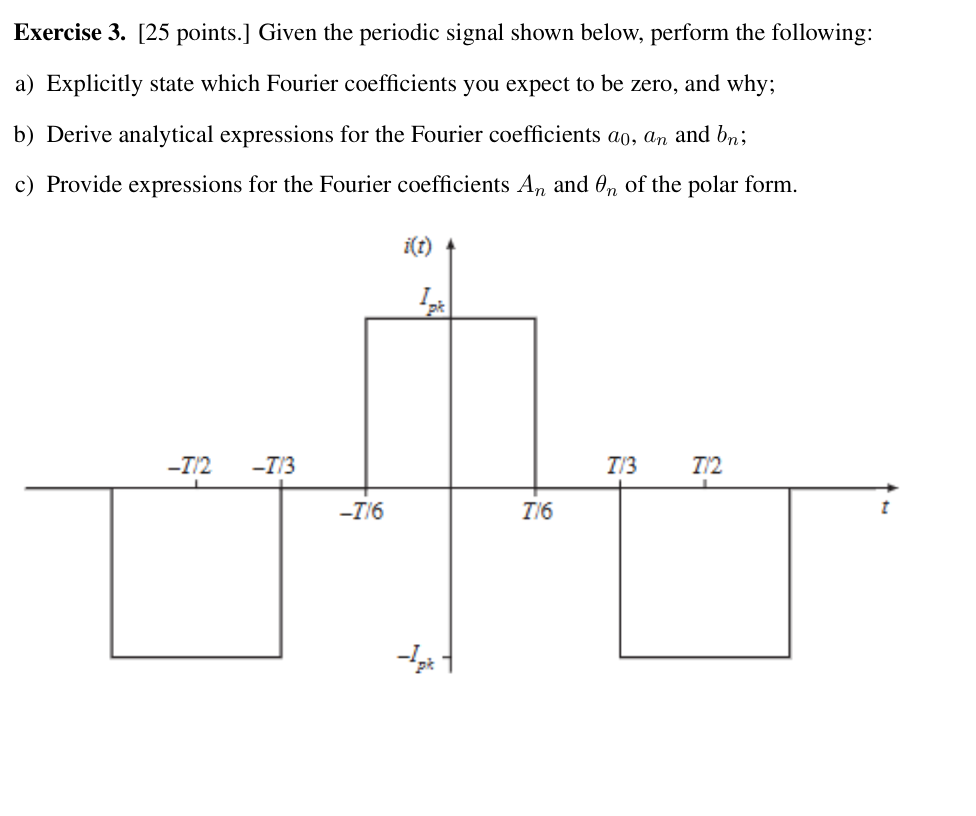 Exercise 3. [25 points.] Given the periodic signal shown below, perform the following:
a) Explicitly state which Fourier coefficients you expect to be zero, and why;
b) Derive analytical expressions for the Fourier coefficients ag, a, and by;
¢) Provide expressions for the Fourier coefficients A,, and 6,, of the polar form.
i)
Le
-12 -I3 3 72
-T/6 116 t
Lx
This is AI generated Response.
Asked by: Jack
Created at: 2025-10-27 08:11:35
Asked by: Jack
Created at: 2025-10-27 08:11:35
Final Answer:
Rendered
Raw Text
Did you like this answer?
Let's analyze the periodic signal step by step to address each part of the problem.
## **Given Signal Description:**
waveform is a pulse that:
- Has \( I_{pk} \)positive and negative).
- centered at \( t = ).
- Is active (non-zero) between \( -T/ \) and \( T/6).
- Is zero elsewhere.
- period of the is \( T).
---
## **a) Fourier coefficients expected to be zero and why**
### **Explanation:**
- The signal is **even** because it is symmetric around \( t= \): the positive and negative pulses are mirror images.
- The signal contains only **cosine terms** in its Fourier series because it's symmetric about the vertical axis (even function).
- The **sine Fourier coefficients** \( b_n \) are **zero** because the signal is even.
### **Fourier Coefficients:**
- \( a_ \) (average value): may be non-zero because of the rectangular pulse.
- \( a_n \) (cosine coefficients): may be non-zero.
- \( b_n \) (sine coefficients): **expected to be zero** because the signal is even.
**Answer:**
- \( b_n = \) for all \( n \), because the signal is even, and sine functions are odd, resulting in zero Fourier sine coefficients.
---
## **b) Derive analytical expressions for \( a_ \), \( a_n \), and \( b_n \)**
### **Fourier Series general forms:**
\[
x(t) = a_ + \sum_{n=1}^{\infty} \left[ a_n \cos \left( \frac{2\pi n t}{T} \right) + b_n \sin \left( \frac{2\pi n t}{T} \right) \right]
\]
### **Since the signal is even:**
- \( b_n = \).
### **Calculating \( a_ \):**
\[
a_ = \frac{1}{T} \int_{-T/2}^{T/2} x(t)\, dt
\]
Since the pulse is non-zero only between \( -T/6 \) and \( T/6 \):
\[
a_ = \frac{1}{T} \int_{-T/6}^{T/6} I_{pk} \, dt + \int_{-T/6}^{T/6} (-I_{pk}) \, dt
\]
But note the pulse is positive \( I_{pk} \) between \( -T/6 \) and \( T/6 \), and zero elsewhere.
\[
a_ = \frac{1}{T} \times \left[ \int_{-T/6}^{T/6} I_{pk} \, dt \right]
\]
\[
a_ = \frac{1}{T} \times I_{pk} \times \left( \frac{T}{3} \right) = \frac{I_{pk}}{3}
\]
---
### **Calculating \( a_n \):**
\[
a_n = \frac{2}{T} \int_{}^{T/2} x(t) \cos \left( \frac{2\pi n t}{T} \right) dt
\]
or equivalently, for a symmetric pulse:
\[
a_n = \frac{2}{T} \int_{-T/2}^{T/2} x(t) \cos \left( \frac{2\pi n t}{T} \right) dt
\]
Since \( x(t) \) is non-zero only in \( -T/6 \) to \( T/6 \):
\[
a_n = \frac{2}{T} \int_{-T/6}^{T/6} I_{pk} \cos \left( \frac{2\pi n t}{T} \right) dt
\]
Because the integrand is even, limits can be doubled:
\[
a_n = \frac{4 I_{pk}}{T} \int_{}^{T/6} \cos \left( \frac{2\pi n t}{T} \right) dt
\]
Calculating the integral:
\[
a_n = \frac{4 I_{pk}}{T} \left[ \frac{\sin \left( \frac{2\pi n t}{T} \right)}{\frac{2\pi n}{T}} \right]_^{T/6}
\]
\[
a_n = \frac{4 I_{pk}}{T} \times \frac{T}{2\pi n} \sin \left( \frac{2\pi n}{T} \times \frac{T}{6} \right)
\]
\[
a_n = \frac{2 I_{pk}}{\pi n} \sin \left( \frac{\pi n}{3} \right)
\]
---
### **Summary:**
\[
\boxed{
\begin{aligned}
a_ &= \frac{I_{pk}}{3} \\
a_n &= \frac{2 I_{pk}}{\pi n} \sin \left( \frac{\pi n}{3} \right) \\
b_n &=
\end{aligned}
}
\]
---
## **c) Expressions for the Fourier coefficients \( A_n \) and \( \theta_n \) in the polar form**
### **Polar form:**
\[
C_n = A_n e^{j \theta_n} = a_n + j b_n
\]
Since \( b_n = \), the coefficients are purely real:
\[
A_n = |a_n + j | = |a_n| \quad \text{and} \quad \theta_n = \quad \text{if } a_n >
\]
or
\[
\theta_n = \pi \quad \text{if } a_n <
\]
### **Expressions:**
\[
\boxed{
A_n = \left| \frac{2 I_{pk}}{\pi n} \sin \left( \frac{\pi n}{3} \right) \right|
}
\]
\[
\theta_n = \begin{cases}
, & \text{if } a_n > \\
\pi, & \text{if } a_n <
\end{cases}
\]
---
## **Summary:**
| **Fourier Coefficients** | **Expression** |
|--------------------------|----------------|
| \( a_ \) | \( \frac{I_{pk}}{3} \) |
| \( a_n \) | \( \frac{2 I_{pk}}{\pi n} \sin \left( \frac{\pi n}{3} \right) \) |
| \( b_n \) | (since the signal is even) |
| \( A_n \) (polar magnitude) | \( \left| a_n \right| \) |
| \( \theta_n \) (phase) | if \( a_n > \), \( \pi \) if \( a_n < \) |
---
Let me know if you'd like more detailed calculations for specific \( n \)!
📢 Instructions:
- Ask anything relatd to above question only.
- For new Question goto :