 VIPSolutions
Please solve this problem step by step correctlyConsider an ideal nMOS transistor in a 0.6um process with a minimum drawn channel length of 15 nm. Let W/L = 4/2 (i.e., 0.03/0.015 um). In this process, the gate oxide thickness is 45 A. Estimate the high-field mobility of electrons to be 276.77 cm2/(Vs). The threshold voltage is 0.7 V. a) Find Ids in cutoff, linear, and saturation mode. Relate the equations to Vgs and Vds. b) Next, given a ratio un / pp = 2, and a threshold voltage of +0.7, give the equations for cutoff, linear, and saturation mode for a pMOS transistor.
Question:
Please solve this problem step by step correctly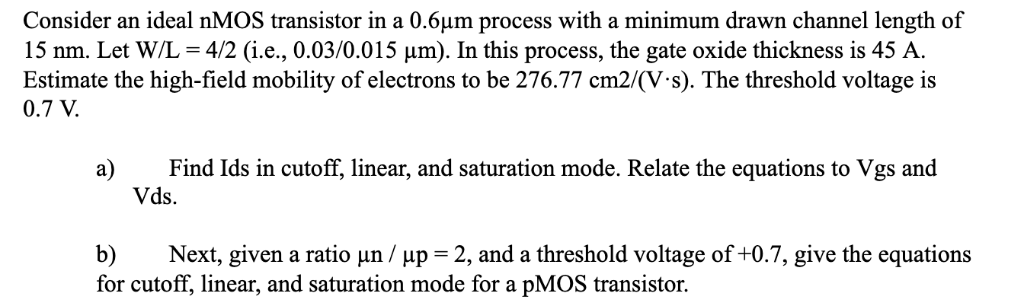 Consider an ideal nMOS transistor in a 0.6um process with a minimum drawn channel length of
15 nm. Let W/L = 4/2 (i.e., 0.03/0.015 um). In this process, the gate oxide thickness is 45 A.
Estimate the high-field mobility of electrons to be 276.77 cm2/(Vs). The threshold voltage is
0.7 V.
a) Find Ids in cutoff, linear, and saturation mode. Relate the equations to Vgs and
Vds.
b) Next, given a ratio un / pp = 2, and a threshold voltage of +0.7, give the equations
for cutoff, linear, and saturation mode for a pMOS transistor.
This is AI generated Response.
Asked by: Jack
Created at: 2025-10-08 06:38:09
Asked by: Jack
Created at: 2025-10-08 06:38:09
Final Answer:
Rendered
Raw Text
Did you like this answer?
Let's walk through the solutions step by step.
---
# **Given Data**
- **W/L** = .03 μm / .015 μm = **2**
- **Gate oxide thickness** \( t_{ox} \) = 45 Å = 4.5 nm = \( 4.5 \times 10^{-9} \) m
- **Electron mobility** \( \mu_n \) = 276.77 cm²/(V·s) = \( .027677 \) m²/(V·s)
- **Threshold voltage** \( V_{th} \) = .7 V
- **Process length** (for reference) = .6 μm
- **\( \varepsilon_{ox} \) (dielectric constant of SiO₂)** = \( 3.45 \times 10^{-11} \) F/m
---
## **(a) Find \( I_{ds} \) in Cutoff, Linear, and Saturation Modes**
### **Step 1: Calculate \( C_{ox} \) (Gate Oxide Capacitance per unit area)**
\[
C_{ox} = \frac{\varepsilon_{ox}}{t_{ox}}
\]
\[
C_{ox} = \frac{3.45 \times 10^{-11}}{4.5 \times 10^{-9}} = 7.67 \times 10^{-3} \, \text{F/m}^2
\]
**Convert to F/cm²:**
\[
1\, \text{m}^2 = 10^4\, \text{cm}^2 \implies C_{ox} = 7.67 \times 10^{-7}\, \text{F/cm}^2
\]
---
### **Step 2: Write \( I_{ds} \) Equations for nMOS**
Let:
- \( W = .03\, \mu m = 3 \times 10^{-8} \, m \)
- \( L = .015\, \mu m = 1.5 \times 10^{-8} \, m \)
#### **1. Cutoff Region (\( V_{gs} < V_{th} \))**
\[
I_{ds} =
\]
#### **2. Linear (Triode) Region (\( V_{gs} > V_{th} \) and \( V_{ds} < V_{gs} - V_{th} \))**
\[
I_{ds} = \mu_n C_{ox} \frac{W}{L} \left[ (V_{gs} - V_{th}) V_{ds} - \frac{V_{ds}^2}{2} \right]
\]
#### **3. Saturation Region (\( V_{gs} > V_{th} \) and \( V_{ds} \geq V_{gs} - V_{th} \))**
\[
I_{ds} = \frac{1}{2} \mu_n C_{ox} \frac{W}{L} (V_{gs} - V_{th})^2
\]
#### **Plugging in Values:**
\[
\frac{W}{L} = 2
\]
\[
\mu_n = .027677\, \text{m}^2/\text{V}\cdot\text{s}
\]
\[
C_{ox} = 7.67 \times 10^{-3}\, \text{F/m}^2
\]
So,
\[
k' = \mu_n C_{ox} = .027677 \times 7.67 \times 10^{-3} = 2.122 \times 10^{-4} \ \text{A/V}^2
\]
\[
k = k' \frac{W}{L} = 2 \times 2.122 \times 10^{-4} = 4.244 \times 10^{-4}\ \text{A/V}^2
\]
So,
- **Linear:**
\[
I_{ds} = k \left[ (V_{gs} - V_{th})V_{ds} - \frac{V_{ds}^2}{2} \right]
\]
- **Saturation:**
\[
I_{ds} = \frac{k}{2} (V_{gs} - V_{th})^2
\]
- **Cutoff:**
\[
I_{ds} =
\]
---
## **(b) pMOS Equations**
Given:
- \( \frac{\mu_n}{\mu_p} = 2 \implies \mu_p = \frac{\mu_n}{2} \)
- Threshold voltage \( V_{th} = +.7\, V \) (for pMOS, threshold is typically negative; but use as given)
### **For pMOS:**
- \( V_{sg} \) (source-gate voltage)
- \( V_{sd} \) (source-drain voltage)
- \( V_{tp} \) (threshold voltage; typically negative, but here given as +.7 V)
### **Equations:**
#### **1. Cutoff (\( V_{sg} < |V_{tp}| \))**
\[
I_{sd} =
\]
#### **2. Linear (\( V_{sg} > |V_{tp}| \) and \( V_{sd} < V_{sg} - |V_{tp}| \))**
\[
I_{sd} = \mu_p C_{ox} \frac{W}{L} \left[ (V_{sg} - |V_{tp}|) V_{sd} - \frac{V_{sd}^2}{2} \right]
\]
#### **3. Saturation (\( V_{sg} > |V_{tp}| \) and \( V_{sd} \geq V_{sg} - |V_{tp}| \))**
\[
I_{sd} = \frac{1}{2} \mu_p C_{ox} \frac{W}{L} (V_{sg} - |V_{tp}|)^2
\]
Where:
\[
\mu_p = \frac{.027677}{2} = .01384\, \text{m}^2/\text{V}\cdot\text{s}
\]
---
## **Summary Table**
| Region | nMOS (\( I_{ds} \)) | pMOS (\( I_{sd} \)) |
|-----------|--------------------------------------------------------------------------|--------------------------------------------------------------------------|
| Cutoff | \( \) | \( \) |
| Linear | \( k[(V_{gs} - V_{th})V_{ds} - \frac{V_{ds}^2}{2}] \) | \( k_p[(V_{sg} - |V_{tp}|)V_{sd} - \frac{V_{sd}^2}{2}] \) |
| Saturation| \( \frac{k}{2}(V_{gs} - V_{th})^2 \) | \( \frac{k_p}{2}(V_{sg} - |V_{tp}|)^2 \) |
Where:
- \( k = 4.244 \times 10^{-4}\, \text{A/V}^2 \) for nMOS
- \( k_p = \mu_p C_{ox} \frac{W}{L} = 2.122 \times 10^{-4} \, \text{A/V}^2 \) for pMOS
---
### **Let me know if you need the equations with actual numbers plugged in for a particular Vgs, Vds!**
Question:
For pmos please give the answers correctly and detailed manner
This is AI generated Response.
Asked by: Jack
Created at: 2025-10-08 06:41:14
Asked by: Jack
Created at: 2025-10-08 06:41:14
Final Answer:
Rendered
Raw Text
Did you like this answer?
# **pMOS Transistor Analysis**
To analyze a pMOS transistor, we will derive the equations for the three operating regions: cutoff, linear, and saturation. We will use the given parameters and relationships for the pMOS transistor.
## **Given Data**
- **Electron mobility** \( \mu_n = 276.77 \, \text{cm}^2/\text{V}\cdot\text{s} \)
- **Threshold voltage** \( V_{tp} = -0.7 \, \text{V} \) (For pMOS, threshold voltage is typically negative)
- **Mobility ratio** \( \frac{\mu_n}{\mu_p} = 2 \) implies \( \mu_p = \frac{276.77}{2} = 138.385 \, \text{cm}^2/\text{V}\cdot\text{s} \)
- **Gate oxide capacitance per unit area** \( C_{ox} \) (calculated previously) = \( 7.67 \times 10^{-7} \, \text{F/cm}^2 \)
- **Width-to-Length Ratio** \( W/L = 2 \)
### **Convert Mobility to SI Units**
\[
\mu_p = 138.385 \, \text{cm}^2/\text{V}\cdot\text{s} = 1.38385 \times 10^{-2} \, \text{m}^2/\text{V}\cdot\text{s}
\]
### **Calculate \( k_p \)**
\[
k_p = \mu_p C_{ox} \frac{W}{L}
\]
\[
k_p = (1.38385 \times 10^{-2}) \times (7.67 \times 10^{-7}) \times 2
\]
\[
k_p = 2.118 \times 10^{-8} \, \text{A/V}^2
\]
---
## **Operating Regions for pMOS Transistor**
### **1. Cutoff Region (\( V_{sg} < |V_{tp}| \))**
In this region, the transistor is off, and the drain-source current \( I_{sd} \) is approximately zero.
\[
I_{sd} = 0 \quad \text{for } V_{sg} < 0.7 \, \text{V}
\]
### **2. Linear (Triode) Region (\( V_{sg} > |V_{tp}| \) and \( V_{sd} < V_{sg} - |V_{tp}| \))**
In this region, the transistor operates in the linear region. The equation for the drain-source current \( I_{sd} \) is:
\[
I_{sd} = k_p \left[ (V_{sg} - |V_{tp}|) V_{sd} - \frac{V_{sd}^2}{2} \right]
\]
### **3. Saturation Region (\( V_{sg} > |V_{tp}| \) and \( V_{sd} \geq V_{sg} - |V_{tp}| \))**
In this region, the transistor operates in saturation. The equation for the drain-source current \( I_{sd} \) is:
\[
I_{sd} = \frac{k_p}{2} (V_{sg} - |V_{tp}|)^2
\]
---
## **Summary of pMOS Equations**
| Region | Condition | Equation |
|-----------|-------------------------------------|-------------------------------------------------------------------------------------------|
| Cutoff | \( V_{sg} < 0.7 \, V \) | \( I_{sd} = 0 \) |
| Linear | \( V_{sg} > 0.7 \, V \) and \( V_{sd} < V_{sg} - 0.7 \) | \( I_{sd} = k_p \left[ (V_{sg} - 0.7) V_{sd} - \frac{V_{sd}^2}{2} \right] \) |
| Saturation| \( V_{sg} > 0.7 \, V \) and \( V_{sd} \geq V_{sg} - 0.7 \) | \( I_{sd} = \frac{k_p}{2} (V_{sg} - 0.7)^2 \) |
Where:
- \( k_p = 2.118 \times 10^{-8} \, \text{A/V}^2 \)
### **Key Notes**
- Ensure \( V_{sg} \) is defined with respect to the source and gate voltages.
- Use appropriate units for all voltage, current, and capacitance values while calculating \( I_{sd} \).
---
Feel free to ask if you need specific values or additional details!
📢 Instructions:
- Ask anything relatd to above question only.
- For new Question goto :