 VIPSolutions
please solve this problem step by stepConsider the following system shown in below. Assume that the sampling period T = 1 second. Suppose, O=e10, GO-GO =C" Ge) = x) =e A 5) =——o0 , ss) =——, 5) =—— E s+1 E s E) s+2 In above, G,(s) represents a zero-order hold. Now, find the expressions of the followings: a) Y(2) b) v*(s) ©) Y(s)
Question:
please solve this problem step by step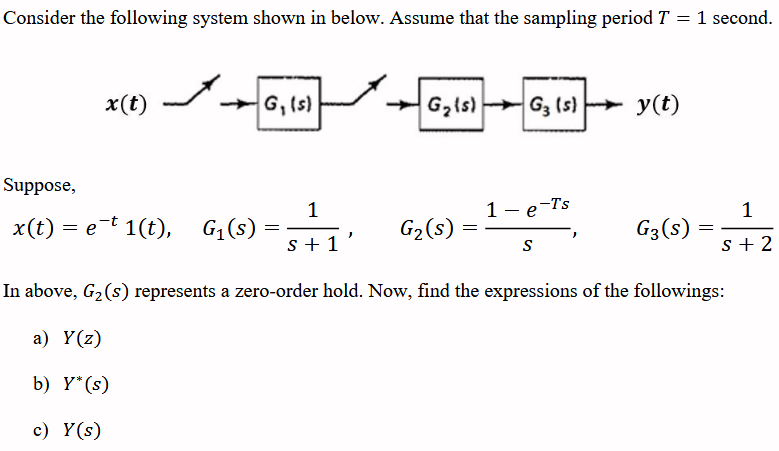 Consider the following system shown in below. Assume that the sampling period T = 1 second.
Suppose,
O=e10, GO-GO =C" Ge) =
x) =e A 5) =——o0 , ss) =——, 5) =——
E s+1 E s E) s+2
In above, G,(s) represents a zero-order hold. Now, find the expressions of the followings:
a) Y(2)
b) v*(s)
©) Y(s)
This is AI generated Response.
Asked by: Mohin
Created at: 2025-11-04 08:14:38
Asked by: Mohin
Created at: 2025-11-04 08:14:38
Final Answer:
Rendered
Raw Text
Did you like this answer?
Let's solve the system step by step:
---
## **Given Data and System**
- **Sampling period:** \( T = 1 \) s
- **Input:** \( x(t) = e^{-t} u(t) \)
- **Blocks:**
- \( G_1(s) = \frac{1}{s+1} \)
- \( G_2(s) = \frac{1 - e^{-Ts}}{s} \) (Zero-order hold)
- \( G_3(s) = \frac{1}{s+2} \)
---
## **Step 1: Find \( X(s) \) (Laplace Transform of Input)**
\[
x(t) = e^{-t} u(t) \implies X(s) = \mathcal{L}\{e^{-t} u(t)\} = \frac{1}{s+1}
\]
---
## **Step 2: Find \( Y(s) \) (Continuous-Time Output)**
The overall transfer function:
\[
Y(s) = X(s) \cdot G_1(s) \cdot G_2(s) \cdot G_3(s)
\]
Plug in the values:
\[
Y(s) = \frac{1}{s+1} \cdot \frac{1}{s+1} \cdot \frac{1 - e^{-Ts}}{s} \cdot \frac{1}{s+2}
\]
For \( T = 1 \):
\[
Y(s) = \frac{1}{(s+1)^2} \cdot \frac{1 - e^{-s}}{s} \cdot \frac{1}{s+2}
\]
\[
\boxed{
Y(s) = \frac{1 - e^{-s}}{s(s+1)^2(s+2)}
}
\]
---
## **Step 3: Find \( Y^*(s) \) (Laplace Transform of Sampled Output)**
The Laplace transform at the output of the sampler (before ZOH):
\[
Y^*(s) = X^*(s) \cdot G_3(s)
\]
Where \( X^*(s) \) is the Laplace transform of the sampled signal **after** \( G_1 \), i.e., after \( G_1(s) \):
- After \( G_1(s) \): \( X_1(s) = X(s)G_1(s) = \frac{1}{(s+1)^2} \)
- Sampled: \( X_1^*(s) \) is the Laplace transform of the sampled version of \( x_1(t) \).
But since the ZOH is represented by \( G_2(s) \), \( Y^*(s) \) is the output after the sampler and before the ZOH. So:
\[
Y^*(s) = X(s) G_1(s) \cdot G_2(s) = \frac{1}{(s+1)^2} \cdot \frac{1 - e^{-s}}{s}
\]
\[
\boxed{
Y^*(s) = \frac{1 - e^{-s}}{s(s+1)^2}
}
\]
---
## **Step 4: Find \( Y(z) \) (Z-domain Output)**
The sampled signal before the ZOH is \( x_1(n) \):
- \( x_1(t) = \mathcal{L}^{-1}\left\{\frac{1}{(s+1)^2}\right\} = t e^{-t} \)
- Sampled at \( t = nT \), \( T = 1 \): \( x_1[n] = n e^{-n} \)
Now, the ZOH transfer function from \( x_1[n] \) to \( y[n] \) (discrete-time system) is equivalent to putting the system in Z-domain.
- \( G_3(s) = \frac{1}{s+2} \)
- Its Z-transform (impulse invariant or step-invariant, but with ZOH and \( T = 1 \)):
\[
G_3(z) = \mathcal{Z}\left\{ h_3(n) \right\}
\]
where \( h_3(t) = e^{-2t}u(t) \), \( h_3[n] = e^{-2n} \)
\[
G_3(z) = \mathcal{Z}\{e^{-2n}\} = \frac{1}{1 - e^{-2}z^{-1}}
\]
So,
\[
Y(z) = X_1(z) \cdot G_3(z)
\]
But \( x_1[n] = n e^{-n} \):
\[
X_1(z) = \mathcal{Z}\{ n e^{-n} \}
\]
Recall:
\[
\mathcal{Z}\{ n a^n \} = \frac{a z^{-1}}{(1 - a z^{-1})^2}
\]
Here, \( a = e^{-1} \):
\[
X_1(z) = \frac{e^{-1} z^{-1}}{(1 - e^{-1} z^{-1})^2}
\]
Therefore,
\[
Y(z) = \frac{e^{-1} z^{-1}}{(1 - e^{-1} z^{-1})^2} \cdot \frac{1}{1 - e^{-2} z^{-1}}
\]
\[
\boxed{
Y(z) = \frac{e^{-1} z^{-1}}{(1 - e^{-1} z^{-1})^2 (1 - e^{-2} z^{-1})}
}
\]
---
## **Summary Table**
| Part | Expression |
|------|------------|
| (a) \( Y(z) \) | \( \boxed{\dfrac{e^{-1} z^{-1}}{(1 - e^{-1} z^{-1})^2 (1 - e^{-2} z^{-1})}} \) |
| (b) \( Y^*(s) \) | \( \boxed{\dfrac{1 - e^{-s}}{s(s+1)^2}} \) |
| (c) \( Y(s) \) | \( \boxed{\dfrac{1 - e^{-s}}{s(s+1)^2(s+2)}} \) |
---
Let me know if you'd like a step-by-step explanation for any of the transformations!
📢 Instructions:
- Ask anything relatd to above question only.
- For new Question goto :