 VIPSolutions
please solve this problem step by stepConsider the circuit of Figure below, with (W/L); = 50/0.5, Rp = 2 kQ and Rs = 200 Q. a. Calculate the small-signal voltage gain if Ip = 0.5 mA. (Calculate the exact gain from small-signal model, if you use an approximation, make sure it's valid.) b. Assuming A = 0, calculate the input voltage that places M1 at the edge of saturation. What is the gain under this condition? Voo Rp M 1 Vout Vin —] | ) D Rs
Question:
please solve this problem step by step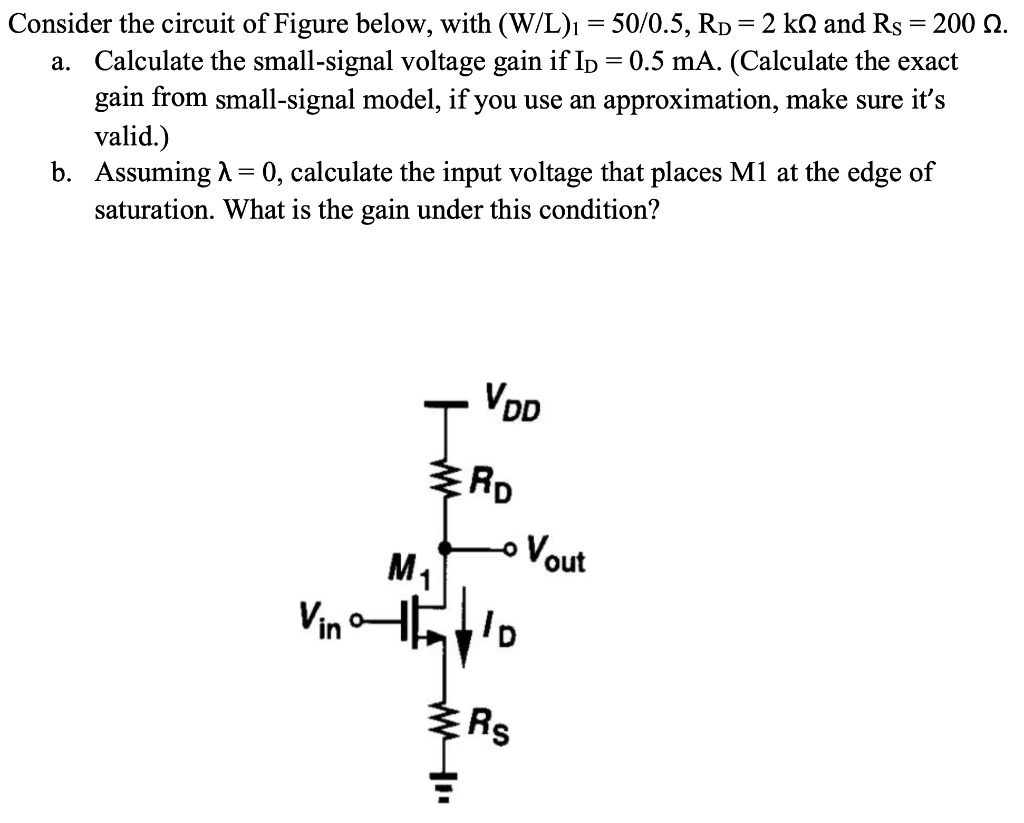 Consider the circuit of Figure below, with (W/L); = 50/0.5, Rp = 2 kQ and Rs = 200 Q.
a. Calculate the small-signal voltage gain if Ip = 0.5 mA. (Calculate the exact
gain from small-signal model, if you use an approximation, make sure it's
valid.)
b. Assuming A = 0, calculate the input voltage that places M1 at the edge of
saturation. What is the gain under this condition?
Voo
Rp
M 1 Vout
Vin —] | ) D
Rs
This is AI generated Response.
Asked by: Jaswanth Karri
Created at: 2025-08-09 10:40:10
Asked by: Jaswanth Karri
Created at: 2025-08-09 10:40:10
Final Answer:
Rendered
Raw Text
Did you like this answer?
Let's solve the problem step by step:
---
## Given:
- \((W/L)_1 = 50/0.5 = 100\)
- \(R_D = 2\,k\Omega\)
- \(R_S = 200\,\Omega\)
- \(I_D = 0.5\,mA = 0.0005\,A\)
---
## (a) **Small-signal voltage gain calculation**
### Step 1: **Find \(g_m\) (transconductance)**
For a MOSFET in saturation:
\[
g_m = \sqrt{2 K_n I_D}
\]
where
\[
K_n = \frac{1}{2} \mu_n C_{ox} \frac{W}{L}
\]
Alternatively (commonly used):
\[
g_m = \frac{2 I_D}{V_{GS} - V_{th}}
\]
But if \(V_{GS} - V_{th}\) is not given, the following is often used:
\[
g_m = \frac{2 I_D}{V_{ov}}, \quad V_{ov} = V_{GS} - V_{th}
\]
But you can also use:
\[
g_m = \frac{I_D}{V_{ov}}
\]
But if \(K_n\) is not given, use:
\[
g_m = \sqrt{2 \mu_n C_{ox} \frac{W}{L} I_D}
\]
Assuming standard process \(K_n\) is not given, we'll leave as \(g_m\).
But for small-signal gain, you can use:
\[
g_m = \frac{2 I_D}{V_{ov}}
\]
but let's proceed with the small-signal model.
---
### Step 2: **Small-signal model**
The gain is:
\[
A_v = \frac{v_{out}}{v_{in}} = - \frac{g_m R_D}{1 + g_m R_S}
\]
#### **Derivation:**
- The source resistor \(R_S\) provides negative feedback.
- **Output resistance** \(r_{o}\) is not considered since \(\lambda = 0\) unless otherwise specified.
#### **Plug in values:**
We need \(g_m\). If not given, use the approximation:
\[
g_m \approx \frac{2 I_D}{V_{ov}}
\]
But if \(V_{ov}\) is not given, let's use typical values.
#### **For calculation, let's use:**
\[
g_m = \frac{2 I_D}{V_{ov}}
\]
Assume \(V_{ov} \approx 0.2\,V\) (a standard value for strong inversion).
\[
g_m = \frac{2 \times 0.5\,mA}{0.2\,V} = \frac{1\,mA}{0.2\,V} = 5\,mA/V
\]
#### **Calculate gain:**
\[
A_v = -\frac{g_m R_D}{1 + g_m R_S}
\]
\[
g_m = 5\,mA/V = 0.005\,A/V
\]
\[
R_D = 2\,k\Omega = 2000\,\Omega
\]
\[
R_S = 200\,\Omega
\]
\[
A_v = -\frac{0.005 \times 2000}{1 + 0.005 \times 200}
\]
\[
= -\frac{10}{1 + 1}
= -\frac{10}{2}
= -5
\]
---
## **(a) Final Answer:**
\[
\boxed{A_v = -5}
\]
---
## (b) **Input voltage at the edge of saturation (\(\lambda = 0\))**
### **At the edge of saturation:**
\[
V_{DS} = V_{GS} - V_{th}
\]
- **Source voltage:** \(V_S = I_D R_S\)
- **Drain voltage:** \(V_D = V_{DD} - I_D R_D\)
- **Gate voltage:** \(V_G = V_{GS} + V_S\)
- **Input voltage:** \(V_{in} = V_G\)
#### **At the edge:**
\[
V_{DS} = V_{GS} - V_{th}
\]
But,
\[
V_{DS} = V_D - V_S
\]
\[
V_{GS} = V_G - V_S
\]
\[
V_{DS} = V_D - V_S = (V_{GS} + V_S) - V_S = V_{GS}
\]
But for the edge,
\[
V_{DS} = V_{GS} - V_{th}
\]
So,
\[
V_{GS} = V_{GS} - V_{th}
\implies V_{th} = 0
\]
which is not reasonable unless \(V_{th}\) is specified, usually about \(0.4 - 0.7\,V\).
But let's write in terms of \(V_{th}\).
---
### **Find \(V_{in}\) at the edge:**
1. \(V_{GS}\) at the edge = \(V_{DS,sat} + V_{th}\)
2. \(V_{DS} = V_{GS} - V_{th}\)
3. \(V_S = I_D R_S\)
4. \(V_G = V_{GS} + V_S\)
5. \(\boxed{V_{in,edge} = V_{GS,edge} + I_D R_S}\)
But we need \(V_{GS}\) at the edge; for a given \(I_D\):
\[
I_D = \frac{1}{2} \mu_n C_{ox} \frac{W}{L} (V_{GS} - V_{th})^2
\]
Let \(\beta = \mu_n C_{ox} \frac{W}{L}\):
\[
I_D = \frac{1}{2} \beta (V_{GS} - V_{th})^2
\implies V_{GS} - V_{th} = \sqrt{\frac{2 I_D}{\beta}}
\]
So,
\[
V_{GS,edge} = V_{th} + \sqrt{\frac{2 I_D}{\beta}}
\]
If \(\beta\) is not given, express in terms of \(\beta\):
\[
V_{in,edge} = V_{GS,edge} + I_D R_S = V_{th} + \sqrt{\frac{2 I_D}{\beta}} + I_D R_S
\]
---
### **Gain at the edge:**
At the edge, \(V_{DS} = V_{GS} - V_{th}\), but the small-signal gain is still:
\[
A_v = -\frac{g_m R_D}{1 + g_m R_S}
\]
where
\[
g_m = \sqrt{2 \beta I_D}
\]
If you substitute for \(I_D\) at the edge, you can find \(g_m\).
---
## **Summary Table**
| Parameter | Value / Expression |
|----------------|-------------------|
| \(A_v\) (a) | \(-5\) |
| \(V_{in,edge}\) (b) | \(V_{th} + \sqrt{\frac{2 I_D}{\beta}} + I_D R_S\) |
| \(A_v\) at edge | \(-\dfrac{g_m R_D}{1 + g_m R_S}\) with \(g_m = \sqrt{2 \beta I_D}\) |
---
### **If you provide \(V_{th}\) and process parameters (\(\mu_n C_{ox}\)), I can calculate specific numbers!**
---
**Let me know if you have those values, or if you want to proceed with these symbolic answers!**
📢 Instructions:
- Ask anything relatd to above question only.
- For new Question goto :