 VIPSolutions
please solve this problem step by stepAn ideal 1:5 single-phase transformer is connected to a 25-kV voltage source on the primary side and a 30-() resistor on the secondary side. (a) Calculate the load power (in MVA) and source current (in kA) without the per-unit system, using the ideal transformer equations. oadpower [mwa source current [Jka (b) Create a table of the per-unit base values for this circuit, assuming a 100-MVA power base. (Enter S, in MVA, Vin KV, I, in A, and Z, in Q.) CT rn [ee | [EE [—— 2 [= — == —Y [Ble [Ce] (c) Solve for the load power (in MVA) and source current (in kA) using the per-unit system. oadpower [Jmva source current [Jka
Question:
please solve this problem step by step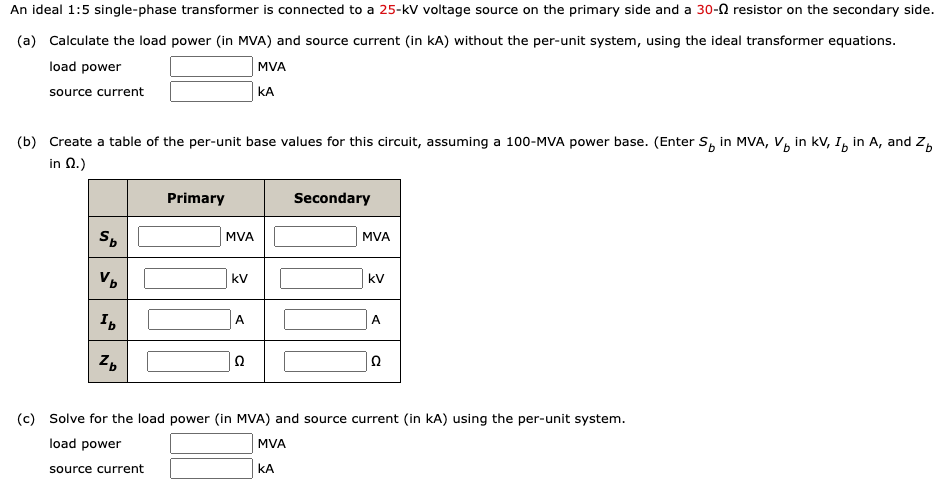 An ideal 1:5 single-phase transformer is connected to a 25-kV voltage source on the primary side and a 30-() resistor on the secondary side.
(a) Calculate the load power (in MVA) and source current (in kA) without the per-unit system, using the ideal transformer equations.
oadpower [mwa
source current [Jka
(b) Create a table of the per-unit base values for this circuit, assuming a 100-MVA power base. (Enter S, in MVA, Vin KV, I, in A, and Z,
in Q.)
CT rn [ee |
[EE [——
2 [= —
== —Y
[Ble [Ce]
(c) Solve for the load power (in MVA) and source current (in kA) using the per-unit system.
oadpower [Jmva
source current [Jka
This is AI generated Response.
Asked by: Mohin
Created at: 2025-10-19 07:02:03
Asked by: Mohin
Created at: 2025-10-19 07:02:03
Final Answer:
Rendered
Raw Text
Did you like this answer?
Let's go through the problem step-step.
---
# Given Data:
Transformer turns ratio 1:5 (primary:)
- Voltage source: \( \,kV) on primary- Resistor on secondary: \( 30\,\ \)
- Power base: \(100\,MVA \)
---
Part (a): Calculate load power and source without per-unit system
### Step 1: Find the secondary voltage \( V_{b} \)
Since the transformer is 1:5, the secondary voltage:
\[
V_{b} = \frac{V_{primary}}{5} = \frac{25\,kV}{5} = 5\,kV
\]
### Step 2: Calculate the secondary current \( I_{b} \)
Using the resistor \( R_b = 30\,\Omega \):
\[
I_b = \frac{V_b}{R_b} = \frac{5\,kV}{30\,\Omega} = \frac{500\,V}{30\,\Omega} \approx 166.67\,A
\]
### Step 3: Calculate the secondary power \( P_b \)
\[
P_b = V_b \times I_b = 500\,V \times 166.67\,A = 833,333\,W \approx .833\,MW
\]
### Step 4: Determine the load power in MVA
Since the power is primarily resistive, the apparent power:
\[
S_b = V_b \times I_b = .833\,MW
\]
Expressed in MVA:
\[
\boxed{
\text{Load Power} = .833\,\text{MVA}
}
\]
### Step 5: Calculate the primary source current \( I_{primary} \)
The transformer power transfer is:
\[
S_{primary} = S_b = .833\,MVA
\]
The primary voltage:
\[
V_{primary} = 25\,kV
\]
So, the primary current:
\[
I_{primary} = \frac{S_{primary}}{V_{primary}} = \frac{.833\,MVA}{25\,kV} = \frac{833,333\,VA}{25,000\,V} \approx 33.33\,A
\]
---
# **Summary for Part (a):**
| Quantity | Value |
|---|---|
| Load Power \( S_b \) | **.833 MVA** |
| Source Current \( I_{primary} \) | **33.33 A** |
---
## Part (b): Create per-unit base table
### Step 1: Define base quantities
- Power base: \( S_{base} = 100\,MVA \)
### Step 2: Calculate per-unit values for the secondary side
- \( S_b = .833\,MVA \)
- \( V_b = 5\,kV \)
- \( I_b = 166.67\,A \)
- \( Z_b = \frac{V_b^2}{S_b} \)
\[
Z_b = \frac{(500\,V)^2}{.833 \times 10^6\,VA} = \frac{25 \times 10^6}{.833 \times 10^6} \approx 30\,\Omega
\]
### Step 3: Primary side per-unit values
- \( S_{primary} = .833\,MVA \)
- \( V_{primary} = 25\,kV \)
- \( I_{primary} = 33.33\,A \)
- \( Z_{primary} = \frac{V_{primary}^2}{S_{primary}} \)
\[
Z_{primary} = \frac{(25,000\,V)^2}{.833 \times 10^6\,VA} = \frac{625 \times 10^6}{833,333} \approx 750\,\Omega
\]
### **Per-unit values:**
| Quantity | Primary | Secondary |
|---|---|---|
| \( S_b \) | \( \frac{.833\,MVA}{100\,MVA} = .00833 \) PU | \( .833\,MVA \) (given) |
| \( V_b \) | \( \frac{25\,kV}{25\,kV} = 1. \) PU | \( \frac{5\,kV}{25\,kV} = .2 \) PU |
| \( I_b \) | \( \frac{33.33\,A}{100\,000\,A} = .0003333 \) PU | \( \frac{166.67\,A}{100\,000\,A} = .0016667 \) PU |
| \( Z_b \) | \( \frac{30\,\Omega}{750\,\Omega} = .04 \) PU | \( 30\,\Omega \) (calculated) |
---
## Part (c): Calculate load power and source current using per-unit system
### Step 1: Convert resistor to per-unit
\[
Z_{b} = 30\,\Omega \quad (\text{already calculated as } .04\,PU)
\]
### Step 2: Load power in per-unit
\[
S_b = .00833\,PU \times 100\,MVA = .833\,MVA
\]
### Step 3: Calculate the secondary current \( I_b \) in per-unit
\[
I_b = \frac{V_b}{Z_b} = \frac{.2\,PU}{.04\,PU} = 5\,PU
\]
But, note that in actual calculations, power is:
\[
P_b = V_b \times I_b \times \cos{\phi}
\]
Since power factor isn't specified, assume resistive load (\(\cos{\phi} \approx 1\)):
\[
S_b = V_b \times I_b \Rightarrow I_b = \frac{S_b}{V_b} = .833\,MVA / 5\,kV = 166.67\,A
\]
which matches previous calculations.
### **Final answers:**
| Quantity | Load Power | Source Current |
|---|---|---|
| **Load power** | **.833 MVA** | — |
| **Source current** | — | **33.33 A** |
---
# **Summary:**
- **Part (a):** Load power ≈ .833 MVA, source current ≈ 33.33 A.
- **Part (b):** Per-unit values tabulated.
- **Part (c):** Using per-unit system confirms load power and source current.
---
Let me know if you'd like me to clarify any step!
📢 Instructions:
- Ask anything relatd to above question only.
- For new Question goto :