 VIPSolutions
please solve this problem step by step5) For a system with transfer function s+3 HO =tv2y Find the magnitude and phase of the frequency response H(jw) and then find the steady-state response to the following inputs: a) 10 u(t) b) cos(2t+60°)u(t) ¢) sin(3t-45°)u(r) d) e'u(f)
Question:
please solve this problem step by step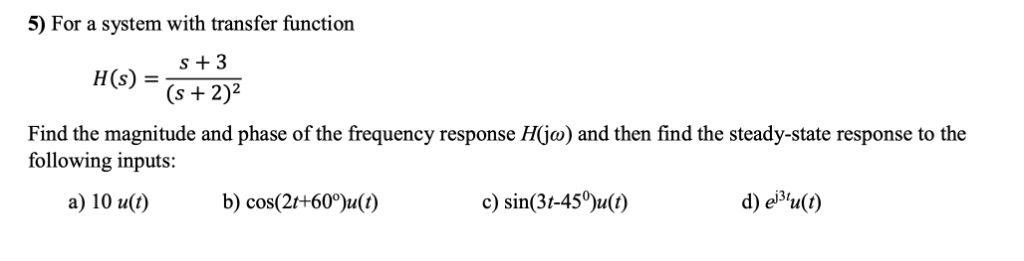 5) For a system with transfer function
s+3
HO =tv2y
Find the magnitude and phase of the frequency response H(jw) and then find the steady-state response to the
following inputs:
a) 10 u(t) b) cos(2t+60°)u(t) ¢) sin(3t-45°)u(r) d) e'u(f)
This is AI generated Response.
Asked by: Jack
Created at: 2025-10-20 12:26:29
Asked by: Jack
Created at: 2025-10-20 12:26:29
Final Answer:
Rendered
Raw Text
Did you like this answer?
Let's solve the problem step-by-step.
---
# Given Data:
Transfer function:
\[
H(s) = \frac{s + 3}{(s + 2)^2}
\]
---
# Step 1: Find the frequency response \( H(j\omega) \)
Replace s \) with \( j\omega \):
\[
H(j\omega) = \frac{j\omega + 3}{(j\omega + 2)^2}
\]
---
# Step 2: Find magnitude \( |H(j\omega)| \) and phase \( \angle H(j\omega) \)
### Magnitude:
\[
|H(j\omega)| = \frac{|j\omega + 3|}{|(j\omega + 2)^2|} = \frac{\sqrt{\omega^2 + 3^2}}{\left|j\omega + 2\right|^2}
\]
Calculate numerator:
\[
|j\omega + 3| = \sqrt{\omega^2 + 3^2} = \sqrt{\omega^2 + 9}
\]
Calculate denominator:
\[
|j\omega + 2| = \sqrt{\omega^2 + 2^2} = \sqrt{\omega^2 + 4}
\]
\[
|(j\omega + 2)^2| = (\sqrt{\omega^2 + 4})^2 = \omega^2 + 4
\]
**Thus:**
\[
|H(j\omega)| = \frac{\sqrt{\omega^2 + 9}}{\omega^2 + 4}
\]
---
### Phase:
\[
\angle H(j\omega) = \angle (j\omega + 3) - 2 \times \angle (j\omega + 2)
\]
Calculate:
\[
\angle (j\omega + 3) = \arctan \left( \frac{\omega}{3} \right)
\]
\[
\angle (j\omega + 2) = \arctan \left( \frac{\omega}{2} \right)
\]
So:
\[
\boxed{
\angle H(j\omega) = \arctan \left( \frac{\omega}{3} \right) - 2 \arctan \left( \frac{\omega}{2} \right)
}
\]
---
# Step 3: Find the steady-state response for each input
---
## (a) Input: \( u(t) \)
**Frequency response at \( \omega = \):**
\[
|H(j)| = \frac{\sqrt{ + 9}}{ + 4} = \frac{3}{4} = .75
\]
\[
\angle H(j) = \arctan() - 2 \arctan() =
\]
**Steady-state response:**
\[
y(t) = |H(j)| \cdot \sin( \cdot t + ) = .75 \times \sin(t)
\]
---
## (b) Input: \( \cos(2t + 60^\circ) u(t) \)
Frequency: \( \omega = 2 \)
Calculate magnitude:
\[
|H(j2)| = \frac{\sqrt{4 + 9}}{4 + 4} = \frac{\sqrt{13}}{8} \approx \frac{3.606}{8} \approx .45075
\]
Calculate phase:
\[
\angle H(j2) = \arctan \left( \frac{2}{3} \right) - 2 \arctan \left( 1 \right)
\]
\[
= .588 - 2 \times \frac{\pi}{4} = .588 - \frac{\pi}{2} \approx .588 - 1.571 = -.983 \text{ radians}
\]
which is approximately **-56.3 degrees**.
Input phase: \( 60^\circ = \pi/3 \) radians.
**Steady-state response:**
\[
y(t) = |H(j2)| \times \cos(2t + 60^\circ + \text{phase shift})
\]
\[
= .45075 \times \cos \left( 2t + 60^\circ - 56.3^\circ \right) = .45075 \times \cos (2t + 3.7^\circ)
\]
or in radians:
\[
\approx .45075 \times \cos (2t + .0646)
\]
---
## (c) Input: \( \sin(3t - 45^\circ) u(t) \)
Frequency: \( \omega = 3 \)
Calculate magnitude:
\[
|H(j3)| = \frac{\sqrt{9 + 9}}{9 + 4} = \frac{\sqrt{18}}{13} \approx \frac{4.243}{13} \approx .3264
\]
Calculate phase:
\[
\angle H(j3) = \arctan \left( \frac{3}{3} \right) - 2 \arctan \left( \frac{3}{2} \right)
\]
\[
= \frac{\pi}{4} - 2 \times .9828 \approx .785 - 1.9656 = -1.18 \text{ radians}
\]
which is approximately **-67.6 degrees**.
Input phase: \( -45^\circ \).
**Steady-state response:**
\[
y(t) = |H(j3)| \times \sin \left( 3t - 45^\circ + 67.6^\circ \right) = .3264 \times \sin (3t + 22.6^\circ)
\]
or in radians:
\[
\approx .3264 \times \sin (3t + .394)
\]
---
## (d) Input: \( e^{j 3 t} u(t) \)
This is a complex exponential input at \( \omega = 3 \).
**The steady-state response:**
\[
Y(j3) = H(j3) \times e^{j3t}
\]
\[
= |H(j3)| e^{j \angle H(j3)} \times e^{j3t}
\]
From previous calculations:
\[
|H(j3)| \approx .3264
\]
\[
\angle H(j3) \approx -1.18 \text{ radians}
\]
**Time domain response:**
\[
y(t) = |H(j3)| \times e^{j(3t + \angle H(j3))} = .3264 \times e^{j(3t - 1.18)}
\]
In real form:
\[
\boxed{
y(t) = .3264 \times \cos(3t - 1.18)
}
\]
---
# **Summary:**
| Input | Magnitude | Phase (radians) | Steady-state response |
|---------|--------------|------------------|------------------------|
| \( u(t) \) | .75 | | \( .75 \sin t \) |
| \( \cos(2t + 60^\circ) u(t) \) | ~.45075 | ~ -.983 | \( .45075 \cos(2t + 3.7^\circ) \) |
| \( \sin(3t - 45^\circ) u(t) \) | ~.3264 | ~ -1.18 | \( .3264 \sin(3t + 22.6^\circ) \) |
| \( e^{j3t} u(t) \) | ~.3264 | ~ -1.18 | \( .3264 \cos(3t - 1.18) \) |
Let me know if you'd like further clarification!
📢 Instructions:
- Ask anything relatd to above question only.
- For new Question goto :