 VIPSolutions
please solve this problem step by step36. Given the unity feedback system of Figure P6.3 with [Section: 6.4] Ks(s+2 G(s) = s(s +2) (s2 —4s+8)(s +3) a. Find the range of K for stability. b. Find the frequency of oscillation when the system is marginally stable.
Question:
please solve this problem step by step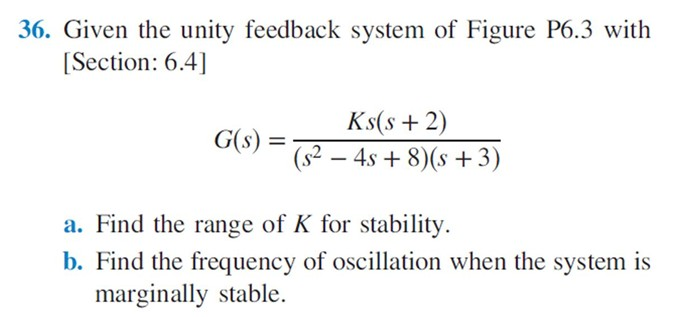 36. Given the unity feedback system of Figure P6.3 with
[Section: 6.4]
Ks(s+2
G(s) = s(s +2)
(s2 —4s+8)(s +3)
a. Find the range of K for stability.
b. Find the frequency of oscillation when the system is
marginally stable.
This is AI generated Response.
Asked by: Mohin
Created at: 2025-10-18 08:41:04
Asked by: Mohin
Created at: 2025-10-18 08:41:04
Final Answer:
Rendered
Raw Text
Did you like this answer?
Let's solve the problem step by step:
---
## **Given:**
The open-loop transfer function is:
\[
G(s) = \frac{Ks(s+2)}{(s^2 - 4s + 8)(s+3)}
\]
Unity feedback is assumed.
---
## **a. Find the range of \( K \) for stability**
### **Step 1: Closed-Loop Characteristic Equation**
For unity feedback, the characteristic equation is:
\[
1 + G(s) =
\]
So,
\[
1 + \frac{Ks(s+2)}{(s^2 - 4s + 8)(s+3)} =
\]
\[
(s^2 - 4s + 8)(s+3) + Ks(s+2) =
\]
Expand \( (s^2 - 4s + 8)(s+3) \):
\[
= (s^2 - 4s + 8)s + (s^2 - 4s + 8)3
= s^3 - 4s^2 + 8s + 3s^2 - 12s + 24
= s^3 - 4s^2 + 8s + 3s^2 - 12s + 24
= s^3 - 4s^2 + 8s + 3s^2 - 12s + 24
= s^3 - 4s^2 + 8s + 3s^2 - 12s + 24
= s^3 - 4s^2 + 8s + 3s^2 - 12s + 24
= s^3 - 4s^2 + 3s^2 + 8s - 12s + 24
= s^3 - s^2 - 4s + 24
\]
So the characteristic equation is:
\[
s^3 - s^2 - 4s + 24 + Ks(s+2) =
\]
Expand \( Ks(s+2) \):
\[
Ks(s+2) = Ks^2 + 2Ks
\]
So,
\[
s^3 - s^2 - 4s + 24 + Ks^2 + 2Ks =
\]
\[
s^3 + (K-1)s^2 + (2K-4)s + 24 =
\]
---
### **Step 2: Routh-Hurwitz Criterion**
Write the characteristic equation:
\[
s^3 + (K-1)s^2 + (2K-4)s + 24 =
\]
Coefficients are:
- \( s^3 \): 1
- \( s^2 \): \( K-1 \)
- \( s^1 \): \( 2K-4 \)
- \( s^ \): 24
**Routh Array:**
\[
\begin{array}{c|cc}
s^3 & 1 & 2K-4 \\
s^2 & K-1 & 24 \\
s^1 & \frac{(K-1)(2K-4)-24}{K-1} & \\
s^ & 24 & \\
\end{array}
\]
For stability, all elements in the first column must be positive.
#### 1. \( K-1 > \implies K > 1 \)
#### 2. \( 2K-4 > \implies K > 2 \)
#### 3. Third row, first element:
\[
a = \frac{(K-1)(2K-4) - 24}{K-1}
= 2K-4 - \frac{24}{K-1}
\]
But let's expand numerator:
\[
(K-1)(2K-4) - 24 = 2K^2 - 4K - 2K + 4 - 24
= 2K^2 - 6K - 20
\]
So,
\[
\frac{2K^2 - 6K - 20}{K-1} >
\]
**Find roots:**
Set numerator \(2K^2 - 6K - 20 = \):
\[
K = \frac{6 \pm \sqrt{36 + 160}}{4} = \frac{6 \pm 14}{4}
\]
\[
K_1 = \frac{20}{4} = 5,\quad K_2 = \frac{-8}{4} = -2
\]
So the numerator is positive for \(K < -2\) or \(K > 5\).
Since denominator \(K-1 > \) for \(K > 1\), combine with the other conditions:
- \(K > 2\) (from earlier)
- \(K > 5\) (from above for positivity of third row)
**Therefore, the range for stability is:**
\[
\boxed{K > 5}
\]
---
## **b. Frequency of Oscillation when System is Marginally Stable**
Marginal stability occurs when a row in the Routh table becomes zero, i.e., a pair of purely imaginary roots.
Set the third row, first element to zero:
\[
2K^2 - 6K - 20 =
\]
Already solved above:
\[
K = 5 \quad \text{or} \quad K = -2
\]
But \(K > 1\), so \(K = 5\).
Now substitute \(K=5\) into the characteristic equation:
\[
s^3 + (5-1)s^2 + (2 \times 5 - 4)s + 24 =
\]
\[
s^3 + 4s^2 + 6s + 24 =
\]
Find the frequency of oscillation (roots on the **imaginary axis**):
Try factoring or let \(s = j\omega\):
\[
(j\omega)^3 + 4(j\omega)^2 + 6(j\omega) + 24 =
\]
\[
j\omega^3 + 4(j^2)\omega^2 + 6j\omega + 24 =
\]
\[
j\omega^3 - 4\omega^2 + 6j\omega + 24 =
\]
\[
(j\omega^3 + 6j\omega) + (-4\omega^2 + 24) =
\]
\[
j(\omega^3 + 6\omega) + (-4\omega^2 + 24) =
\]
Equate real and imaginary parts to zero:
- Real: \( -4\omega^2 + 24 = \implies \omega^2 = 6 \implies \omega = \sqrt{6} \)
- Imaginary: \( \omega^3 + 6\omega = \implies \omega(\omega^2 + 6) = \implies \omega = \) or \( \omega^2 = -6 \) (not possible for real frequency)
So, the non-zero frequency is:
\[
\boxed{\omega = \sqrt{6}}
\]
---
## **Final Answers**
### **a. Range of \( K \) for stability:**
\[
\boxed{K > 5}
\]
### **b. Frequency of Oscillation when Marginally Stable:**
\[
\boxed{\omega = \sqrt{6}}
\]
Question:
please provide me the answer without any render equation errors
This is AI generated Response.
Asked by: Mohin
Created at: 2025-10-18 08:42:38
Asked by: Mohin
Created at: 2025-10-18 08:42:38
Final Answer:
Rendered
Raw Text
Did you like this answer?
Let's solve the problem step by step:
---
## **Given:**
The open-loop transfer function is:
\[
G(s) = \frac{Ks(s+2)}{(s^2 - 4s + 8)(s+3)}
\]
Unity feedback is assumed.
---
## **a. Find the range of \( K \) for stability**
### **Step 1: Closed-Loop Characteristic Equation**
For unity feedback, the characteristic equation is:
\[
1 + G(s) = 0
\]
This leads to:
\[
(s^2 - 4s + 8)(s+3) + Ks(s+2) = 0
\]
### **Step 2: Expand \( (s^2 - 4s + 8)(s + 3) \)**
Calculating the expansion:
\[
(s^2 - 4s + 8)(s + 3) = s^3 - 4s^2 + 8s + 3s^2 - 12s + 24 = s^3 - s^2 - 4s + 24
\]
### **Step 3: Formulate the Characteristic Equation**
The full characteristic equation becomes:
\[
s^3 + (K-1)s^2 + (2K-4)s + 24 = 0
\]
### **Step 4: Apply Routh-Hurwitz Criterion**
Using the coefficients:
- \( s^3 \): 1
- \( s^2 \): \( K-1 \)
- \( s^1 \): \( 2K-4 \)
- \( s^0 \): 24
#### **Routh Array:**
\[
\begin{array}{c|cc}
s^3 & 1 & 2K-4 \\
s^2 & K-1 & 24 \\
s^1 & \frac{(K-1)(2K-4) - 24}{K-1} & \\
s^0 & 24 & \\
\end{array}
\]
**Conditions for stability:**
1. \( K-1 > 0 \implies K > 1 \)
2. \( 2K-4 > 0 \implies K > 2 \)
#### Third Row Analysis:
\[
(K-1)(2K-4) - 24 > 0
\]
Calculating:
\[
= 2K^2 - 6K - 20
\]
**Finding Roots:**
Set the numerator:
\[
2K^2 - 6K - 20 = 0
\]
Using the quadratic formula:
\[
K = \frac{6 \pm \sqrt{36 + 160}}{4} = \frac{6 \pm 14}{4}
\]
This gives:
\[
K_1 = 5, \quad K_2 = -2
\]
Combining conditions, we find:
**Thus, the range for stability is:**
\[
\boxed{K > 5}
\]
---
## **b. Frequency of Oscillation when System is Marginally Stable**
Marginal stability occurs when a row in the Routh table becomes zero.
Setting:
\[
2K^2 - 6K - 20 = 0
\]
For \( K = 5 \):
Substituting into the characteristic equation:
\[
s^3 + 4s^2 + 6s + 24 = 0
\]
### **Finding Frequency:**
Substituting \( s = j\omega \):
\[
(j\omega)^3 + 4(j\omega)^2 + 6(j\omega) + 24 = 0
\]
This simplifies to:
\[
j\omega^3 - 4\omega^2 + 6j\omega + 24 = 0
\]
Separating real and imaginary parts:
1. **Real:** \( -4\omega^2 + 24 = 0 \implies \omega^2 = 6 \implies \omega = \sqrt{6} \)
2. **Imaginary:** \( \omega^3 + 6\omega = 0 \) gives \( \omega(\omega^2 + 6) = 0 \)
Thus, we have non-zero frequency:
\[
\boxed{\omega = \sqrt{6}}
\]
---
## **Final Answers**
### **a. Range of \( K \) for stability:**
\[
\boxed{K > 5}
\]
### **b. Frequency of Oscillation when Marginally Stable:**
\[
\boxed{\omega = \sqrt{6}}
\]
📢 Instructions:
- Ask anything relatd to above question only.
- For new Question goto :