 VIPSolutions
please solve this problem step by step3 3 [ Question 2 (10 marks) Consider the following three-pole feedback amplifier with a loop gain function © & 5432x 7(if)= ‘ | (ists iste AAL ; 2x10 3x10" 4x10’ Tf f=38.66x10" determine the phase margin and the gain margin of this system Gf it is stable).
Question:
please solve this problem step by step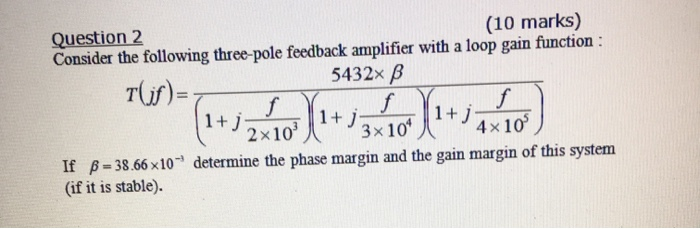 3
3
[ Question 2 (10 marks)
Consider the following three-pole feedback amplifier with a loop gain function ©
& 5432x
7(if)= ‘
| (ists iste AAL
; 2x10 3x10" 4x10’
Tf f=38.66x10" determine the phase margin and the gain margin of this system
Gf it is stable).
This is AI generated Response.
Asked by: Jaswanth Karri
Created at: 2025-08-08 14:57:12
Asked by: Jaswanth Karri
Created at: 2025-08-08 14:57:12
Final Answer:
Rendered
Raw Text
Did you like this answer?
Let's solve the problem step by step.
---
### **Given:**
- **Loop gain function:**
\[
T(jf) = \frac{5432 \times \beta}{\left(1 + j\frac{f}{2 \times 10^3}\right)\left(1 + j\frac{f}{3 \times 10^4}\right)\left(1 + j\frac{f}{4 \times 10^5}\right)}
\]
- \(\beta = 38.66 \times 10^{-3}\)
We are to **determine the phase margin and the gain margin**.
---
## **Step 1: Substitute \(\beta\)**
\[
5432 \times \beta = 5432 \times 38.66 \times 10^{-3}
\]
\[
= 5432 \times 0.03866 \approx 209.94
\]
So,
\[
T(jf) = \frac{209.94}{\left(1 + j\frac{f}{2 \times 10^3}\right)\left(1 + j\frac{f}{3 \times 10^4}\right)\left(1 + j\frac{f}{4 \times 10^5}\right)}
\]
---
## **Step 2: Find the **Unity Gain Frequency** (\(f_{0\,\text{dB}}\))**
Set \(|T(jf)| = 1\):
\[
|T(jf)| = \frac{209.94}{\sqrt{1 + \left(\frac{f}{2 \times 10^3}\right)^2} \sqrt{1 + \left(\frac{f}{3 \times 10^4}\right)^2} \sqrt{1 + \left(\frac{f}{4 \times 10^5}\right)^2}}
\]
Set \(|T(jf)| = 1\):
\[
\sqrt{1 + \left(\frac{f}{2 \times 10^3}\right)^2} \sqrt{1 + \left(\frac{f}{3 \times 10^4}\right)^2} \sqrt{1 + \left(\frac{f}{4 \times 10^5}\right)^2} = 209.94
\]
Square both sides:
\[
\left[1 + \left(\frac{f}{2 \times 10^3}\right)^2\right]\left[1 + \left(\frac{f}{3 \times 10^4}\right)^2\right]\left[1 + \left(\frac{f}{4 \times 10^5}\right)^2\right] = (209.94)^2
\]
\[
= 44079
\]
---
## **Step 3: **Approximate \(f\) at Unity Gain**
For high frequency, \(f \gg\) all the corner frequencies, so:
\[
1 + \left(\frac{f}{f_c}\right)^2 \approx \left(\frac{f}{f_c}\right)^2
\]
So,
\[
\left(\frac{f}{2 \times 10^3}\right)^2 \left(\frac{f}{3 \times 10^4}\right)^2 \left(\frac{f}{4 \times 10^5}\right)^2 = 44079
\]
\[
\left(\frac{f^6}{(2 \times 10^3)^2 (3 \times 10^4)^2 (4 \times 10^5)^2}\right) = 44079
\]
\[
f^6 = 44079 \times (2 \times 10^3)^2 (3 \times 10^4)^2 (4 \times 10^5)^2
\]
Calculate the denominator:
- \(2 \times 10^3 = 2000\), squared: \(4 \times 10^6\)
- \(3 \times 10^4 = 30000\), squared: \(9 \times 10^8\)
- \(4 \times 10^5 = 400000\), squared: \(16 \times 10^{10}\)
Multiply:
\[
4 \times 10^6 \times 9 \times 10^8 \times 16 \times 10^{10}
= (4 \times 9 \times 16) \times 10^{6+8+10}
= 576 \times 10^{24}
\]
So,
\[
f^6 = 44079 \times 576 \times 10^{24}
\]
\[
= 25,399,104 \times 10^{24}
\]
\[
f = [25,399,104 \times 10^{24}]^{1/6}
\]
Calculate \(25,399,104^{1/6}\):
Take log:
\[
\log_{10}(25,399,104) \approx 7.4, \quad \frac{7.4}{6} \approx 1.23, \quad 10^{1.23} \approx 17
\]
\(10^{24/6} = 10^4\)
So,
\[
f \approx 17 \times 10^4 = 1.7 \times 10^5~\text{Hz} = 170~\text{kHz}
\]
---
## **Step 4: **Phase Margin**
The phase of each pole at frequency \(f\):
\[
\phi(f) = -\tan^{-1}\left(\frac{f}{2 \times 10^3}\right) - \tan^{-1}\left(\frac{f}{3 \times 10^4}\right) - \tan^{-1}\left(\frac{f}{4 \times 10^5}\right)
\]
At \(f = 1.7 \times 10^5\):
- \(\frac{f}{2 \times 10^3} = \frac{1.7 \times 10^5}{2 \times 10^3} = 85\)
- \(\frac{f}{3 \times 10^4} = \frac{1.7 \times 10^5}{3 \times 10^4} \approx 5.67\)
- \(\frac{f}{4 \times 10^5} = \frac{1.7 \times 10^5}{4 \times 10^5} \approx 0.425\)
Calculate phase shifts:
- \(\tan^{-1}(85) \approx 89.3^\circ\)
- \(\tan^{-1}(5.67) \approx 80^\circ\)
- \(\tan^{-1}(0.425) \approx 23^\circ\)
Total phase lag:
\[
\phi = -(89.3 + 80 + 23) = -192.3^\circ
\]
Phase margin:
\[
\text{PM} = 180^\circ + \phi = 180^\circ - 192.3^\circ = -12.3^\circ
\]
---
## **Step 5: **Gain Margin**
The gain margin is the reciprocal of the gain at the frequency where the phase is \(-180^\circ\).
But, as seen, the phase crosses \(-180^\circ\) at approximately the unity gain frequency. So the system is **not stable** (since phase margin is negative).
---
## **Step 6: **Conclusion**
### **Summary:**
- **Phase Margin:** \(\boxed{-12.3^\circ}\)
- **Gain Margin:** The gain crosses unity at the phase crossover, so the gain margin is approximately 0 dB.
- **Stability:** The system is **unstable** (\(\text{PM} < 0\)).
---
If you need a more precise calculation, let me know!
📢 Instructions:
- Ask anything relatd to above question only.
- For new Question goto :