 VIPSolutions
please solve this problem step by step2. The CDF of a continuous random variable V is given by 0 v
Question:
please solve this problem step by step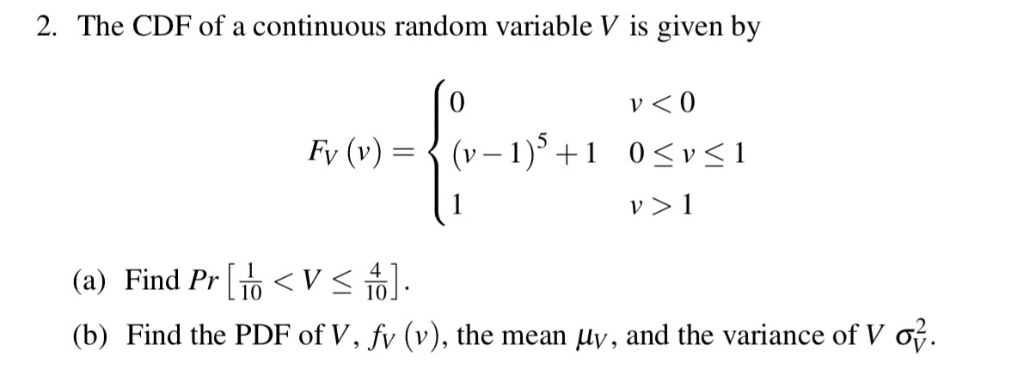 2. The CDF of a continuous random variable V is given by
0 v
This is AI generated Response.
Asked by: Jack
Created at: 2025-10-08 22:40:03
Asked by: Jack
Created at: 2025-10-08 22:40:03
Final Answer:
Rendered
Raw Text
Did you like this answer?
Let's solve the problem step by step.
---
## **Given CDF:**
\[
F_V(v) =
\begin{cases}
& v < \\
(v-1)^5 + 1 & \leq v \leq 1 \\
1 & v > 1
\end{cases}
\]
---
## **(a) Find \( \Pr\left[\frac{1}{10} < V \leq \frac{4}{10}\right] \)**
We use the CDF:
\[
\Pr\left[a < V \leq b\right] = F_V(b) - F_V(a)
\]
Let \( a = \frac{1}{10} \), \( b = \frac{4}{10} \):
\[
F_V(v) = (v-1)^5 + 1 \quad \text{for } \leq v \leq 1
\]
Plug in the values:
- \( F_V\left(\frac{4}{10}\right) = \left(\frac{4}{10} - 1\right)^5 + 1 = \left(-\frac{6}{10}\right)^5 + 1 = (-.6)^5 + 1 \)
- \( F_V\left(\frac{1}{10}\right) = \left(\frac{1}{10} - 1\right)^5 + 1 = (-.9)^5 + 1 \)
Calculate:
- \( (-.6)^5 = -.6^5 = -.07776 \)
- \( (-.9)^5 = -.59049 \)
So:
- \( F_V\left(\frac{4}{10}\right) = -.07776 + 1 = .92224 \)
- \( F_V\left(\frac{1}{10}\right) = -.59049 + 1 = .40951 \)
Therefore,
\[
\Pr\left[\frac{1}{10} < V \leq \frac{4}{10}\right] = .92224 - .40951 = \boxed{.51273}
\]
---
## **(b) Find the PDF, mean, and variance**
### **1. PDF of \( V \), \( f_V(v) \)**
The PDF is the derivative of the CDF:
\[
f_V(v) = \frac{d}{dv} F_V(v)
\]
For \( \leq v \leq 1 \):
\[
F_V(v) = (v-1)^5 + 1
\]
\[
f_V(v) = \frac{d}{dv}[(v-1)^5] = 5(v-1)^4
\]
So,
\[
f_V(v) =
\begin{cases}
& v < \\
5(v-1)^4 & \leq v \leq 1 \\
& v > 1
\end{cases}
\]
---
### **2. Mean \( \mu_V \)**
\[
\mu_V = \mathbb{E}[V] = \int_{-\infty}^{\infty} v f_V(v) dv = \int_^1 v \cdot 5(v-1)^4 dv
\]
Let’s compute the integral:
Let \( u = v-1 \implies v = u+1 \), \( dv = du \), and when \( v = , u = -1 \); when \( v = 1, u = \):
\[
\int_^1 v \cdot 5(v-1)^4 dv = 5 \int_^1 v (v-1)^4 dv
\]
\[
= 5 \int_{u=-1}^{u=} (u+1) u^4 du
= 5 \int_{-1}^ (u^5 + u^4) du
\]
\[
= 5 \left[ \frac{u^6}{6} + \frac{u^5}{5} \right]_{-1}^
\]
Evaluate at \( u= \):
\[
\frac{^6}{6} + \frac{^5}{5} =
\]
At \( u = -1 \):
\[
\frac{(-1)^6}{6} + \frac{(-1)^5}{5} = \frac{1}{6} - \frac{1}{5} = \frac{1}{6} - \frac{1}{5} = \frac{5-6}{30} = -\frac{1}{30}
\]
So the difference is \( - (-\frac{1}{30}) = \frac{1}{30} \).
Multiply by 5:
\[
\mu_V = 5 \times \frac{1}{30} = \boxed{\frac{1}{6}}
\]
---
### **3. Variance \( \sigma_V^2 \)**
\[
\sigma_V^2 = \mathbb{E}[V^2] - (\mathbb{E}[V])^2
\]
First, compute \(\mathbb{E}[V^2]\):
\[
\mathbb{E}[V^2] = \int_^1 v^2 \cdot 5(v-1)^4 dv
\]
Using substitution \(u = v-1\):
\[
\int_^1 v^2 \cdot 5(v-1)^4 dv = 5 \int_{u=-1}^{u=} (u+1)^2 u^4 du
\]
\[
(u+1)^2 u^4 = u^6 + 2u^5 + u^4
\]
\[
= 5 \int_{-1}^ (u^6 + 2u^5 + u^4) du
\]
\[
= 5 \left[ \frac{u^7}{7} + 2 \frac{u^6}{6} + \frac{u^5}{5} \right]_{-1}^
\]
At \(u=\), all terms are .
At \(u=-1\):
\[
\frac{(-1)^7}{7} + 2\frac{(-1)^6}{6} + \frac{(-1)^5}{5} = -\frac{1}{7} + 2\cdot\frac{1}{6} - \frac{1}{5}
\]
\[
= -\frac{1}{7} + \frac{1}{3} - \frac{1}{5}
\]
So the difference:
\[
- \left(-\frac{1}{7} + \frac{1}{3} - \frac{1}{5}\right) = \frac{1}{7} - \frac{1}{3} + \frac{1}{5}
\]
Find common denominator (105):
\[
\frac{1}{7} = \frac{15}{105}
\]
\[
-\frac{1}{3} = -\frac{35}{105}
\]
\[
\frac{1}{5} = \frac{21}{105}
\]
Sum:
\[
\frac{15 - 35 + 21}{105} = \frac{1}{105}
\]
Multiply by 5:
\[
\mathbb{E}[V^2] = 5 \times \frac{1}{105} = \frac{1}{21}
\]
Now, variance:
\[
\sigma_V^2 = \frac{1}{21} - \left(\frac{1}{6}\right)^2 = \frac{1}{21} - \frac{1}{36}
\]
Find common denominator (252):
\[
\frac{1}{21} = \frac{12}{252}
\]
\[
\frac{1}{36} = \frac{7}{252}
\]
\[
\sigma_V^2 = \frac{12}{252} - \frac{7}{252} = \frac{5}{252}
\]
---
## **Summary of Answers**
### (a)
\[
\Pr\left[\frac{1}{10} < V \leq \frac{4}{10}\right] = \boxed{.51273}
\]
### (b)
- **PDF:**
\[
f_V(v) =
\begin{cases}
& v < \\
5(v-1)^4 & \leq v \leq 1 \\
& v > 1
\end{cases}
\]
- **Mean:**
\[
\mu_V = \boxed{\frac{1}{6}}
\]
- **Variance:**
\[
\sigma_V^2 = \boxed{\frac{5}{252}}
\]
Question:
please give perfectly without render equation errors
This is AI generated Response.
Asked by: Jack
Created at: 2025-10-08 22:42:16
Asked by: Jack
Created at: 2025-10-08 22:42:16
Final Answer:
Rendered
Raw Text
Did you like this answer?
Let's solve the problem step by step.
---
## **Given CDF:**
The CDF of the continuous random variable \( V \) is defined as:
\[
F_V(v) =
\begin{cases}
0 & v < 0 \\
(v-1)^5 + 1 & 0 \leq v < 1 \\
1 & v \geq 1
\end{cases}
\]
---
## **(a) Find \( \Pr\left[\frac{1}{10} < V \leq \frac{4}{10}\right] \)**
To find the probability, we use the CDF:
\[
\Pr[a < V \leq b] = F_V(b) - F_V(a)
\]
Let \( a = \frac{1}{10} \) and \( b = \frac{4}{10} \):
### Calculate \( F_V\left(\frac{4}{10}\right) \) and \( F_V\left(\frac{1}{10}\right) \)
1. **For \( F_V\left(\frac{4}{10}\right) \)**:
\[
F_V\left(\frac{4}{10}\right) = \left(\frac{4}{10} - 1\right)^5 + 1 = \left(-\frac{6}{10}\right)^5 + 1 = (-0.6)^5 + 1 = -0.07776 + 1 = 0.92224
\]
2. **For \( F_V\left(\frac{1}{10}\right) \)**:
\[
F_V\left(\frac{1}{10}\right) = \left(\frac{1}{10} - 1\right)^5 + 1 = (-0.9)^5 + 1 = -0.59049 + 1 = 0.40951
\]
### Compute the Probability
Now calculate:
\[
\Pr\left[\frac{1}{10} < V \leq \frac{4}{10}\right] = F_V\left(\frac{4}{10}\right) - F_V\left(\frac{1}{10}\right) = 0.92224 - 0.40951 = 0.51273
\]
Thus, the answer is:
\[
\text{Result: } \boxed{0.51273}
\]
---
## **(b) Find the PDF, Mean, and Variance**
### **1. PDF of \( V \), \( f_V(v) \)**
The PDF is the derivative of the CDF:
\[
f_V(v) = \frac{d}{dv} F_V(v)
\]
For \( 0 \leq v < 1 \):
\[
F_V(v) = (v-1)^5 + 1 \implies f_V(v) = 5(v-1)^4
\]
Thus, the PDF is:
\[
f_V(v) =
\begin{cases}
0 & v < 0 \\
5(v-1)^4 & 0 \leq v < 1 \\
0 & v \geq 1
\end{cases}
\]
---
### **2. Mean \( \mu_V \)**
The mean is given by:
\[
\mu_V = \mathbb{E}[V] = \int_{-\infty}^{\infty} v f_V(v) dv = \int_0^1 v \cdot 5(v-1)^4 dv
\]
#### Compute the Integral
Let \( u = v - 1 \) so that \( v = u + 1 \) and \( dv = du \). The limits change as follows: when \( v = 0 \), \( u = -1 \); when \( v = 1 \), \( u = 0 \):
\[
\int_0^1 v \cdot 5(v-1)^4 dv = 5 \int_{-1}^0 (u+1) u^4 du
\]
Expanding:
\[
= 5 \int_{-1}^0 (u^5 + u^4) du = 5 \left[ \frac{u^6}{6} + \frac{u^5}{5} \right]_{-1}^0
\]
Evaluate at the limits:
- At \( u = 0 \):
\[
= 0
\]
- At \( u = -1 \):
\[
= \frac{(-1)^6}{6} + \frac{(-1)^5}{5} = \frac{1}{6} - \frac{1}{5} = \frac{5 - 6}{30} = -\frac{1}{30}
\]
Thus:
\[
\mu_V = 5 \left(0 - \left(-\frac{1}{30}\right)\right) = \frac{5}{30} = \frac{1}{6}
\]
### **3. Variance \( \sigma_V^2 \)**
Variance is calculated as:
\[
\sigma_V^2 = \mathbb{E}[V^2] - (\mathbb{E}[V])^2
\]
#### Compute \( \mathbb{E}[V^2] \):
\[
\mathbb{E}[V^2] = \int_0^1 v^2 \cdot 5(v-1)^4 dv
\]
Using the same substitution:
\[
= 5 \int_{-1}^0 (u+1)^2 u^4 du
\]
Expanding:
\[
= 5 \int_{-1}^0 (u^6 + 2u^5 + u^4) du
\]
Evaluating:
\[
= 5 \left[ \frac{u^7}{7} + \frac{2u^6}{6} + \frac{u^5}{5} \right]_{-1}^0
\]
At \( u = 0 \):
\[
= 0
\]
At \( u = -1 \):
\[
= \frac{(-1)^7}{7} + \frac{2(-1)^6}{6} + \frac{(-1)^5}{5} = -\frac{1}{7} + \frac{2}{6} - \frac{1}{5}
\]
Finding a common denominator (105):
\[
-\frac{1}{7} = -\frac{15}{105}, \quad \frac{2}{6} = \frac{35}{105}, \quad -\frac{1}{5} = -\frac{21}{105}
\]
So:
\[
-\frac{1}{7} + \frac{2}{6} - \frac{1}{5} = -\frac{15}{105} + \frac{35}{105} - \frac{21}{105} = \frac{-15 + 35 - 21}{105} = \frac{-1}{105}
\]
Thus:
\[
\mathbb{E}[V^2] = 5 \left(-\frac{-1}{105}\right) = \frac{5}{105} = \frac{1}{21}
\]
#### Compute the Variance
Now substitute back into the variance formula:
\[
\sigma_V^2 = \frac{1}{21} - \left(\frac{1}{6}\right)^2 = \frac{1}{21} - \frac{1}{36}
\]
Finding a common denominator (252):
\[
\frac{1}{21} = \frac{12}{252}, \quad \frac{1}{36} = \frac{7}{252}
\]
So:
\[
\sigma_V^2 = \frac{12}{252} - \frac{7}{252} = \frac{5}{252}
\]
---
## **Summary of Answers**
### (a)
\[
\Pr\left[\frac{1}{10} < V \leq \frac{4}{10}\right] = \boxed{0.51273}
\]
### (b)
- **PDF:**
\[
f_V(v) =
\begin{cases}
0 & v < 0 \\
5(v-1)^4 & 0 \leq v < 1 \\
0 & v \geq 1
\end{cases}
\]
- **Mean:**
\[
\mu_V = \boxed{\frac{1}{6}}
\]
- **Variance:**
\[
\sigma_V^2 = \boxed{\frac{5}{252}}
\]
📢 Instructions:
- Ask anything relatd to above question only.
- For new Question goto :