 VIPSolutions
please solve this problem and find i_o(t) using Laplace transform4) Laplace doniisiimiinii kullanarak asagidaki devrede lo(t)’yi bulunuz. (20 Puan) 10 1F 10 anv) 20 G) eunyv \ " iol)
Question:
please solve this problem and find i_o(t) using Laplace transform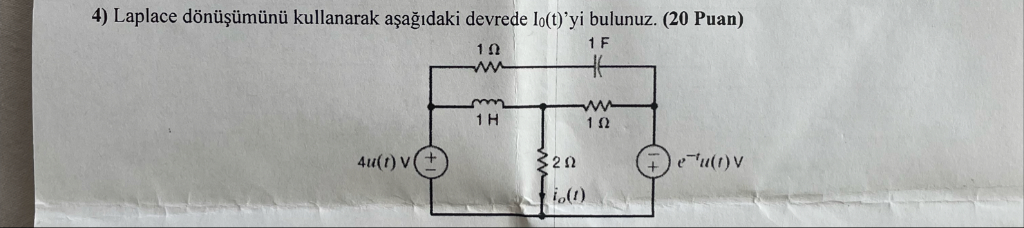 4) Laplace doniisiimiinii kullanarak asagidaki devrede lo(t)’yi bulunuz. (20 Puan)
10 1F
10
anv) 20 G) eunyv
\ " iol)
This is AI generated Response.
Asked by: Jack
Created at: 2025-10-15 11:44:31
Asked by: Jack
Created at: 2025-10-15 11:44:31
Final Answer:
Rendered
Raw Text
Did you like this answer?
Let's solve for \( i_o(t) \) using the **Laplace transform** in the given circuit.
---
## **Step 1: Laplace Transform of the Circuit Elements**
- **Resistor \( R \):** \( R \)
- **Inductor \( L \):** \( sL \)
- **Capacitor \( C \):** \( \frac{1}{sC} \)
Given values:
- \( R_1 = 1\,\Omega \) (left)
- \( R_2 = 2\,\Omega \) (bottom)
- \( R_3 = 1\,\Omega \) (right)
- \( L = 1\,H \)
- \( C = 1\,F \)
---
## **Step 2: Laplace Transform of Sources**
- \( 4u(t) \rightarrow \frac{4}{s} \)
- \( e^{-t}u(t) \rightarrow \frac{1}{s+1} \)
---
## **Step 3: Redraw Circuit in \( s \)-Domain**
- Left branch: \( \frac{4}{s} \) in series with \( 1\,\Omega \) and \( s \) (from \( 1H \))
- Right branch: \( \frac{1}{s+1} \) in series with \( 1\,\Omega \) and \( \frac{1}{s} \) (from \( 1F \))
- Both branches connect at the top and bottom nodes, with \( 2\,\Omega \) resistor between them (where \( i_o(t) \) flows).
---
## **Step 4: Write Node Equation (at the top node)**
Let the top node voltage be \( V_x \).
**Left branch:**
\[
I_{\text{left}} = \frac{\frac{4}{s} - V_x}{1 + s}
\]
**Right branch:**
\[
I_{\text{right}} = \frac{\frac{1}{s+1} - V_x}{1 + \frac{1}{s}} = \frac{\frac{1}{s+1} - V_x}{1 + \frac{1}{s}} = \frac{\frac{1}{s+1} - V_x}{\frac{s+1}{s}} = \frac{s}{s+1}\left( \frac{1}{s+1} - V_x \right)
\]
**Current through \( 2 \Omega \) (downwards, \( i_o(s) \)):**
\[
i_o(s) = \frac{V_x}{2}
\]
**KCL at top node:**
\[
I_{\text{left}} + I_{\text{right}} = i_o(s)
\]
Plug in the expressions:
\[
\frac{\frac{4}{s} - V_x}{1 + s} + \frac{s}{s+1}\left(\frac{1}{s+1} - V_x\right) = \frac{V_x}{2}
\]
---
## **Step 5: Simplify the Equation**
### First term:
\[
\frac{4}{s(1+s)} - \frac{V_x}{1+s}
\]
### Second term:
\[
\frac{s}{s+1} \cdot \frac{1}{s+1} - \frac{s}{s+1} V_x = \frac{s}{(s+1)^2} - \frac{s}{s+1} V_x
\]
### Combine all:
\[
\frac{4}{s(1+s)} - \frac{V_x}{1+s} + \frac{s}{(s+1)^2} - \frac{s}{s+1} V_x = \frac{V_x}{2}
\]
Group \( V_x \) terms:
\[
\frac{4}{s(1+s)} + \frac{s}{(s+1)^2} = \frac{V_x}{2} + \frac{V_x}{1+s} + \frac{s}{s+1} V_x
\]
Combine right hand side:
\[
\frac{V_x}{2} + \frac{V_x}{1+s} + \frac{s}{s+1} V_x
\]
\[
= V_x \left[ \frac{1}{2} + \frac{1}{1+s} + \frac{s}{s+1} \right]
\]
Note:
\[
\frac{1}{1+s} + \frac{s}{s+1} = \frac{1 + s}{1 + s} = 1
\]
So:
\[
V_x \left[ \frac{1}{2} + 1 \right] = V_x \left( \frac{3}{2} \right)
\]
Therefore, the equation is:
\[
\frac{4}{s(1+s)} + \frac{s}{(s+1)^2} = \frac{3}{2} V_x
\]
---
## **Step 6: Solve for \( V_x \) and \( i_o(s) \)**
\[
V_x = \frac{2}{3} \left[ \frac{4}{s(1+s)} + \frac{s}{(s+1)^2} \right]
\]
Recall:
\[
i_o(s) = \frac{V_x}{2}
\]
So:
\[
i_o(s) = \frac{1}{3} \left[ \frac{4}{s(1+s)} + \frac{s}{(s+1)^2} \right]
\]
---
## **Step 7: Inverse Laplace Transform**
### Break into parts:
#### First part:
\[
\frac{4}{s(1+s)} = \frac{4}{s} - \frac{4}{s+1}
\]
So,
\[
\frac{4}{s(1+s)} \rightarrow 4u(t) - 4e^{-t}u(t)
\]
#### Second part:
\[
\frac{s}{(s+1)^2}
\]
Let’s expand:
\[
\frac{s}{(s+1)^2} = \frac{(s+1)-1}{(s+1)^2} = \frac{1}{s+1} - \frac{1}{(s+1)^2}
\]
So,
\[
\frac{s}{(s+1)^2} \rightarrow e^{-t}u(t) - t e^{-t}u(t)
\]
### Combine:
\[
i_o(s) = \frac{1}{3} \left[ 4 \left(\frac{1}{s} - \frac{1}{s+1}\right) + \left(\frac{1}{s+1} - \frac{1}{(s+1)^2}\right) \right ]
\]
\[
= \frac{1}{3} \left[ \frac{4}{s} - \frac{4}{s+1} + \frac{1}{s+1} - \frac{1}{(s+1)^2} \right]
\]
\[
= \frac{1}{3} \left[ \frac{4}{s} - \frac{3}{s+1} - \frac{1}{(s+1)^2} \right]
\]
---
## **Step 8: Final Time Domain Solution**
\[
i_o(t) = \frac{1}{3} \left[ 4u(t) - 3e^{-t}u(t) - t e^{-t}u(t) \right ]
\]
Or, simplified:
\[
\boxed{
i_o(t) = \frac{4}{3} u(t) - e^{-t}u(t) - \frac{1}{3} t e^{-t}u(t)
}
\]
---
### **Summary**
\[
\boxed{
i_o(t) = \frac{4}{3} - e^{-t} - \frac{1}{3} t e^{-t},\quad t \geq
}
\]
---
If you’d like to see the full algebra or any specific step in more detail, let me know!
📢 Instructions:
- Ask anything relatd to above question only.
- For new Question goto :