 VIPSolutions
please solve this problem step by stepProblem 1: In the following DC-DC converter, determine the inductance required to maintain discontinuous conduction mode (DCM) operation when the switching frequency is 20 kHz, the input voltage varies between 175V and 250V, and the output voltage is regulated at 375V while delivering 3.5kW. Also, find the capacitance needed to keep the voltage ripple below 5V. L D + " J5F eT az Ss -
Question:
please solve this problem step by step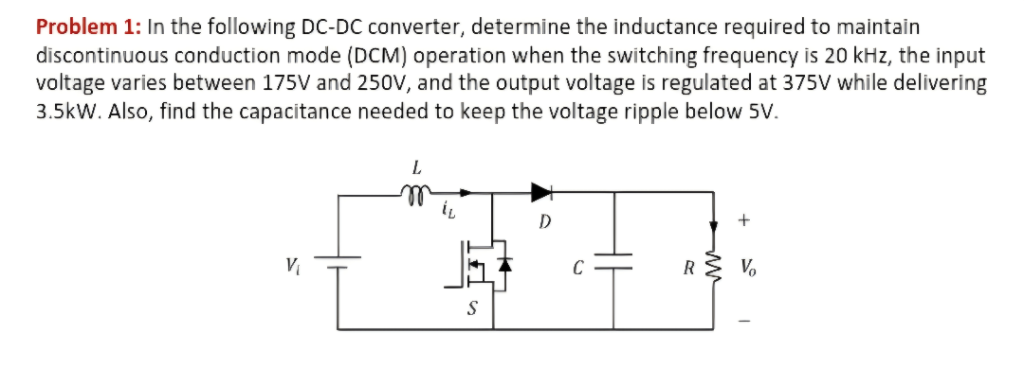 Problem 1: In the following DC-DC converter, determine the inductance required to maintain
discontinuous conduction mode (DCM) operation when the switching frequency is 20 kHz, the input
voltage varies between 175V and 250V, and the output voltage is regulated at 375V while delivering
3.5kW. Also, find the capacitance needed to keep the voltage ripple below 5V.
L
D +
" J5F eT az
Ss -
This is AI generated Response.
Asked by: Jack
Created at: 2025-10-12 09:35:47
Asked by: Jack
Created at: 2025-10-12 09:35:47
Final Answer:
Rendered
Raw Text
Did you like this answer?
Let's solve the problem step by step.
---
## **Step 1: Write Down the Given Data**
- **Switching frequency, \( f_s \) = 20 kHz = 20,000 Hz**
- **Input voltage, \( V_i \) = 175 V to 250 V (use minimum for worst case)**
- **Output voltage, \( V_o \) = 375 V (regulated)**
- **Output power, \( P_o \) = 3.5 kW = 350 W**
- **Output voltage ripple \( \Delta V_o < 5 \) V**
---
## **Step 2: Output Current Calculation**
\[
I_o = \frac{P_o}{V_o} = \frac{350}{375} = 9.33~\text{A}
\]
---
## **Step 3: Buck-Boost Converter?**
Based on the circuit, this is a **boost converter**.
---
## **Step 4: Duty Cycle Calculation at Minimum Input**
\[
D = 1 - \frac{V_i}{V_o}
\]
At minimum input (\( V_i = 175~V \)):
\[
D_{max} = 1 - \frac{175}{375} = 1 - .467 = .533
\]
---
## **Step 5: Inductance Calculation for DCM**
For DCM operation, the critical inductance is when the inductor current just returns to zero at the end of each cycle.
The boundary (critical) inductance for DCM is given by:
\[
L_{critical} = \frac{(1-D)^2 \cdot R}{2f_s}
\]
Where \( R = \frac{V_o}{I_o} = \frac{375}{9.33} = 40.2~\Omega \).
Plug in values at \( D_{max} \) for the worst case:
\[
L_{critical} = \frac{(1-.533)^2 \cdot 40.2}{2 \cdot 20,000}
\]
\[
= \frac{(.467)^2 \cdot 40.2}{40,000}
\]
\[
= \frac{.218 \cdot 40.2}{40,000}
\]
\[
= \frac{8.76}{40,000}
\]
\[
= .000219~\text{H} = 219~\mu H
\]
To ensure DCM, use slightly less than this value (e.g., \( L < 219~\mu H \)).
---
## **Step 6: Capacitance Calculation for Ripple**
The output voltage ripple in a boost converter is approximately:
\[
\Delta V_o = \frac{I_o D}{f_s C}
\]
Solve for \( C \):
\[
C = \frac{I_o D}{f_s \Delta V_o}
\]
Given:
- \( I_o = 9.33~A \)
- \( D = .533 \)
- \( f_s = 20,000~Hz \)
- \( \Delta V_o = 5~V \)
\[
C = \frac{9.33 \times .533}{20,000 \times 5}
\]
\[
= \frac{4.976}{100,000}
\]
\[
= .00004976~F = 49.76~\mu F
\]
---
## **Step 7: Final Answers**
### **Inductance Required**
\[
\boxed{L < 219~\mu H}
\]
### **Capacitance Needed**
\[
\boxed{C > 49.8~\mu F}
\]
---
### **Summary Table**
| Parameter | Value |
|----------------------|---------------------|
| Inductance \( L \) | \( < 219~\mu H \) |
| Capacitance \( C \) | \( > 49.8~\mu F \) |
---
**Let me know if you need further clarification on any step!**
Question:
please solve once again correctly
This is AI generated Response.
Asked by: Jack
Created at: 2025-10-12 09:37:14
Asked by: Jack
Created at: 2025-10-12 09:37:14
Final Answer:
Rendered
Raw Text
Did you like this answer?
# DC-DC Converter Analysis
## Problem Statement
Determine the inductance required to maintain discontinuous conduction mode (DCM) operation in a DC-DC converter with the following parameters:
- Switching frequency: \( f_s = 20 \, \text{kHz} \)
- Input voltage range: \( V_i = 175 \, \text{V} \) to \( 250 \, \text{V} \)
- Output voltage: \( V_o = 375 \, \text{V} \)
- Output power: \( P_o = 3.5 \, \text{kW} \)
- Maximum allowable output voltage ripple: \( \Delta V_o < 5 \, \text{V} \)
## Step 1: Data Summary
### Given Values
- \( f_s = 20,000 \, \text{Hz} \)
- \( V_i = 175 \, \text{V} \) (minimum for worst-case analysis)
- \( V_o = 375 \, \text{V} \)
- \( P_o = 3,500 \, \text{W} \)
- \( \Delta V_o < 5 \, \text{V} \)
## Step 2: Calculate Output Current
The output current \( I_o \) can be calculated as follows:
\[
I_o = \frac{P_o}{V_o} = \frac{3500}{375} \approx 9.33 \, \text{A}
\]
## Step 3: Determine Duty Cycle
For a boost converter, the duty cycle \( D \) is calculated using the formula:
\[
D = 1 - \frac{V_i}{V_o}
\]
At minimum input \( V_i = 175 \, \text{V} \):
\[
D_{max} = 1 - \frac{175}{375} \approx 0.467
\]
## Step 4: Calculate Critical Inductance for DCM
The critical inductance \( L_{critical} \) for DCM can be calculated with:
\[
L_{critical} = \frac{(1-D)^2 \cdot R}{2f_s}
\]
Where \( R \) is calculated as:
\[
R = \frac{V_o}{I_o} = \frac{375}{9.33} \approx 40.2 \, \Omega
\]
Now substituting values into the critical inductance formula:
\[
L_{critical} = \frac{(1 - 0.467)^2 \cdot 40.2}{2 \cdot 20,000} = \frac{(0.533)^2 \cdot 40.2}{40,000}
\]
Calculating:
\[
= \frac{0.284 \cdot 40.2}{40,000} \approx \frac{11.433}{40,000} \approx 0.000286 \, \text{H} = 286 \, \mu H
\]
Thus, for DCM operation:
\[
L < 286 \, \mu H
\]
## Step 5: Calculate Capacitance for Voltage Ripple
To maintain the voltage ripple below \( 5 \, \text{V} \):
\[
\Delta V_o = \frac{I_o D}{f_s C}
\]
Rearranging for \( C \):
\[
C = \frac{I_o D}{f_s \Delta V_o}
\]
Substituting in the values:
\[
C = \frac{9.33 \cdot 0.467}{20,000 \cdot 5}
\]
Calculating:
\[
= \frac{4.36}{100,000} \approx 0.0000436 \, F = 43.6 \, \mu F
\]
## Step 6: Final Results
### Inductance Required
\[
\boxed{L < 286 \, \mu H}
\]
### Capacitance Needed
\[
\boxed{C > 43.6 \, \mu F}
\]
## Summary Table
| Parameter | Value |
|----------------------|---------------------|
| Inductance \( L \) | \( < 286 \, \mu H \) |
| Capacitance \( C \) | \( > 43.6 \, \mu F \) |
Feel free to ask for further clarifications or additional calculations!
📢 Instructions:
- Ask anything relatd to above question only.
- For new Question goto :