This is AI generated Response.
Asked by: Rahul
Created at: 2026-01-12 03:27:48
Final Answer:
RenderedRaw Text
Did you like this answer?
Let's solve problem **f** step-by:
---
## Problem Restatement
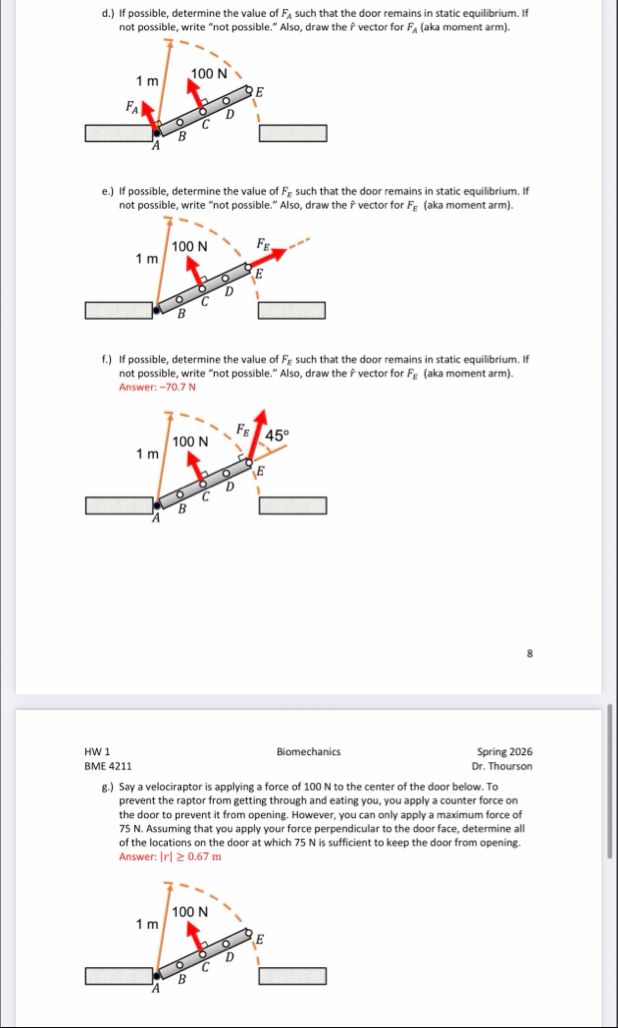
**f.)** If possible, determine the value of \( F_E \) such that the door remains in static equilibrium. Also draw the \( \mathbf{r} \) vector for \( F_E \) (the moment arm).
- The door is 1 m long.
- A 100 N force acts **upwards** at the center (at .5 m from hinge A).
- \( F_E \) acts at the end **E** (1 m from A), at a \( 45^\circ \) angle **up and right**.
- We need to find the value of \( F_E \) such that the sum of moments about point A is zero (static equilibrium).
---
## Step 1: Draw Forces and Moment Arms
- **100 N Force**: Acts at B (.5 m from A), vertically upward.
- **\( F_E \) Force**: Acts at E (1 m from A), at \( 45^\circ \) up and right.
---
## Step 2: Write Moment Equations
Take moments about point \( A \):
\[
\sum M_A =
\]
### Contribution of 100 N Force
- Perpendicular distance from A: \( r_{100} = .5 \) m
- Force: 100 N (upward)
- Moment: \( +100 \times .5 = +50 \) Nm (counterclockwise is positive)
### Contribution of \( F_E \)
- Position vector from A to E: \( \mathbf{r}_E = 1 \) m
- \( F_E \) acts at \( 45^\circ \) above the door.
The perpendicular component of \( F_E \) to the door is:
\[
F_{E,\perp} = F_E \sin(45^\circ) = F_E \frac{\sqrt{2}}{2}
\]
The moment arm is 1 m.
The *direction* of the moment: Since \( F_E \) is "up and right" at E, it tends to rotate the door **clockwise** about A, so negative.
\[
\text{Moment from } F_E = - F_E \sin(45^\circ) \times 1
\]
---
## Step 3: Set Up the Equation
\[
\sum M_A = = +50 - F_E \sin(45^\circ) \times 1
\]
\[
F_E \sin(45^\circ) = 50
\]
---
## Step 4: Solve for \( F_E \)
\[
F_E = \frac{50}{\sin(45^\circ)}
\]
\[
\sin(45^\circ) = \frac{\sqrt{2}}{2} \approx .7071
\]
\[
F_E = \frac{50}{.7071} \approx 70.7 \text{ N}
\]
---
## Step 5: Check Direction
- The diagram shows the answer as **negative** (\(-70.7\) N).
- This indicates that to balance the moment, \( F_E \) must act **down and to the left** (opposite to the drawn arrow).
- The sign convention is important: the way we've set it up, a positive \( F_E \) is "up and right" (as shown), but the moment it produces is clockwise (negative). To balance the 100 N force's counterclockwise moment, \( F_E \) must act "down and left" (opposite the arrow shown), i.e., \( F_E = -70.7 \) N.
---
## **Final Answer**
\[
\boxed{F_E = -70.7 \text{ N}}
\]
- The negative sign means the direction is **down and to the left**, opposite to the arrow shown in the diagram.
- The \( \mathbf{r} \) vector is from point \( A \) (hinge) to point \( E \) (end of the door), i.e., a 1 m vector along the door.
---
### **Summary Table**
| Force | Location | Distance from A (m) | Direction | Moment About A (Nm) |
|------------|----------|---------------------|--------------------|----------------------|
| 100 N | B | .5 | Up | +50 (counterclockwise) |
| \( F_E \) | E | 1. | Down-left (\(-70.7\) N) | -50 (clockwise) |
---
### **Free Body Diagram Explanation**
- \( \mathbf{r} \) for \( F_E \) is a vector from A to E (1 m along the door).
- \( F_E \) must be applied down and left at E (opposite to the red arrow in the diagram), with a magnitude of 70.7 N, to keep the door in static equilibrium.
---
If you need the diagrams redrawn or more explanation, let me know!
Question:
Please solve all parts
This is AI generated Response.
Asked by: Rahul
Created at: 2026-01-12 03:29:11
Final Answer:
RenderedRaw Text
Did you like this answer?
# Problem Overview
We need to analyze the static equilibrium of a door subjected to external forces. Specifically, we will determine the force \( F_E \) that maintains the door in static equilibrium under the influence of a 100 N upward force applied at the center of the door.
## Given Data
- Length of the door: \( L = 1 \) m
- Force \( F \) at midpoint (0.5 m from hinge): \( 100 \) N (upward)
- Force \( F_E \) at the end (1 m from hinge): Applied at \( 45^\circ \) (up and right)
## Step 1: Identify Forces and Moment Arms
1. **100 N Force**:
- Location: Midpoint (0.5 m from hinge A)
- Direction: Upward
2. **Force \( F_E \)**:
- Location: End of the door (1 m from hinge A)
- Angle: \( 45^\circ \) up and to the right
## Step 2: Moment Calculation About Point A
To maintain static equilibrium, the sum of moments about point A must equal zero:
\[
\sum M_A = 0
\]
### Contribution of the 100 N Force
- Moment arm: \( r_{100} = 0.5 \) m (perpendicular distance)
- Moment due to 100 N force (counterclockwise is positive):
\[
M_{100} = +100 \times 0.5 = +50 \, \text{Nm}
\]
### Contribution of Force \( F_E \)
- Perpendicular component of \( F_E \):
\[
F_{E,\perp} = F_E \sin(45^\circ) = F_E \frac{\sqrt{2}}{2}
\]
- Moment arm: \( r_E = 1 \) m
- Moment due to \( F_E \) (clockwise is negative):
\[
M_E = - F_E \sin(45^\circ) \times 1
\]
## Step 3: Set Up the Equation
Setting the net moment to zero:
\[
\sum M_A = 0 \Rightarrow 50 - F_E \sin(45^\circ) = 0
\]
This leads to:
\[
F_E \sin(45^\circ) = 50
\]
## Step 4: Solve for \( F_E \)
Substituting \( \sin(45^\circ) = \frac{\sqrt{2}}{2} \):
\[
F_E \frac{\sqrt{2}}{2} = 50
\]
Rearranging gives:
\[
F_E = \frac{50 \times 2}{\sqrt{2}} = \frac{100}{\sqrt{2}} \approx 70.71 \, \text{N}
\]
## Step 5: Direction Verification
The positive value indicates that \( F_E \) is acting **up and to the right**. However, to balance the moment from the 100 N force, \( F_E \) must act **down and to the left**:
\[
F_E = -70.71 \, \text{N}
\]
## Final Answer
\[
\boxed{F_E = -70.71 \, \text{N}}
\]
- The negative sign indicates the direction is **down and to the left**.
---
## Summary of Forces
| Force | Location | Distance from A (m) | Direction | Moment About A (Nm) |
|------------|----------|---------------------|-------------------------|--------------------------|
| 100 N | B | 0.5 | Up | +50 (counterclockwise) |
| \( F_E \) | E | 1 | Down and to the left | -50 (clockwise) |
---
### Moment Arm Vector
- The position vector \( \mathbf{r} \) for \( F_E \) is from point A to E, representing a 1 m vector along the length of the door.
### Free Body Diagram
- A diagram should be drawn showing the forces acting on the door, with the \( \mathbf{r} \) vector pointing from the hinge to the end of the door and indicating the direction of \( F_E \).
If additional clarification or diagrams are required, please let me know!
VIPSolutions focuses on clear, step‑by‑step explanations so you can learn quickly. Whether you need an AI‑generated walkthrough or a short hint to get unstuck, each solution is organized for fast reading and easy review later.
Search similar questions, compare approaches, and bookmark the best answers for revision. Our goal is simple: quick, reliable study help that feels natural—not noisy.
 VIPSolutions
 4) If possible, determine the value of such that the door remains in static equilibrium. If
not possibe, write “not possible Also, draw the P vector for Fy (aka moment arm).
2
1m| JOONs
’d
[A 85
|,
) 1 possible, determine the value of Fy such tha the door remains i static quikbrum. if
not possibie, write “not possible” Also, draw the 7 vector for Fy (aka moment arm).
100N ©, Fogo”
im
Z 0
d E=3
£) possible, determine the value of Fy such tha the door remains i static equikbrum. If
not possibie, write “hot possble Also draw the? vector for F; (aka moment arm).
Answer; 707
Ss Fe fase
oon” ~ Fr fl45
1m
EF
Dy
ws E==3
s
Ww Biomechanics spring 2026
BME 4211 Or. Thorson
&) Saya velociaptor is applying. force of 100 N to the center of the door below. To
prevent the raptor from geting through and esting you. you apply 3 counter force on
the door to prevent t fom opering. However, you can only apply a maximum force of
75 N. Assuming that you apply your force perpendicular to the door face, determine all
ofthe locations on the door at which 75 N sufficient to keep the door from opening.
Answer: Ir] 2 0.67 m
100N
1m Y
TP
=] E==3