 VIPSolutions
please solve this problem step by step2. A filter’s transfer function (30%) 1 17jw HULSE eee a. Is this filter Low Pass or High Pass? b. Ifan input u(t) = 2sin3t — 3 sin 14t, what is the output? c. What is the cut-off frequency?
Question:
please solve this problem step by step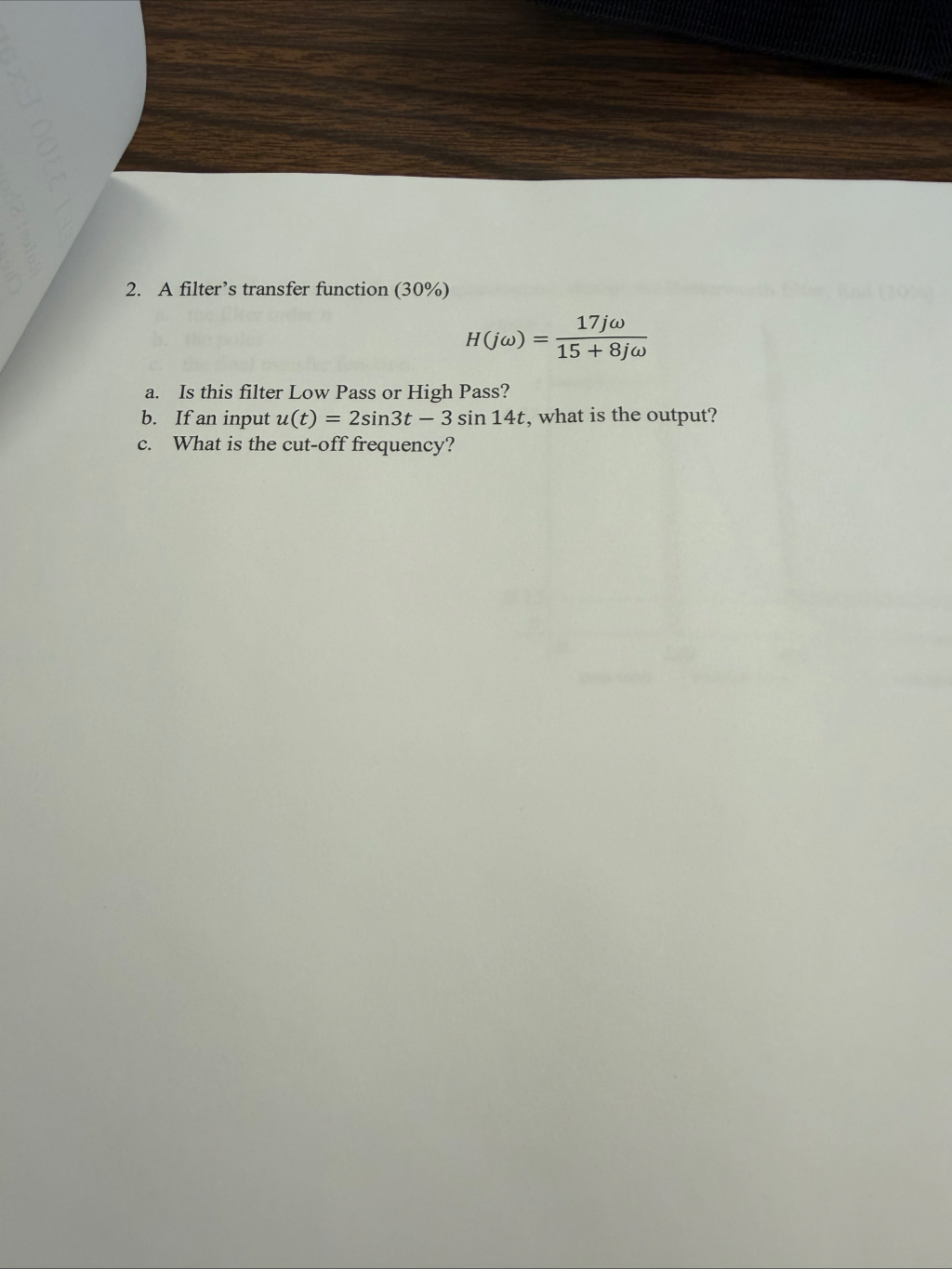 2. A filter’s transfer function (30%)
1 17jw
HULSE eee
a. Is this filter Low Pass or High Pass?
b. Ifan input u(t) = 2sin3t — 3 sin 14t, what is the output?
c. What is the cut-off frequency?
This is AI generated Response.
Asked by: Mohin
Created at: 2025-11-10 21:34:26
Asked by: Mohin
Created at: 2025-11-10 21:34:26
Final Answer:
Rendered
Raw Text
Did you like this answer?
Let's solve the problem step by step.
---
## Given:
The filter's transfer function is:
\[
H(j\omega) = \frac{17j\omega}{15 + 8j\omega}
\]
### (a) Is this filter Low Pass or High Pass?
#### **Step 1: Analyze the Transfer Function**
- For low frequencies (\(\omega \to \)):
\[
H(j\omega) \approx \frac{17j \cdot }{15 + } =
\]
(Output is close to zero at low frequencies.)
- For high frequencies (\(\omega \to \infty\)):
\[
H(j\omega) \approx \frac{17j\omega}{8j\omega} = \frac{17}{8}
\]
(Output approaches a constant at high frequencies.)
#### **Conclusion:**
- **This filter is a High Pass filter**, as it attenuates low frequencies and passes high frequencies.
---
### (b) If an input \(u(t) = 2\sin(3t) - 3\sin(14t)\), what is the output?
#### **Step 1: Express the input as a sum of sinusoids**
\[
u(t) = 2\sin(3t) - 3\sin(14t)
\]
#### **Step 2: Find the frequency response for each frequency**
- For \(\sin(3t)\), \(\omega_1 = 3\)
- For \(\sin(14t)\), \(\omega_2 = 14\)
#### **Step 3: Find output for each frequency using \(H(j\omega)\)**
For a sinusoidal input \(A\sin(\omega t)\), the output is \(|H(j\omega)|A \sin(\omega t + \arg H(j\omega))\).
---
#### **For \(\omega_1 = 3\):**
\[
H(j3) = \frac{17j \cdot 3}{15 + 8j \cdot 3} = \frac{51j}{15 + 24j}
\]
- Convert denominator to polar: \(15 + 24j\)
- Magnitude: \(\sqrt{15^2 + 24^2} = \sqrt{225 + 576} = \sqrt{801}\)
- Phase: \(\tan^{-1}(24/15)\)
So,
- Magnitude: \(|H(j3)| = \frac{51}{\sqrt{801}} \approx 1.804\)
- Phase:
- Numerator: \(+90^\circ\)
- Denominator: \(\tan^{-1}(24/15) \approx 58^\circ\)
- Total phase: \(90^\circ - 58^\circ = 32^\circ\)
So,
\[
\text{Output for } 2\sin(3t):\ 2 \times 1.804 \sin(3t + 32^\circ) \approx 3.608\sin(3t + 32^\circ)
\]
---
#### **For \(\omega_2 = 14\):**
\[
H(j14) = \frac{17j \cdot 14}{15 + 8j \cdot 14} = \frac{238j}{15 + 112j}
\]
- Magnitude: \(\sqrt{15^2 + 112^2} = \sqrt{225 + 12544} = \sqrt{12769} = 113\)
- \(|H(j14)| = \frac{238}{113} \approx 2.106\)
- Phase: Numerator \(+90^\circ\), denominator \(\tan^{-1}(112/15) \approx 82.4^\circ\), so phase difference \(90^\circ - 82.4^\circ = 7.6^\circ\)
So,
\[
\text{Output for } -3\sin(14t):\ -3 \times 2.106 \sin(14t + 7.6^\circ) \approx -6.318\sin(14t + 7.6^\circ)
\]
---
#### **Total Output:**
\[
y(t) = 3.61\sin(3t + 32^\circ) - 6.32\sin(14t + 7.6^\circ)
\]
---
### (c) What is the cut-off frequency?
The cutoff frequency (\(\omega_c\)) is where the magnitude drops to \(1/\sqrt{2}\) (about .707) of its maximum.
\[
|H(j\omega)| = \frac{17\omega}{\sqrt{15^2 + (8\omega)^2}}
\]
Set this equal to the maximum value (\(\frac{17}{8}\)) times \(\frac{1}{\sqrt{2}}\):
\[
\frac{17\omega_c}{\sqrt{225 + 64\omega_c^2}} = \frac{17}{8} \cdot \frac{1}{\sqrt{2}} = \frac{17}{8\sqrt{2}}
\]
Solving for \(\omega_c\):
\[
\frac{\omega_c}{\sqrt{225 + 64\omega_c^2}} = \frac{1}{8\sqrt{2}}
\]
\[
\omega_c = \frac{\sqrt{225 + 64\omega_c^2}}{8\sqrt{2}}
\]
\[
8\sqrt{2} \omega_c = \sqrt{225 + 64\omega_c^2}
\]
\[
(8\sqrt{2} \omega_c)^2 = 225 + 64\omega_c^2
\]
\[
128 \omega_c^2 = 225 + 64\omega_c^2
\]
\[
128 \omega_c^2 - 64\omega_c^2 = 225
\]
\[
64\omega_c^2 = 225
\]
\[
\omega_c^2 = \frac{225}{64}
\]
\[
\omega_c = \frac{15}{8}
\]
---
## **Summary of Answers**
**a.** High Pass Filter
**b.** Output:
\[
y(t) \approx 3.61\sin(3t + 32^\circ) - 6.32\sin(14t + 7.6^\circ)
\]
**c.** Cutoff frequency:
\[
\omega_c = \frac{15}{8} \approx 1.875\ \text{rad/s}
\]
Question:
please provide the solution without any errors in rendered equations
This is AI generated Response.
Asked by: Mohin
Created at: 2025-11-10 21:36:08
Asked by: Mohin
Created at: 2025-11-10 21:36:08
Final Answer:
Rendered
Raw Text
Did you like this answer?
# Step-by-Step Solution
## Given:
The filter's transfer function is:
\[
H(j\omega) = \frac{17j\omega}{15 + 8j\omega}
\]
## (a) Is this filter Low Pass or High Pass?
### Step 1: Analyze the Transfer Function
- **Low Frequencies (\(\omega \to 0\))**:
\[
H(j\omega) \approx \frac{17j \cdot 0}{15 + 8j \cdot 0} = 0
\]
(Output is close to zero at low frequencies.)
- **High Frequencies (\(\omega \to \infty\))**:
\[
H(j\omega) \approx \frac{17j\omega}{8j\omega} = \frac{17}{8}
\]
(Output approaches a constant at high frequencies.)
### Conclusion:
- **This filter is a High Pass filter**, as it attenuates low frequencies and passes high frequencies.
---
## (b) If an input \(u(t) = 2\sin(3t) - 3\sin(14t)\), what is the output?
### Step 1: Express the Input
\[
u(t) = 2\sin(3t) - 3\sin(14t)
\]
### Step 2: Find Frequency Response for Each Frequency
- For \(\sin(3t)\), \(\omega_1 = 3\)
- For \(\sin(14t)\), \(\omega_2 = 14\)
### Step 3: Find Output for Each Frequency Using \(H(j\omega)\)
For a sinusoidal input \(A\sin(\omega t)\), the output is:
\[
y(t) = |H(j\omega)| A \sin(\omega t + \arg H(j\omega))
\]
---
### For \(\omega_1 = 3\):
\[
H(j3) = \frac{17j \cdot 3}{15 + 8j \cdot 3} = \frac{51j}{15 + 24j}
\]
- **Magnitude**:
\[
|H(j3)| = \frac{51}{\sqrt{15^2 + 24^2}} = \frac{51}{\sqrt{801}} \approx 1.804
\]
- **Phase**:
- Numerator: \(+90^\circ\)
- Denominator: \(\tan^{-1}(24/15) \approx 58^\circ\)
- Total phase: \(90^\circ - 58^\circ = 32^\circ\)
So, the output for \(2\sin(3t)\):
\[
y_1(t) \approx 2 \times 1.804 \sin(3t + 32^\circ) \approx 3.608\sin(3t + 32^\circ)
\]
---
### For \(\omega_2 = 14\):
\[
H(j14) = \frac{17j \cdot 14}{15 + 8j \cdot 14} = \frac{238j}{15 + 112j}
\]
- **Magnitude**:
\[
|H(j14)| = \frac{238}{\sqrt{15^2 + 112^2}} = \frac{238}{113} \approx 2.106
\]
- **Phase**:
- Numerator: \(+90^\circ\)
- Denominator: \(\tan^{-1}(112/15) \approx 82.4^\circ\)
- Total phase: \(90^\circ - 82.4^\circ = 7.6^\circ\)
So, the output for \(-3\sin(14t)\):
\[
y_2(t) \approx -3 \times 2.106 \sin(14t + 7.6^\circ) \approx -6.318\sin(14t + 7.6^\circ)
\]
---
### Total Output:
Combining both outputs:
\[
y(t) \approx 3.608\sin(3t + 32^\circ) - 6.318\sin(14t + 7.6^\circ)
\]
---
## (c) What is the Cut-off Frequency?
The cutoff frequency (\(\omega_c\)) is where the magnitude drops to \(1/\sqrt{2}\) (about 0.707) of its maximum value.
### Step 1: Set Up the Equation
The magnitude of the transfer function is:
\[
|H(j\omega)| = \frac{17\omega}{\sqrt{15^2 + (8\omega)^2}}
\]
Setting this equal to the cutoff condition:
\[
\frac{17\omega_c}{\sqrt{225 + 64\omega_c^2}} = \frac{17}{8\sqrt{2}}
\]
### Step 2: Solve for \(\omega_c\)
Cross-multiplying and squaring both sides leads to:
\[
(8\sqrt{2} \omega_c)^2 = 225 + 64\omega_c^2
\]
\[
128 \omega_c^2 = 225 + 64\omega_c^2
\]
\[
64\omega_c^2 = 225
\]
\[
\omega_c^2 = \frac{225}{64}
\]
\[
\omega_c = \frac{15}{8}
\]
---
## Summary of Answers
**a.** High Pass Filter
**b.** Output:
\[
y(t) \approx 3.608\sin(3t + 32^\circ) - 6.318\sin(14t + 7.6^\circ)
\]
**c.** Cutoff frequency:
\[
\omega_c = \frac{15}{8} \approx 1.875\ \text{rad/s}
\]
📢 Instructions:
- Ask anything relatd to above question only.
- For new Question goto :