Please provide the answer in a neat format.
provide explanations for each question and at last overall summary.2. Suppose that Vf(x, y) is always parallel to the position vector (x,y). Convince
me that f(3,0) = f(-3,0). You will need to first compute the normal vector to the
circle that is centered at the origin and has radius 3.
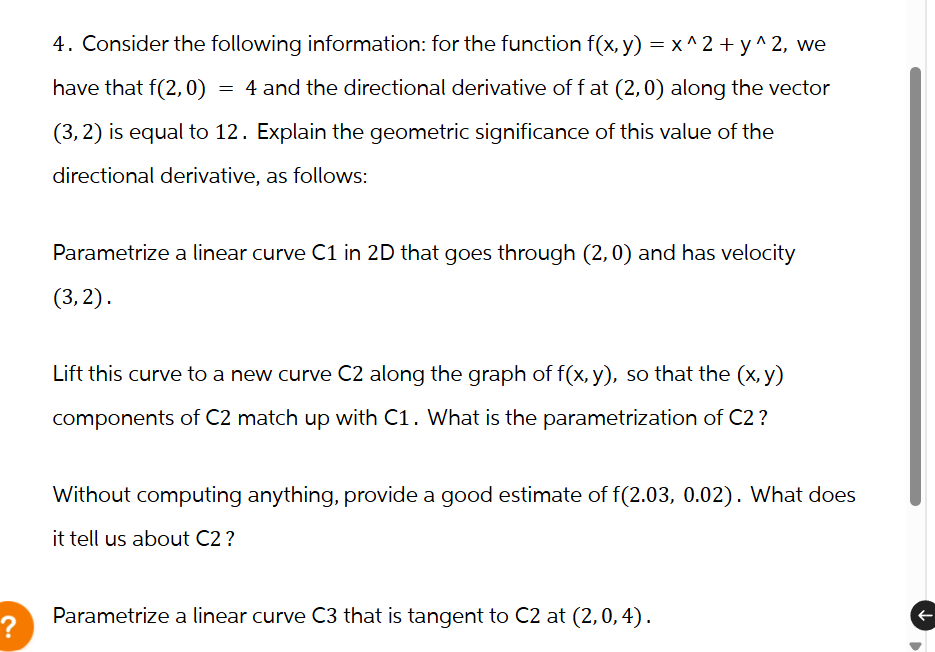
4. Consider the following information: for the function f(x,y) = x2 + y "2, we
have that f(2,0) = 4 and the directional derivative of f at (2,0) along the vector
(3,2) is equal to 12. Explain the geometric significance of this value of the
directional derivative, as follows:
Parametrize a linear curve C1 in 2D that goes through (2,0) and has velocity
(3,2).
Lift this curve to a new curve C2 along the graph of f(x,y), so that the (x,y)
components of C2 match up with C1. What is the parametrization of C2?
Without computing anything, provide a good estimate of f(2.03, 0.02). What does
it tell us about C2?
2] Parametrize a linear curve C3 that is tangent to C2 at (2,0,4). [
Question:
Please provide the answer in a neat format.
provide explanations for each question and at last overall summary.2. Suppose that Vf(x, y) is always parallel to the position vector (x,y). Convince
me that f(3,0) = f(-3,0). You will need to first compute the normal vector to the
circle that is centered at the origin and has radius 3.
4. Consider the following information: for the function f(x,y) = x2 + y "2, we
have that f(2,0) = 4 and the directional derivative of f at (2,0) along the vector
(3,2) is equal to 12. Explain the geometric significance of this value of the
directional derivative, as follows:
Parametrize a linear curve C1 in 2D that goes through (2,0) and has velocity
(3,2).
Lift this curve to a new curve C2 along the graph of f(x,y), so that the (x,y)
components of C2 match up with C1. What is the parametrization of C2?
Without computing anything, provide a good estimate of f(2.03, 0.02). What does
it tell us about C2?
2] Parametrize a linear curve C3 that is tangent to C2 at (2,0,4). [
This is AI generated Response.
Asked by: ASWINI
Created at: 2025-10-01 22:00:17
Thought Process:
RenderedRaw Text
**Analyzing mathematical statements**
I need to address the questions based on screenshots, specifically focusing on Q2 first. The problem states that the gradient of f is always parallel to the position vector, which seems to imply some symmetry. I'll compute the normal vector to the circle with a radius of 3. Since the gradient is radial and orthogonal to these circles, it suggests that the level sets are indeed circles. If the gradient points outward, then it should confirm that f(3, 0) equals f(-3, 0).**Clarifying gradient and circle properties**
I see that along the circle with a radius of 3, the gradient is perpendicular to the tangent vectors, meaning that the function f must be constant along that circle. So, f(3,0) equals f(-3,0). I need to compute the normal vector for this circle using the implicit equation x² + y² = 9. The gradient of this equation is (2x, 2y), pointing outward along (x, y). Normalizing gives me the vector n = (x, y)/3, confirming that the gradient is indeed normal to the circle.**Explaining constant values along the circle**
At the points (3,0) and (-3,0), the function f has the same value. To show this mathematically, I need to parameterize the circle with c(t) = (3 cos t, 3 sin t), and compute the derivative c'(t) = (-3 sin t, 3 cos t), which gives me the tangent. Given that the gradient ∇f(c(t)) is parallel to c(t), the dot product ∇f(c(t)) · c'(t) equals zero. This means f is constant along the path, confirming f(c(t)) is constant for t values, including t=0 and t=π. Now, I should look at question 4.**Exploring directional derivatives and curves**
I need to explain the geometric significance of the directional derivative value. First, I'll parametrize a linear curve C1 in 2D that passes through (2,0) with a velocity of (3,2). The parametric equation for C1 would be r(t) = (2,0) + t*(3,2). For curve C2, I'll lift this curve along the graph of f(x,y), aligning the (x,y) components with C1. I should estimate f(2.03, 0.02) without calculating it, which will reflect certain properties of C2. Finally, I’ll create a tangent curve C3 at (2,0,4) and connect the gradient and directional derivative while linking them to the linear approximation.**Structuring answers for questions**
For Q2, C2 is parameterized as C2(t) = (2+3t, 2t, f(2+3t, 2t)), giving z(t) = 4 + 12t + 13t². The normal vector for the circle is found from g(x,y) = x² + y² - 9, with the gradient ∇g = (2x, 2y) being radial. Since ∇f is parallel at all points, this indicates that f is constant along the circle.
For Q4, the linear curve C1(t) is set and C2(t) represents a lifted curve. The directional derivative along vector (3,2) at (2,0) equals 12, indicating that f increases at this rate in that direction. Estimating f(2.03, 0.02) gives a value close to 4.12.**Creating a thorough explanation**
In this section, I’ll summarize how the predicted value relates to linearization along the tangent line. For the tangent line C3, I can write it as C3(t) = (2,0,4) + t(3,2,12). This tangent line shows the instantaneous rate of change.
The directional derivative indicates how fast the function f increases in the direction (3,2). At the point (2,0), the gradient (4,0) dot product with (3,2) yields 12, meaning the height changes at that rate while moving in the xy-plane. Overall, the tangent vector of the lifted curve is (3,2,12).
Final Answer:
RenderedRaw Text
Did you like this answer?
Answer set-up
- We are given smooth f(x,y).
- Whenever a curve in the xy–plane is parameterized as c(t)=(x(t),y(t)), the rate of change of f along it is d/dt f(c(t)) = ∇f(c(t)) · c′(t).
Question 2
Statement: ∇f(x,y) is always parallel to the position vector (x,y). Show f(3,0) = f(−3,0).
Step 1: Normal to the circle r=3.
- The circle centered at the origin of radius 3 is g(x,y) = x^2 + y^2 = 9.
- Its normal vector at (x,y) is ∇g(x,y) = (2x, 2y), which is parallel to the radial vector (x,y). In particular, at points on the circle the outward unit normal is n = (x,y)/3.
Step 2: Gradient is normal to that circle.
- By hypothesis, ∇f(x,y) is parallel to (x,y), hence also parallel to ∇g(x,y). So at every point of the circle r=3, ∇f is perpendicular to the circle’s tangent direction.
Step 3: f is constant along the circle.
- Parametrize the circle by c(t) = (3 cos t, 3 sin t). Then c′(t) = (−3 sin t, 3 cos t) is tangent to the circle.
- d/dt f(c(t)) = ∇f(c(t)) · c′(t) = 0, because ∇f(c(t)) is normal to the circle and c′(t) is tangent.
- Hence f(c(t)) is constant for all t. In particular,
f(3,0) = f(c(0)) = f(c(π)) = f(−3,0).
Therefore, f(3,0) = f(−3,0).
Question 4
Given f(x,y) = x^2 + y^2, f(2,0) = 4, and the directional derivative of f at (2,0) along the vector (3,2) equals 12.
Interpretation of the directional derivative
- ∇f(2,0) = (2x, 2y)|(2,0) = (4, 0).
- D_(3,2) f(2,0) = ∇f(2,0) · (3,2) = (4,0)·(3,2) = 12.
- Geometrically: if you move from (2,0) in the planar direction (3,2) with parameter t, the height z = f increases at rate 12 with respect to t at t=0. This will be the z–component of the tangent vector to the lifted curve on the graph.
(a) Parametrize a linear curve C1 in 2D through (2,0) with velocity (3,2).
- C1(t) = (2,0) + t(3,2) = (2 + 3t, 2t), with C1′(t) = (3,2).
(b) Lift C1 to the graph to get C2 so that its (x,y) components match C1.
- C2(t) = (x(t), y(t), z(t)) = (2 + 3t, 2t, f(2 + 3t, 2t)).
- Since f(x,y) = x^2 + y^2,
z(t) = (2 + 3t)^2 + (2t)^2 = 4 + 12t + 13 t^2.
- Tangent at t=0: C2′(0) = (3, 2, 12), in agreement with the directional derivative.
(c) Estimate f(2.03, 0.02) without computing exactly.
- Note (2.03, 0.02) = (2,0) + 0.01(3,2); i.e., t = 0.01 along C1.
- Using the directional derivative (linearization), the change in f is ≈ 12·t = 12·0.01 = 0.12.
- So f(2.03, 0.02) ≈ 4 + 0.12 = 4.12.
- Interpretation: near (2,0,4), the lifted curve C2 is well approximated by its tangent line with slope dz/dt = 12; the exact value would differ by about O(t^2) = O(0.0001). Indeed, the exact z(t) above gives 4 + 12·0.01 + 13·(0.01)^2 = 4.1213, close to the estimate.
(d) Parametrize a linear curve C3 tangent to C2 at (2,0,4).
- Use the base point (2,0,4) and the tangent direction C2′(0) = (3,2,12):
C3(t) = (2,0,4) + t(3,2,12).
- Equivalently: x=2+3t, y=2t, z=4+12t.
Overall summary
- If ∇f is parallel to the radial vector (x,y), then ∇f is normal to every circle centered at the origin. Therefore f is constant along each such circle; in particular, on the circle r=3, f(3,0)=f(−3,0).
- For f(x,y)=x^2+y^2, moving from (2,0) in direction (3,2) defines a planar line C1(t) and a lifted space curve C2(t) = (2+3t, 2t, 4+12t+13t^2) on the graph. The directional derivative 12 is exactly the z–rate of change of C2 at t=0, giving the tangent vector (3,2,12). The tangent line C3(t) = (2,0,4) + t(3,2,12) provides linear estimates such as f(2.03,0.02) ≈ 4.12, with small quadratic error.
VIPSolutions focuses on clear, step‑by‑step explanations so you can learn quickly. Whether you need an AI‑generated walkthrough or a short hint to get unstuck, each solution is organized for fast reading and easy review later.
Search similar questions, compare approaches, and bookmark the best answers for revision. Our goal is simple: quick, reliable study help that feels natural—not noisy.
 VIPSolutions
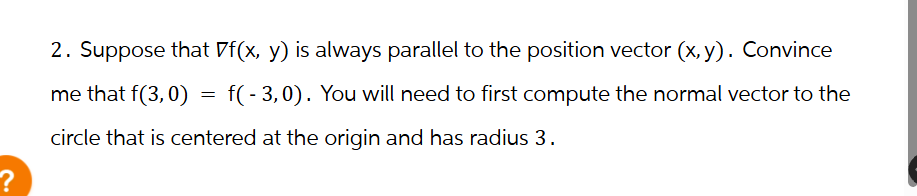
 2. Suppose that Vf(x, y) is always parallel to the position vector (x,y). Convince
me that f(3,0) = f(-3,0). You will need to first compute the normal vector to the
circle that is centered at the origin and has radius 3.
4. Consider the following information: for the function f(x,y) = x2 + y "2, we
have that f(2,0) = 4 and the directional derivative of f at (2,0) along the vector
(3,2) is equal to 12. Explain the geometric significance of this value of the
directional derivative, as follows:
Parametrize a linear curve C1 in 2D that goes through (2,0) and has velocity
(3,2).
Lift this curve to a new curve C2 along the graph of f(x,y), so that the (x,y)
components of C2 match up with C1. What is the parametrization of C2?
Without computing anything, provide a good estimate of f(2.03, 0.02). What does
it tell us about C2?
2] Parametrize a linear curve C3 that is tangent to C2 at (2,0,4). [