VIPSolutions logo ✨ VIPSolutions

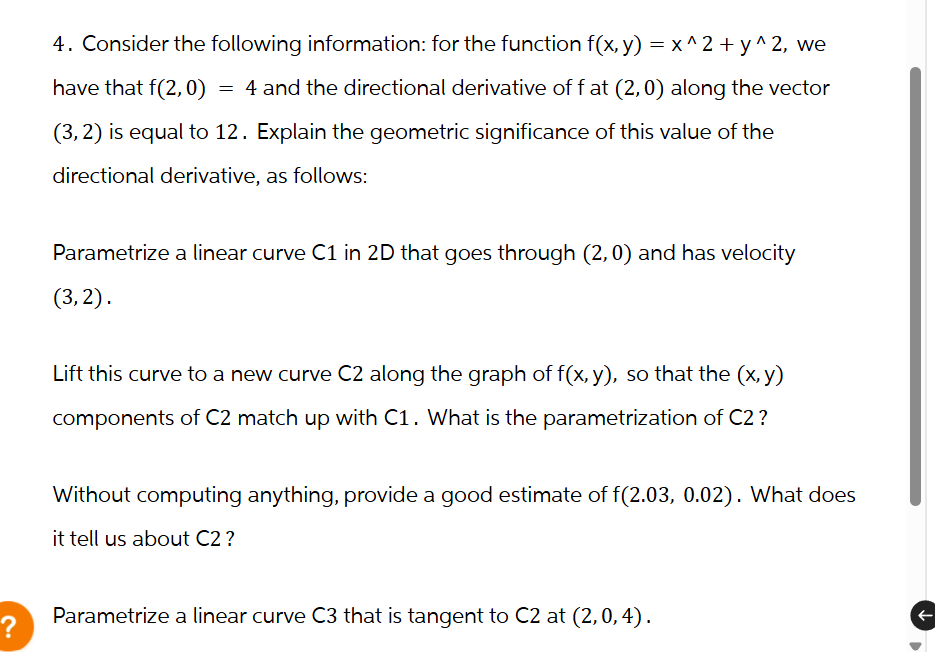
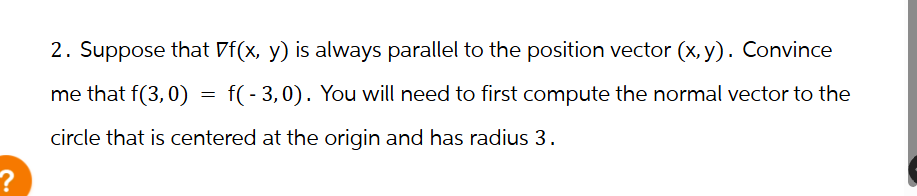
Please provide the answer in a neat format.2. Suppose that Vf(x, y) is always parallel to the position vector (x,y). Convince me that f(3,0) = f(-3,0). You will need to first compute the normal vector to the circle that is centered at the origin and has radius 3. 4. Consider the following information: for the function f(x,y) = x2 + y "2, we have that f(2,0) = 4 and the directional derivative of f at (2,0) along the vector (3,2) is equal to 12. Explain the geometric significance of this value of the directional derivative, as follows: Parametrize a linear curve C1 in 2D that goes through (2,0) and has velocity (3,2). Lift this curve to a new curve C2 along the graph of f(x,y), so that the (x,y) components of C2 match up with C1. What is the parametrization of C2? Without computing anything, provide a good estimate of f(2.03, 0.02). What does it tell us about C2? 2] Parametrize a linear curve C3 that is tangent to C2 at (2,0,4). [

Question:

Please provide the answer in a neat format.Uploaded ImageUploaded Image2. Suppose that Vf(x, y) is always parallel to the position vector (x,y). Convince me that f(3,0) = f(-3,0). You will need to first compute the normal vector to the circle that is centered at the origin and has radius 3. 4. Consider the following information: for the function f(x,y) = x2 + y "2, we have that f(2,0) = 4 and the directional derivative of f at (2,0) along the vector (3,2) is equal to 12. Explain the geometric significance of this value of the directional derivative, as follows: Parametrize a linear curve C1 in 2D that goes through (2,0) and has velocity (3,2). Lift this curve to a new curve C2 along the graph of f(x,y), so that the (x,y) components of C2 match up with C1. What is the parametrization of C2? Without computing anything, provide a good estimate of f(2.03, 0.02). What does it tell us about C2? 2] Parametrize a linear curve C3 that is tangent to C2 at (2,0,4). [
This is AI generated Response.
Asked by: ASWINI
Created at: 2025-10-01 21:45:48

Final Answer:

Rendered Raw Text
Did you like this answer?
# Solutions --- ## Problem 2 **Given:** - ∇f(x, y) is always parallel to the vector (x, y). - Show that f(3,) = f(-3,). - Use the normal vector to the circle centered at the origin with radius 3. ### Step 1: Understanding the Gradient Condition - If ∇f(x, y) is parallel to (x, y), then ∇f(x, y) = λ(x, y) for some scalar λ(x, y). ### Step 2: Circle and Normal Vector - The equation for a circle centered at the origin with radius 3 is: \( x^2 + y^2 = 9 \) - The normal vector to the circle at (x, y) is (x, y), which matches the position vector. ### Step 3: Implication for f - Since the gradient is normal to level curves, the level curves of f must be the circles centered at the origin (because the gradient points radially outwards). - Therefore, f(x, y) is constant on each circle: \( f(x, y) = g(x^2 + y^2) \), for some function g. ### Step 4: Evaluate f at (3,) and (-3,) - \( f(3,) = g(3^2 + ^2) = g(9) \) - \( f(-3,) = g((-3)^2 + ^2) = g(9) \) - **Thus, \( f(3,) = f(-3,) \).** --- ## Problem 4 **Given:** - \( f(x, y) = x^2 + y^2 \) - \( f(2, ) = 4 \) - Directional derivative at (2, ) along (3, 2) is 12. ### Step 1: Geometric Significance of the Directional Derivative - The directional derivative gives the rate of change of f in the direction (3, 2) at (2, ). - A value of 12 means f is increasing most rapidly in that direction with rate 12. ### Step 2: Parametrize Curve \( C_1 \) - Curve \( C_1 \) through (2, ) with velocity (3, 2): \( C_1(t) = (2 + 3t, + 2t) = (2 + 3t, 2t) \) ### Step 3: Lift Curve to \( C_2 \) on the Graph of f - \( C_2(t) = (2 + 3t, 2t, f(2 + 3t, 2t)) \) - \( f(2 + 3t, 2t) = (2 + 3t)^2 + (2t)^2 = 4 + 12t + 9t^2 + 4t^2 = 4 + 12t + 13t^2 \) - So, \( C_2(t) = (2 + 3t, 2t, 4 + 12t + 13t^2) \) ### Step 4: Estimate \( f(2.03, .02) \) - \( (2.03, .02) \) is close to \( (2, ) \). - Use linear approximation: \( f(2.03, .02) \approx f(2, ) + \nabla f(2, ) \cdot (.03, .02) \) - \( \nabla f(x, y) = (2x, 2y) \Rightarrow \nabla f(2, ) = (4, ) \) - \( \nabla f(2, ) \cdot (.03, .02) = 4 \times .03 = .12 \) - Estimate: \( 4 + .12 = 4.12 \) - **Conclusion:** \( f \) increases rapidly in the direction of (3, 2), matching the large directional derivative. ### Step 5: Parametrize Tangent Curve \( C_3 \) at \( (2, , 4) \) - Tangent vector to \( C_2 \) at \( t= \) is (3, 2, 12). - \( C_3(s) = (2 + 3s, + 2s, 4 + 12s) \) --- ## **Summary Table** | Part | Key Result | |------|------------| | 2 | \( f(3,) = f(-3,) \) because f is constant on circles centered at the origin. | | 4 | - \( C_1(t) = (2 + 3t, 2t) \) <br> - \( C_2(t) = (2 + 3t, 2t, 4 + 12t + 13t^2) \) <br> - \( f(2.03, .02) \approx 4.12 \) <br> - \( C_3(s) = (2 + 3s, 2s, 4 + 12s) \) | --- Let me know if you'd like any part explained further!

📢 Instructions:

  • Ask anything relatd to above question only.
  • For new Question goto :

Study Help, Fast Answers

VIPSolutions focuses on clear, step‑by‑step explanations so you can learn quickly. Whether you need an AI‑generated walkthrough or a short hint to get unstuck, each solution is organized for fast reading and easy review later.

Search similar questions, compare approaches, and bookmark the best answers for revision. Our goal is simple: quick, reliable study help that feels natural—not noisy.