 VIPSolutions
please solve this problem step by step clearly‘Series RLC Circuit - develop expressions for a and w,, ‘Barais] RLG Gircull develop expressions fo a and w, —s «® ! L
Question:
please solve this problem step by step clearly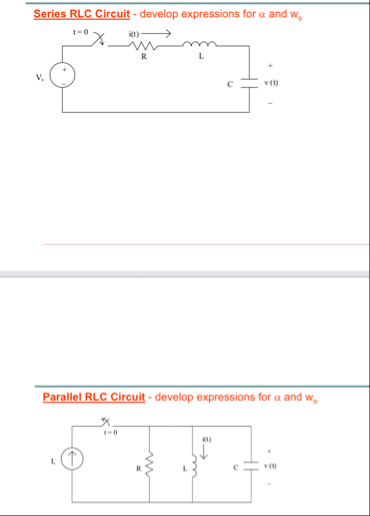 ‘Series RLC Circuit - develop expressions for a and w,,
‘Barais] RLG Gircull develop expressions fo a and w,
—s
«® ! L
This is AI generated Response.
Asked by: Jack
Created at: 2025-10-09 17:54:44
Asked by: Jack
Created at: 2025-10-09 17:54:44
Final Answer:
Rendered
Raw Text
Did you like this answer?
Let's solve **both problems step by step** and **develop expressions for the damping factor (α)** and the **undamped natural frequency (ω₀)** for both the **series** and **parallel RLC circuits**.
---
# 1. **Series RLC Circuit**
**Circuit:**
A resistor (R), inductor (L), and capacitor (C) are connected in series.
## **Step 1: Write the Differential Equation**
By KVL (Kirchhoff's Voltage Law):
\[
V(t) = V_R + V_L + V_C = Ri(t) + L \frac{di(t)}{dt} + \frac{1}{C}\int i(t)dt
\]
Taking the derivative with respect to time:
\[
L \frac{d^2i(t)}{dt^2} + R \frac{di(t)}{dt} + \frac{1}{C}i(t) = \frac{dV(t)}{dt}
\]
For the homogeneous case (\( V(t) = \)):
\[
L \frac{d^2i(t)}{dt^2} + R \frac{di(t)}{dt} + \frac{1}{C}i(t) =
\]
Divide by \( L \):
\[
\frac{d^2i(t)}{dt^2} + \frac{R}{L} \frac{di(t)}{dt} + \frac{1}{LC}i(t) =
\]
---
## **Step 2: Standard Second-Order Form**
This matches the standard form:
\[
\frac{d^2x}{dt^2} + 2\alpha \frac{dx}{dt} + \omega_^2 x =
\]
Comparing coefficients:
- \( 2\alpha = \frac{R}{L} \implies \boxed{\alpha = \frac{R}{2L}} \)
- \( \omega_^2 = \frac{1}{LC} \implies \boxed{\omega_ = \frac{1}{\sqrt{LC}}} \)
---
## **Summary: Series RLC**
\[
\boxed{
\begin{align*}
\alpha &= \frac{R}{2L} \\
\omega_ &= \frac{1}{\sqrt{LC}}
\end{align*}
}
\]
---
# 2. **Parallel RLC Circuit**
**Circuit:**
A resistor (R), inductor (L), and capacitor (C) are connected in parallel.
## **Step 1: Write the Differential Equation**
By KCL (Kirchhoff's Current Law):
\[
I(t) = I_R + I_L + I_C = \frac{v(t)}{R} + \frac{1}{L}\int v(t)dt + C\frac{dv(t)}{dt}
\]
Taking the derivative with respect to time:
\[
\frac{dI(t)}{dt} = \frac{1}{R}\frac{dv(t)}{dt} + \frac{v(t)}{L} + C\frac{d^2v(t)}{dt^2}
\]
For the homogeneous case (\( I(t) = \)):
\[
C\frac{d^2v(t)}{dt^2} + \frac{1}{R}\frac{dv(t)}{dt} + \frac{1}{L}v(t) =
\]
Divide by \( C \):
\[
\frac{d^2v(t)}{dt^2} + \frac{1}{RC}\frac{dv(t)}{dt} + \frac{1}{LC}v(t) =
\]
---
## **Step 2: Standard Second-Order Form**
This matches the standard form:
\[
\frac{d^2x}{dt^2} + 2\alpha \frac{dx}{dt} + \omega_^2 x =
\]
Comparing coefficients:
- \( 2\alpha = \frac{1}{RC} \implies \boxed{\alpha = \frac{1}{2RC}} \)
- \( \omega_^2 = \frac{1}{LC} \implies \boxed{\omega_ = \frac{1}{\sqrt{LC}}} \)
---
## **Summary: Parallel RLC**
\[
\boxed{
\begin{align*}
\alpha &= \frac{1}{2RC} \\
\omega_ &= \frac{1}{\sqrt{LC}}
\end{align*}
}
\]
---
# **Final Answers Table**
| Circuit Type | Damping Factor (\(\alpha\)) | Natural Frequency (\(\omega_\)) |
|---------------------|----------------------------|-----------------------------------|
| Series RLC | \(\frac{R}{2L}\) | \(\frac{1}{\sqrt{LC}}\) |
| Parallel RLC | \(\frac{1}{2RC}\) | \(\frac{1}{\sqrt{LC}}\) |
Question:
please give clear answer without any render equation errors
This is AI generated Response.
Asked by: Jack
Created at: 2025-10-09 17:57:28
Asked by: Jack
Created at: 2025-10-09 17:57:28
Final Answer:
Rendered
Raw Text
Did you like this answer?
# Expressions for Damping Factor (α) and Natural Frequency (ω₀)
This document outlines the derivation of expressions for the damping factor (α) and the undamped natural frequency (ω₀) for both series and parallel RLC circuits.
## 1. Series RLC Circuit
### Step 1: Write the Differential Equation
Using Kirchhoff's Voltage Law (KVL):
\[
V(t) = Ri(t) + L \frac{di(t)}{dt} + \frac{1}{C}\int i(t) dt
\]
Taking the derivative with respect to time leads to:
\[
L \frac{d^2i(t)}{dt^2} + R \frac{di(t)}{dt} + \frac{1}{C}i(t) = 0
\]
Dividing by \( L \):
\[
\frac{d^2i(t)}{dt^2} + \frac{R}{L} \frac{di(t)}{dt} + \frac{1}{LC}i(t) = 0
\]
### Step 2: Standard Second-Order Form
This resembles the standard form:
\[
\frac{d^2x}{dt^2} + 2\alpha \frac{dx}{dt} + \omega_0^2 x = 0
\]
Comparing coefficients gives:
- \( 2\alpha = \frac{R}{L} \) → \( \alpha = \frac{R}{2L} \)
- \( \omega_0^2 = \frac{1}{LC} \) → \( \omega_0 = \frac{1}{\sqrt{LC}} \)
### Summary: Series RLC
\[
\begin{align*}
\alpha &= \frac{R}{2L} \\
\omega_0 &= \frac{1}{\sqrt{LC}}
\end{align*}
\]
---
## 2. Parallel RLC Circuit
### Step 1: Write the Differential Equation
Using Kirchhoff's Current Law (KCL):
\[
I(t) = \frac{v(t)}{R} + \frac{1}{L}\int v(t) dt + C\frac{dv(t)}{dt}
\]
Taking the derivative leads to:
\[
\frac{dI(t)}{dt} = \frac{1}{R}\frac{dv(t)}{dt} + \frac{v(t)}{L} + C\frac{d^2v(t)}{dt^2}
\]
For the homogeneous case:
\[
C\frac{d^2v(t)}{dt^2} + \frac{1}{R}\frac{dv(t)}{dt} + \frac{1}{L}v(t) = 0
\]
Dividing by \( C \):
\[
\frac{d^2v(t)}{dt^2} + \frac{1}{RC}\frac{dv(t)}{dt} + \frac{1}{LC}v(t) = 0
\]
### Step 2: Standard Second-Order Form
This matches the standard form:
\[
\frac{d^2x}{dt^2} + 2\alpha \frac{dx}{dt} + \omega_0^2 x = 0
\]
Comparing coefficients gives:
- \( 2\alpha = \frac{1}{RC} \) → \( \alpha = \frac{1}{2RC} \)
- \( \omega_0^2 = \frac{1}{LC} \) → \( \omega_0 = \frac{1}{\sqrt{LC}} \)
### Summary: Parallel RLC
\[
\begin{align*}
\alpha &= \frac{1}{2RC} \\
\omega_0 &= \frac{1}{\sqrt{LC}}
\end{align*}
\]
---
## Final Answers Table
| Circuit Type | Damping Factor (α) | Natural Frequency (ω₀) |
|---------------------|--------------------------|---------------------------------|
| **Series RLC** | \( \frac{R}{2L} \) | \( \frac{1}{\sqrt{LC}} \) |
| **Parallel RLC** | \( \frac{1}{2RC} \) | \( \frac{1}{\sqrt{LC}} \) |
📢 Instructions:
- Ask anything relatd to above question only.
- For new Question goto :