 VIPSolutions
please solve this problem step by stepSoru 3: oo Asagidaki devrede anahtar t=0 aninda “a” konumundan “b” konumuna alinmaktadir. Anahtarlama oncesinde devrenin kararh hale geldigi varsayilmaktadir. Endiiktans akimini i(t) t>0 i¢in bulunuz. 1 aF ne p t=0 | 50V 5Q 31m
Question:
please solve this problem step by step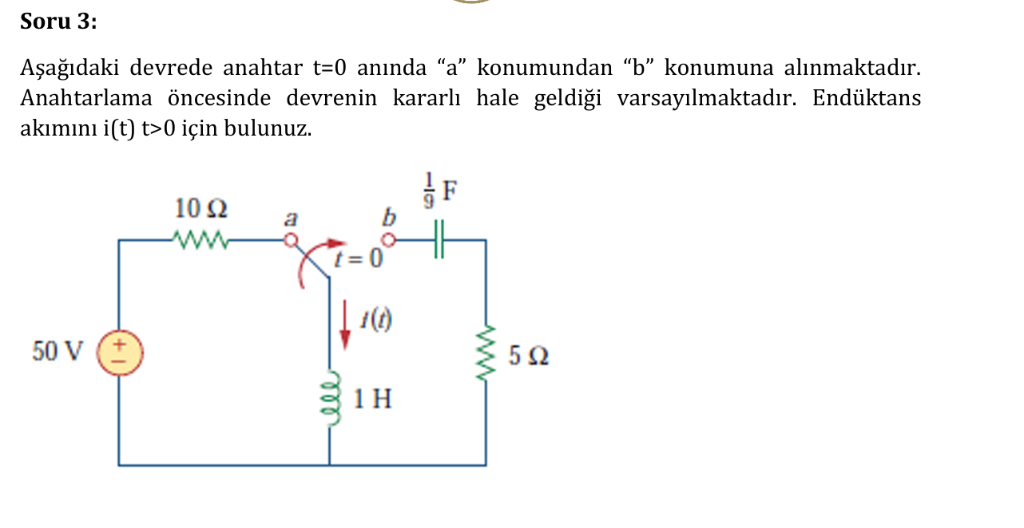 Soru 3: oo
Asagidaki devrede anahtar t=0 aninda “a” konumundan “b” konumuna alinmaktadir.
Anahtarlama oncesinde devrenin kararh hale geldigi varsayilmaktadir. Endiiktans
akimini i(t) t>0 i¢in bulunuz.
1
aF
ne p
t=0
|
50V 5Q
31m
This is AI generated Response.
Asked by: Jaswanth Karri
Created at: 2025-08-11 10:13:21
Asked by: Jaswanth Karri
Created at: 2025-08-11 10:13:21
Final Answer:
Rendered
Raw Text
Did you like this answer?
Tabii, bu tip anahtarlamalı devre sorularında adım adım çözüm aşağıdaki gibi yapılır:
### **Adım 1: Başlangıç (t < 0) - Anahtar "a" Konumunda**
- Anahtar "a" konumunda, devrede sadece 50V kaynağı, 10Ω direnç ve 1H endüktans var.
- **Endüktansın kararlı halde davranışı:** Kararlı halde endüktans kısa devre gibi davranır.
**Devre:**
50V — 10Ω — 1H (kısa devre)
**İndüktör akımı (t = 0⁻):**
\[ i_L(0^-) = \frac{50V}{10\Omega} = 5 \text{ A} \]
---
### **Adım 2: Anahtar "b" Konumuna Geçiyor (t = 0 ve sonrası)**
- Anahtar "b" konumuna geçince, 50V kaynağı ve 10Ω direnç devreden çıkıyor.
- Devre: 1H indüktör, 5Ω direnç, \( \frac{1}{9} \) F kapasitör bir seri RLC devresi oluşturuyor.
- **Endüktör akımı süreklidir:** \( i_L(0^+) = i_L(0^-) = 5A \)
---
### **Adım 3: Diferansiyel Denklemin Kurulması**
Seri RLC devresi için KVL yazalım:
\[
L \frac{di}{dt} + Ri + \frac{1}{C} \int i dt = 0
\]
Verilenler:
- \( L = 1 \) H
- \( R = 5 \) Ω
- \( C = \frac{1}{9} \) F
Denklem:
\[
1 \frac{di}{dt} + 5i + 9 \int i dt = 0
\]
Türevi alalım:
\[
\frac{d^2 i}{dt^2} + 5 \frac{di}{dt} + 9i = 0
\]
---
### **Adım 4: Karakteristik Denklemin Çözümü**
Karakteristik denklem:
\[
s^2 + 5s + 9 = 0
\]
Kökler:
\[
s = \frac{-5 \pm \sqrt{25 - 36}}{2} = \frac{-5 \pm j\sqrt{11}}{2}
\]
Kökler karmaşık:
\[
s_{1,2} = -\frac{5}{2} \pm j\frac{\sqrt{11}}{2}
\]
---
### **Adım 5: Genel Çözüm**
Çözüm:
\[
i(t) = e^{-\frac{5}{2}t} \left[ A \cos\left(\frac{\sqrt{11}}{2}t\right) + B \sin\left(\frac{\sqrt{11}}{2}t\right) \right]
\]
---
### **Adım 6: Başlangıç Şartlarını Bulma**
- \( i(0^+) = 5 \) A (başlangıç akımı)
- \( \frac{di}{dt} \bigg|_{t=0^+} \) için devreyi analiz edelim:
KVL: \( L \frac{di}{dt} + Ri + v_C = 0 \)
İlk anda kondansatör üzerindeki gerilim sıfırdır (\( v_C(0) = 0 \)), çünkü daha önce açık devreydi.
\[
1 \cdot \frac{di}{dt}\bigg|_{t=0} + 5 \cdot 5 + 0 = 0 \implies \frac{di}{dt}\bigg|_{t=0} = -25
\]
---
### **Adım 7: Sabitleri Bulma**
\[
i(0) = 5 = A
\]
Türevi:
\[
\frac{di}{dt} = e^{-\frac{5}{2}t} \left[ -\frac{5}{2}A \cos(\omega t) - A \omega \sin(\omega t) - \frac{5}{2} B \sin(\omega t) + B \omega \cos(\omega t) \right]
\]
\( \omega = \frac{\sqrt{11}}{2} \)
\( t = 0 \) için:
\[
\frac{di}{dt}\bigg|_{t=0} = -\frac{5}{2}A + B\omega = -25
\]
\[
-\frac{5}{2} \cdot 5 + B \cdot \frac{\sqrt{11}}{2} = -25
\]
\[
-\frac{25}{2} + B \cdot \frac{\sqrt{11}}{2} = -25
\]
\[
B \cdot \frac{\sqrt{11}}{2} = -25 + \frac{25}{2} = -\frac{25}{2}
\]
\[
B = -\frac{25}{2} \cdot \frac{2}{\sqrt{11}} = -\frac{25}{\sqrt{11}}
\]
---
### **Adım 8: Sonuç**
\[
\boxed{
i(t) = e^{-\frac{5}{2}t} \left[ 5 \cos\left( \frac{\sqrt{11}}{2} t \right) - \frac{25}{\sqrt{11}} \sin\left( \frac{\sqrt{11}}{2} t \right) \right], \quad t > 0
}
\]
Her adımı detaylıca gösterdim, başka bir nokta açıklama isterseniz memnuniyetle yardımcı olurum!
Question:
please solve the problem in english
This is AI generated Response.
Asked by: Jaswanth Karri
Created at: 2025-08-11 10:18:16
Asked by: Jaswanth Karri
Created at: 2025-08-11 10:18:16
Final Answer:
Rendered
Raw Text
Did you like this answer?
Certainly! Here's a step-by-step solution to the problem in English:
---
### **Problem Overview:**
- At \( t = 0 \), the switch is suddenly moved from position "a" to position "b".
- Before \( t=0 \), the circuit is in steady state.
- The goal: Find the inductor current \( i(t) \) for \( t > 0 \).
---
### **Step 1: Steady-State (for \( t < 0 \))**
- When the switch is at position "a" (for \( t<0 \)), the circuit consists of:
- 50 V voltage source
- 10 Ω resistor
- 1 H inductor
- **In steady state**, the inductor acts as a short circuit (since current is constant).
- **Calculate initial current \( i(0^-) \):**
\[
i(0^-) = \frac{V}{R} = \frac{50\,V}{10\,Ω} = 5\,A
\]
- The initial current through the inductor at \( t=0^- \) is **5 A**.
---
### **Step 2: At \( t=0^+ \) (immediately after switching)**
- The circuit switches to a different configuration (position "b").
- The voltage source and resistor are disconnected.
- The inductor current is **continuous** at the instant of switching:
\[
i(0^+) = i(0^-) = 5\,A
\]
- The circuit now is a series RLC circuit with:
- 1 H inductor
- 5 Ω resistor
- Capacitance \( C = \frac{1}{9} \,F \)
---
### **Step 3: Write the differential equation**
- The series RLC circuit obeys:
\[
L \frac{d^2 i}{dt^2} + R \frac{di}{dt} + \frac{1}{C} i = 0
\]
- Substituting values:
\[
1 \cdot \frac{d^2 i}{dt^2} + 5 \frac{di}{dt} + 9 i = 0
\]
---
### **Step 4: Solve the characteristic equation**
- Characteristic equation:
\[
s^2 + 5 s + 9 = 0
\]
- Roots:
\[
s = \frac{-5 \pm \sqrt{25 - 36}}{2} = \frac{-5 \pm j \sqrt{11}}{2}
\]
- Roots are complex conjugates:
\[
s_{1,2} = -\frac{5}{2} \pm j \frac{\sqrt{11}}{2}
\]
---
### **Step 5: Write the general solution**
- The solution for \( i(t) \):
\[
i(t) = e^{-\frac{5}{2} t} \left[ A \cos\left( \frac{\sqrt{11}}{2} t \right) + B \sin\left( \frac{\sqrt{11}}{2} t \right) \right]
\]
---
### **Step 6: Apply initial conditions**
- At \( t=0 \):
\[
i(0) = A = 5\,A
\]
- To find \( B \), differentiate \( i(t) \):
\[
\frac{di}{dt} = e^{-\frac{5}{2} t} \left[ -\frac{5}{2} A \cos(\omega t) - A \omega \sin(\omega t) + -\frac{5}{2} B \sin(\omega t) + B \omega \cos(\omega t) \right]
\]
where \( \omega = \frac{\sqrt{11}}{2} \).
- Evaluate at \( t=0 \):
\[
\frac{di}{dt}\bigg|_{t=0} = -\frac{5}{2} A + B \omega
\]
- From circuit analysis (initial inductor behavior):
\[
L \frac{di}{dt}\bigg|_{t=0^+} + R i(0^+) = 0 \Rightarrow 1 \cdot \frac{di}{dt} + 5 \times 5 = 0
\]
\[
\Rightarrow \frac{di}{dt} = -25\,A/s
\]
- Now substitute known values:
\[
-\frac{5}{2} \times 5 + B \times \frac{\sqrt{11}}{2} = -25
\]
\[
- \frac{25}{2} + B \times \frac{\sqrt{11}}{2} = -25
\]
\[
B \times \frac{\sqrt{11}}{2} = -25 + \frac{25}{2} = -\frac{25}{2}
\]
\[
B = -\frac{25/2}{\sqrt{11}/2} = -\frac{25}{\sqrt{11}}
\]
---
### **Final answer:**
\[
\boxed{
i(t) = e^{-\frac{5}{2} t} \left[ 5 \cos\left( \frac{\sqrt{11}}{2} t \right) - \frac{25}{\sqrt{11}} \sin\left( \frac{\sqrt{11}}{2} t \right) \right], \quad t > 0
}
\]
This describes the inductor current after the switch is moved at \( t=0 \).
---
If you need further clarification on any step, feel free to ask!
Question:
please give all in math equations
This is AI generated Response.
Asked by: Jaswanth Karri
Created at: 2025-08-11 10:19:57
Asked by: Jaswanth Karri
Created at: 2025-08-11 10:19:57
Final Answer:
Rendered
Raw Text
Did you like this answer?
Certainly! Here's the complete step-by-step solution in mathematical equations:
---
### **Initial Conditions (\( t < 0 \))**
- Circuit: 50 V source, 10 Ω resistor, 1 H inductor in series.
- **Steady state inductor current:**
\[
i(0^-) = \frac{V}{R} = \frac{50\,V}{10\,Ω} = 5\,A
\]
---
### **At \( t = 0 \), the switch moves from position "a" to "b"**
- **Initial inductor current:**
\[
i(0^+) = i(0^-) = 5\,A
\]
- The circuit after switching is a series RLC circuit with:
\[
L = 1\,H,\quad R=5\,Ω,\quad C=\frac{1}{9}\,F
\]
---
### **Differential Equation for \( t > 0 \)**
Applying Kirchhoff's Voltage Law:
\[
L \frac{d^2 i}{dt^2} + R \frac{di}{dt} + \frac{1}{C} i = 0
\]
Substitute known values:
\[
1 \cdot \frac{d^2 i}{dt^2} + 5 \frac{di}{dt} + 9 i = 0
\]
or:
\[
\boxed{
\frac{d^2 i}{dt^2} + 5 \frac{di}{dt} + 9 i = 0
}
\]
---
### **Characteristic Equation**
\[
s^2 + 5s + 9 = 0
\]
Discriminant:
\[
\Delta = 25 - 36 = -11
\]
Roots:
\[
s = \frac{-5 \pm j \sqrt{11}}{2}
\]
which are complex conjugates:
\[
\boxed{
s_{1,2} = -\frac{5}{2} \pm j \frac{\sqrt{11}}{2}
}
\]
---
### **General Solution**
\[
\boxed{
i(t) = e^{-\frac{5}{2} t} \left[ A \cos\left( \frac{\sqrt{11}}{2} t \right) + B \sin\left( \frac{\sqrt{11}}{2} t \right) \right]
}
\]
---
### **Initial Conditions**
- **At \( t=0 \):**
\[
i(0) = A = 5
\]
- **Derivative \( \frac{di}{dt} \) at \( t=0 \):**
Calculate:
\[
\frac{di}{dt} = e^{-\frac{5}{2} t} \left[ -\frac{5}{2} A \cos\left( \frac{\sqrt{11}}{2} t \right) - A \cdot \frac{\sqrt{11}}{2} \sin\left( \frac{\sqrt{11}}{2} t \right) + -\frac{5}{2} B \sin\left( \frac{\sqrt{11}}{2} t \right) + B \cdot \frac{\sqrt{11}}{2} \cos\left( \frac{\sqrt{11}}{2} t \right) \right]
\]
At \( t=0 \):
\[
\frac{di}{dt}\bigg|_{t=0} = -\frac{5}{2} A + B \cdot \frac{\sqrt{11}}{2}
\]
From circuit considerations:
\[
L \frac{di}{dt}\bigg|_{0^+} + R i(0^+) = 0 \Rightarrow 1 \times \frac{di}{dt}\bigg|_{0^+} + 5 \times 5 = 0
\]
\[
\Rightarrow \frac{di}{dt}\bigg|_{0^+} = -25
\]
Substitute \( A=5 \):
\[
- \frac{5}{2} \times 5 + B \cdot \frac{\sqrt{11}}{2} = -25
\]
\[
- \frac{25}{2} + B \cdot \frac{\sqrt{11}}{2} = -25
\]
Multiply through by 2:
\[
-25 + B \sqrt{11} = -50
\]
\[
B \sqrt{11} = -50 + 25 = -25
\]
\[
\boxed{
B = - \frac{25}{\sqrt{11}}
}
\]
---
### **Final Expression for \( i(t) \)**
\[
\boxed{
i(t) = e^{-\frac{5}{2} t} \left[ 5 \cos\left( \frac{\sqrt{11}}{2} t \right) - \frac{25}{\sqrt{11}} \sin\left( \frac{\sqrt{11}}{2} t \right) \right], \quad t > 0
}
\]
This describes the inductor current after switching at \( t=0 \).
📢 Instructions:
- Ask anything relatd to above question only.
- For new Question goto :