VIPSolutions logo ✨ VIPSolutions

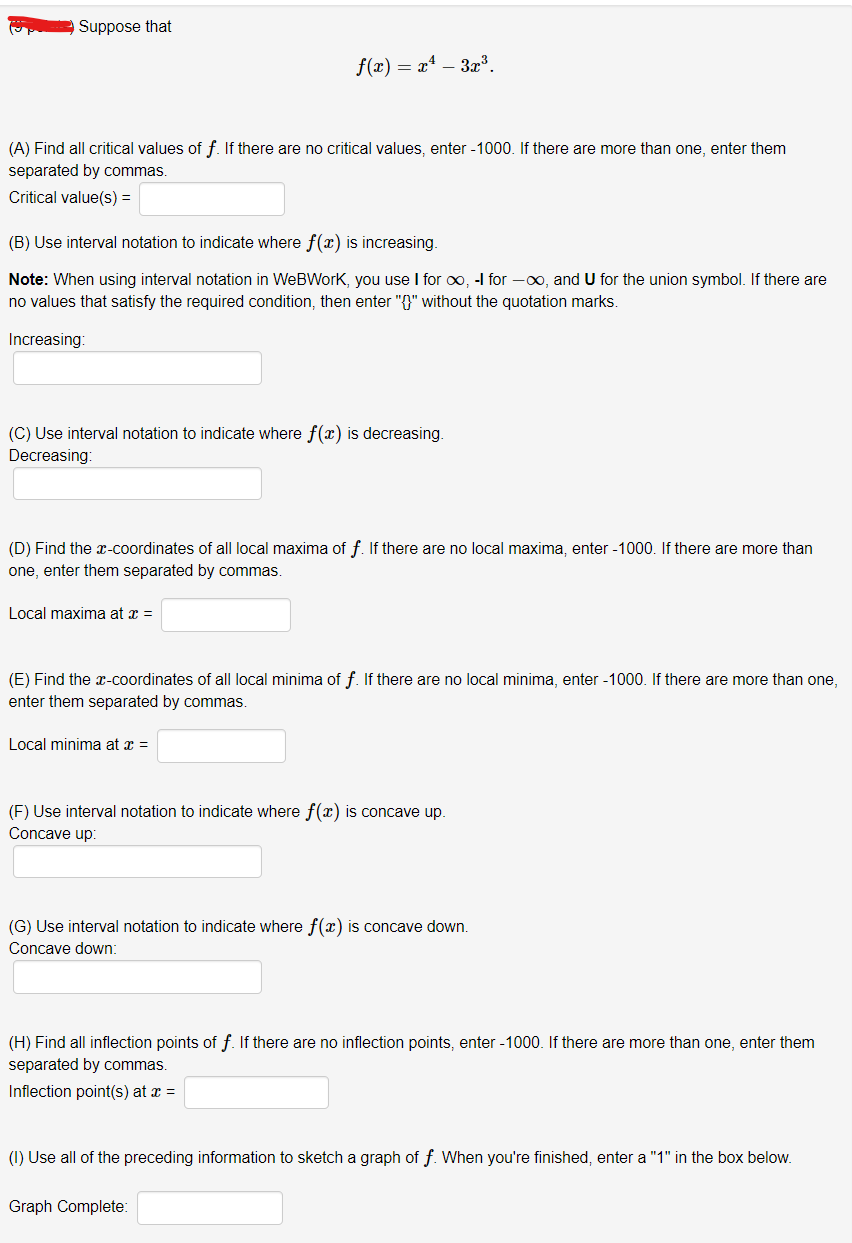
Give step-by-step solution with explanation and final answer:‘Tes Suppose that f(z) =z* — 32°. (A) Find all critical values of f. If there are no critical values, enter -1000. If there are more than one, enter them separated by commas Critical value(s) = (B) Use interval notation to indicate where f(z) is increasing Note: When using interval notation in WeBWork, you use I for 00, I for —0o, and U for the union symbol. If there are no values that satisfy the required condition, then enter "{" without the quotation marks. Increasing (C) Use interval notation to indicate where f(z) is decreasing. Decreasing: (D) Find the z-coordinates of all local maxima of f. If there are no local maxima, enter -1000. If there are more than one, enter them separated by commas. Local maxima at = = (E) Find the coordinates of all local minima of . If there are no local minima, enter -1000. If there are more than one, enter them separated by commas Local minima at z = (F) Use interval notation to indicate where f(z) is concave up. Concave up: (G) Use interval notation to indicate where f(z) is concave down Concave down (H) Find all inflection points of f. If there are no inflection points, enter -1000. If there are more than one, enter them separated by commas Inflection point(s) at z = (1) Use all of the preceding information to sketch a graph of . When you're finished, enter a "1" in the box below. Graph Complete:

Question:

Give step-by-step solution with explanation and final answer:Uploaded Image‘Tes Suppose that f(z) =z* — 32°. (A) Find all critical values of f. If there are no critical values, enter -1000. If there are more than one, enter them separated by commas Critical value(s) = (B) Use interval notation to indicate where f(z) is increasing Note: When using interval notation in WeBWork, you use I for 00, I for —0o, and U for the union symbol. If there are no values that satisfy the required condition, then enter "{" without the quotation marks. Increasing (C) Use interval notation to indicate where f(z) is decreasing. Decreasing: (D) Find the z-coordinates of all local maxima of f. If there are no local maxima, enter -1000. If there are more than one, enter them separated by commas. Local maxima at = = (E) Find the coordinates of all local minima of . If there are no local minima, enter -1000. If there are more than one, enter them separated by commas Local minima at z = (F) Use interval notation to indicate where f(z) is concave up. Concave up: (G) Use interval notation to indicate where f(z) is concave down Concave down (H) Find all inflection points of f. If there are no inflection points, enter -1000. If there are more than one, enter them separated by commas Inflection point(s) at z = (1) Use all of the preceding information to sketch a graph of . When you're finished, enter a "1" in the box below. Graph Complete:
This is AI generated Response.
Asked by: gvr
Created at: 2025-07-09 09:33:09

Final Answer:

Rendered Raw Text
Did you like this answer?
Let's go step by step for the function: \[ f(x) = x^4 - 3x^3 \] --- ### (A) Critical values Critical values occur where \( f'(x) = 0 \) or is undefined. First, find the derivative: \[ f'(x) = 4x^3 - 9x^2 \] Set \( f'(x) = 0 \): \[ 4x^3 - 9x^2 = 0 \\ x^2(4x - 9) = 0 \\ x^2 = 0 \implies x = 0 \\ 4x - 9 = 0 \implies x = \frac{9}{4} \] **Critical values:** \( x = 0, \frac{9}{4} \) --- ### (B) Where is \( f(x) \) increasing? Test intervals determined by critical points: \( (-\infty, 0), (0, \frac{9}{4}), (\frac{9}{4}, \infty) \). Test each interval in \( f'(x) = 4x^3 - 9x^2 \): - For \( x < 0 \) (e.g., \( x = -1 \)): \( 4(-1)^3 - 9(-1)^2 = -4 - 9 = -13 \) (Negative, so **decreasing**) - For \( 0 < x < \frac{9}{4} \) (e.g., \( x = 1 \)): \( 4(1)^3 - 9(1)^2 = 4 - 9 = -5 \) (Negative, so **decreasing**) - For \( x > \frac{9}{4} \) (e.g., \( x = 3 \)): \( 4(3)^3 - 9(3)^2 = 4(27) - 9(9) = 108 - 81 = 27 \) (Positive, so **increasing**) **Increasing:** \( \left(\frac{9}{4}, \infty\right) \) --- ### (C) Where is \( f(x) \) decreasing? From above: **Decreasing:** \( (-\infty, 0) \cup (0, \frac{9}{4}) \) --- ### (D) Local maxima Check sign change of \( f'(x) \): - At \( x = 0 \): \( f'(x) \) negative on both sides (no max/min). - At \( x = \frac{9}{4} \): \( f'(x) \) changes from negative to positive (**local minimum**). So, **no local maxima**. **Local maxima at \( x = \) -1000** --- ### (E) Local minima From above, at \( x = \frac{9}{4} \), \( f'(x) \) changes from negative to positive (**local minimum**). **Local minima at \( x = \frac{9}{4} \)** --- ### (F) Concave up Second derivative: \[ f''(x) = 12x^2 - 18x = 6x(2x - 3) \] Set \( f''(x) = 0 \): \[ 6x(2x - 3) = 0 \implies x = 0, \frac{3}{2} \] Test intervals: - \( x < 0 \) (e.g., \( x = -1 \)): \( 6(-1)(2(-1) - 3) = 6(-1)(-2 - 3) = 6(-1)(-5) = 30 \) (Positive, concave up) - \( 0 < x < \frac{3}{2} \) (e.g., \( x = 1 \)): \( 6(1)(2 - 3) = 6(1)(-1) = -6 \) (Negative, concave down) - \( x > \frac{3}{2} \) (e.g., \( x = 2 \)): \( 6(2)(4 - 3) = 6(2)(1) = 12 \) (Positive, concave up) **Concave up:** \( (-\infty, 0) \cup \left(\frac{3}{2}, \infty\right) \) --- ### (G) Concave down **Concave down:** \( (0, \frac{3}{2}) \) --- ### (H) Inflection points Inflection at \( x = 0 \) and \( x = \frac{3}{2} \), where \( f''(x) \) changes sign. **Inflection points:** \( x = 0, \frac{3}{2} \) --- ### (I) Graph complete Enter "1" when done. --- ## **Final Answers** **(A) Critical value(s):** `0,9/4` **(B) Increasing:** `(9/4, infinity)` **(C) Decreasing:** `(-infinity,0) U (0,9/4)` **(D) Local maxima at x =** `-1000` **(E) Local minima at x =** `9/4` **(F) Concave up:** `(-infinity,0) U (3/2,infinity)` **(G) Concave down:** `(0,3/2)` **(H) Inflection point(s) at x =** `0,3/2` **(I) Graph Complete:** `1` --- If you need the graph or more explanation, let me know!

Question:

please generate only all final answers in table

This is AI generated Response.
Asked by: gvr
Created at: 2025-07-09 09:33:57

Final Answer:

Rendered Raw Text
Did you like this answer?
| Question | Final Answer | |--------------------------------------------------------|-------------------------------------------------| | (A) Critical value(s) | 0, 9/4 | | (B) Where is \(f(z)\) increasing | (9/4, ∞) | | (C) Where is \(f(z)\) decreasing | \(-\infty, 0) \cup (0, 9/4)\) | | (D) Local maxima at \(z\) | -1000 (none) | | (E) Local minima at \(z\) | 9/4 | | (F) Concave up | \(-\infty, 0) \cup (3/2, \infty)\) | | (G) Concave down | (0, 3/2) | | (H) Inflection point(s) at \(z\) | 0, 3/2 |

📢 Instructions:

  • Ask anything relatd to above question only.
  • For new Question goto :

Study Help, Fast Answers

VIPSolutions focuses on clear, step‑by‑step explanations so you can learn quickly. Whether you need an AI‑generated walkthrough or a short hint to get unstuck, each solution is organized for fast reading and easy review later.

Search similar questions, compare approaches, and bookmark the best answers for revision. Our goal is simple: quick, reliable study help that feels natural—not noisy.