 VIPSolutions
Find the area of the shaded region shown in the figure.y y=T7x 4 y=3X% y=44—x> X
Question:
Find the area of the shaded region shown in the figure.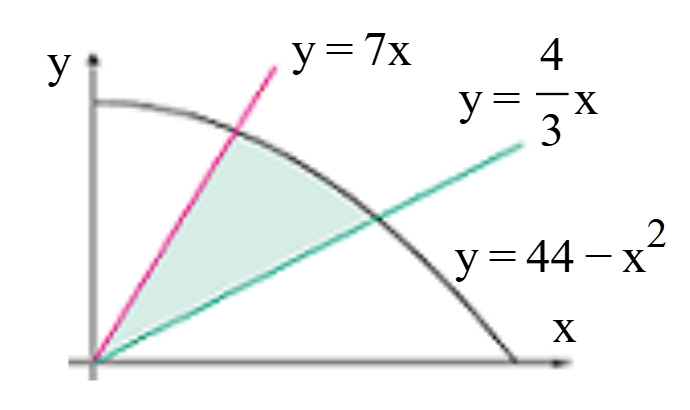 y y=T7x 4
y=3X%
y=44—x>
X
This is AI generated Response.
Asked by: gvr
Created at: 2025-07-28 08:27:06
Asked by: gvr
Created at: 2025-07-28 08:27:06
Final Answer:
Rendered
Raw Text
Did you like this answer?
Let's break down the **area of the shaded region** step by step:
### 1. **Find the intersection points**
#### **Between \( y = 7x \) and \( y = 44 - x^2 \):**
Set \( 7x = 44 - x^2 \):
\[
x^2 + 7x - 44 = 0
\]
\[
(x + 11)(x - 4) = 0
\]
So, \( x = -11 \) or \( x = 4 \).
Since we are in the first quadrant, **use \( x = 4 \)**.
---
#### **Between \( y = \frac{4}{3}x \) and \( y = 44 - x^2 \):**
Set \( \frac{4}{3}x = 44 - x^2 \):
\[
x^2 + \frac{4}{3}x - 44 = 0
\]
Multiply both sides by 3:
\[
3x^2 + 4x - 132 = 0
\]
\[
(x + 6)(3x - 22) = 0
\]
So, \( x = -6 \) or \( x = \frac{22}{3} \).
Since we are in the first quadrant, **use \( x = \frac{22}{3} \)**.
---
#### **Both lines and the parabola intersect at \( x = 0 \):**
At \( x=0 \): \( y = 0 \) for both lines and \( y = 44 \) for the parabola. But for area, we only consider from \( x = 0 \).
---
### 2. **Set up the integral**
The shaded region is bounded above by \( y = 44 - x^2 \), below by \( y = 7x \) on the left and \( y = \frac{4}{3}x \) on the right.
#### The limits:
- From \( x = 0 \) to \( x = 4 \): lower bound is \( y = 7x \)
- From \( x = 4 \) to \( x = \frac{22}{3} \): lower bound is \( y = \frac{4}{3}x \)
#### **Area is:**
\[
\text{Area} = \int_0^4 \left[ (44 - x^2) - 7x \right] dx + \int_4^{\frac{22}{3}} \left[ (44 - x^2) - \frac{4}{3}x \right] dx
\]
---
### 3. **Calculate the integrals**
#### **First integral:**
\[
\int_0^4 (44 - x^2 - 7x) dx = \int_0^4 (44 - 7x - x^2) dx
\]
\[
= \left[ 44x - \frac{7}{2}x^2 - \frac{1}{3}x^3 \right]_0^4
\]
Plug in \( x = 4 \):
- \( 44 \times 4 = 176 \)
- \( \frac{7}{2} \times 16 = 56 \)
- \( \frac{1}{3} \times 64 = \frac{64}{3} \)
So,
\[
= 176 - 56 - \frac{64}{3}
= 120 - \frac{64}{3}
= \frac{360 - 64}{3} = \frac{296}{3}
\]
---
#### **Second integral:**
\[
\int_4^{\frac{22}{3}} (44 - x^2 - \frac{4}{3}x) dx
= \left[ 44x - \frac{1}{3}x^3 - \frac{2}{3}x^2 \right]_4^{\frac{22}{3}}
\]
Calculate at \( x = \frac{22}{3} \):
- \( 44 \times \frac{22}{3} = \frac{968}{3} \)
- \( \left(\frac{22}{3}\right)^3 = \frac{10648}{27} \implies \frac{1}{3} \times \frac{10648}{27} = \frac{10648}{81} \)
- \( \left(\frac{22}{3}\right)^2 = \frac{484}{9} \implies \frac{2}{3} \times \frac{484}{9} = \frac{968}{27} \)
So,
\[
\text{At } x = \frac{22}{3}:
\frac{968}{3} - \frac{10648}{81} - \frac{968}{27}
\]
At \( x = 4 \):
- \( 44 \times 4 = 176 \)
- \( \frac{1}{3} \times 64 = \frac{64}{3} \)
- \( \frac{2}{3} \times 16 = \frac{32}{3} \)
So,
\[
176 - \frac{64}{3} - \frac{32}{3} = 176 - \frac{96}{3} = 176 - 32 = 144
\]
The definite integral:
\[
\left[ \frac{968}{3} - \frac{10648}{81} - \frac{968}{27} \right] - 144
\]
Let's get a common denominator for the first part:
- \(\frac{968}{3} = \frac{26136}{81}\)
- \(\frac{968}{27} = \frac{2904}{81}\)
So,
\[
\frac{26136}{81} - \frac{10648}{81} - \frac{2904}{81} = \frac{26136 - 10648 - 2904}{81} = \frac{12584}{81}
\]
Minus 144:
\[
\frac{12584}{81} - 144 = \frac{12584 - (144 \times 81)}{81} = \frac{12584 - 11664}{81} = \frac{920}{81}
\]
---
### 4. **Total Area**
\[
\text{Area} = \frac{296}{3} + \frac{920}{81}
\]
Make common denominator:
- \(\frac{296}{3} = \frac{7992}{81}\)
So,
\[
\text{Area} = \frac{7992 + 920}{81} = \frac{8912}{81}
\]
---
## **Final Answer**
\[
\boxed{\frac{8912}{81}}
\]
This is the exact area of the shaded region.
Question:
please calculate accurately
This is AI generated Response.
Asked by: gvr
Created at: 2025-07-28 08:30:38
Asked by: gvr
Created at: 2025-07-28 08:30:38
Final Answer:
Rendered
Raw Text
Did you like this answer?
Let's carefully recompute the area of the shaded region step by step, ensuring accuracy.
---
### Step 1: Find intersection points
**Between \( y = 7x \) and \( y = 44 - x^2 \):**
Set \(7x = 44 - x^2\):
\[
x^2 + 7x - 44 = 0
\]
Factor:
\[
(x + 11)(x - 4) = 0
\]
Solutions:
\[
x = -11 \quad \text{or} \quad x=4
\]
Since we're interested in the first quadrant, the relevant intersection is at:
\[
x=4
\]
Corresponding \( y \):
\[
y=7 \times 4 = 28
\]
---
**Between \( y = \frac{4}{3}x \) and \( y = 44 - x^2 \):**
Set \( \frac{4}{3}x = 44 - x^2 \):
\[
x^2 + \frac{4}{3}x -44=0
\]
Multiply through by 3:
\[
3x^2 + 4x -132=0
\]
Factor or use quadratic formula:
\[
x = \frac{-4 \pm \sqrt{(4)^2 - 4 \times 3 \times (-132)}}{2 \times 3}
\]
Calculate discriminant:
\[
16 + 4 \times 3 \times 132 = 16 + 4 \times 396 = 16 + 1584 = 1600
\]
Square root:
\[
\sqrt{1600} = 40
\]
Solutions:
\[
x = \frac{-4 \pm 40}{6}
\]
- \( x= \frac{-4 + 40}{6} = \frac{36}{6} =6 \)
- \( x= \frac{-4 - 40}{6} = \frac{-44}{6} = -\frac{22}{3} \)
In the first quadrant, only positive \( x \):
\[
x=6
\]
Corresponding \( y \):
\[
y= \frac{4}{3} \times 6=8
\]
---
### Step 2: Determine the bounds of integration
The relevant intersection points are at:
- \( x=0 \), \( y=0 \), where all three curves meet
- \( x=4 \), \( y=28 \)
- \( x=6 \), \( y=8 \)
The shaded region is bounded between:
- \( x=0 \) to \( x=4 \): between \( y=7x \) and \( y=44 - x^2 \)
- \( x=4 \) to \( x=6 \): between \( y=\frac{4}{3}x \) and \( y=44 - x^2 \)
---
### Step 3: Set up the integrals
**Area \(A\):**
\[
A = \int_{0}^{4} \left[ (44 - x^2) - 7x \right] dx + \int_{4}^{6} \left[ (44 - x^2) - \frac{4}{3}x \right] dx
\]
---
### Step 4: Compute the first integral
\[
I_1 = \int_{0}^{4} (44 - x^2 - 7x) dx
\]
Antiderivative:
\[
44x - \frac{x^3}{3} - \frac{7}{2}x^2
\]
Evaluate from 0 to 4:
At \( x=4 \):
\[
44 \times 4 - \frac{64}{3} - \frac{7}{2} \times 16 = 176 - \frac{64}{3} - 56
\]
Simplify:
\[
(176 - 56) - \frac{64}{3} = 120 - \frac{64}{3} = \frac{360}{3} - \frac{64}{3} = \frac{296}{3}
\]
At \( x=0 \), integral is 0.
**Thus,**
\[
I_1 = \frac{296}{3}
\]
---
### Step 5: Compute the second integral
\[
I_2 = \int_{4}^{6} \left(44 - x^2 - \frac{4}{3}x \right) dx
\]
Antiderivative:
\[
44x - \frac{x^3}{3} - \frac{2}{3}x^2
\]
Evaluate at \( x=6 \):
\[
44 \times 6 - \frac{216}{3} - \frac{2}{3} \times 36
\]
\[
= 264 - 72 - 24 = 168
\]
At \( x=4 \):
\[
44 \times 4 - \frac{64}{3} - \frac{2}{3} \times 16
\]
\[
= 176 - \frac{64}{3} - \frac{32}{3} = 176 - \frac{96}{3} = 176 - 32 = 144
\]
Subtract:
\[
I_2=168 - 144=24
\]
---
### **Step 6: Total area**
\[
A = I_1 + I_2 = \frac{296}{3} + 24
\]
Express 24 as \(\frac{72}{3}\):
\[
A= \frac{296}{3} + \frac{72}{3} = \frac{368}{3}
\]
---
## **Final Answer:**
\[
\boxed{\frac{368}{3}}
\]
This is the exact area of the shaded region.
📢 Instructions:
- Ask anything relatd to above question only.
- For new Question goto :