 VIPSolutions
Give step-by-step solution with explanation and final answer:A. You are 25 years old and would like to retire as a millionaire at age 65. How much money would you have to invest each year to reach your goal if you start with no money and think you can earn 7% interest each year on your investment? B. How much money would you need to invest each month to reach your goal
Question:
Give step-by-step solution with explanation and final answer: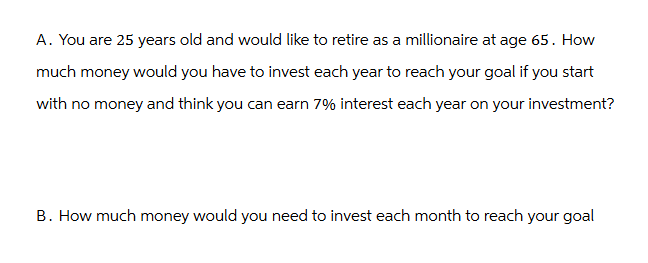 A. You are 25 years old and would like to retire as a millionaire at age 65. How
much money would you have to invest each year to reach your goal if you start
with no money and think you can earn 7% interest each year on your investment?
B. How much money would you need to invest each month to reach your goal
This is AI generated Response.
Asked by: gvr
Created at: 2025-08-05 21:07:02
Asked by: gvr
Created at: 2025-08-05 21:07:02
Final Answer:
Rendered
Raw Text
Did you like this answer?
Let's break down the solution step by step:
---
### **A. Annual Investment Needed**
**Given:**
- Current age = **25 years**
- Retirement age = **65 years**
- Years to invest = **65 - 25 = 40 years**
- Future Value (FV) = **$1,000,000**
- Interest rate (r) = **7% per year**
- Initial investment = **$0**
- Payments are made **at the end of each year** (ordinary annuity)
#### **Step 1: Use the Future Value of an Ordinary Annuity Formula**
\[
FV = PMT \times \frac{(1 + r)^n - 1}{r}
\]
Where:
- \( FV \) = Future Value ($1,000,000)
- \( PMT \) = Payment per period (what we want to find)
- \( r \) = annual interest rate (7% = 0.07)
- \( n \) = number of periods (40 years)
#### **Step 2: Plug in the Values**
\[
1,000,000 = PMT \times \frac{(1 + 0.07)^{40} - 1}{0.07}
\]
Calculate \((1 + 0.07)^{40}\):
\[
(1.07)^{40} \approx 14.974
\]
\[
\frac{(1.07)^{40} - 1}{0.07} = \frac{14.974 - 1}{0.07} = \frac{13.974}{0.07} \approx 199.63
\]
#### **Step 3: Solve for PMT**
\[
1,000,000 = PMT \times 199.63
\]
\[
PMT = \frac{1,000,000}{199.63} \approx \$5,010.38
\]
---
### **Final Answer for A:**
**You need to invest approximately \$5,010.38 at the end of each year to reach \$1,000,000 by age 65.**
---
### **B. Monthly Investment Needed**
Now, let's find the monthly investment amount.
#### **Step 1: Convert Parameters to Monthly**
- Number of months: \( 40 \times 12 = 480 \)
- Monthly interest rate: \( \frac{0.07}{12} = 0.005833 \)
#### **Step 2: Use the Future Value of an Ordinary Annuity Formula (monthly)**
\[
FV = PMT \times \frac{(1 + r_{monthly})^{n_{months}} - 1}{r_{monthly}}
\]
Plug in the values:
\[
1,000,000 = PMT \times \frac{(1 + 0.005833)^{480} - 1}{0.005833}
\]
Calculate \((1.005833)^{480}\):
\[
(1.005833)^{480} \approx 16.445
\]
\[
\frac{16.445 - 1}{0.005833} = \frac{15.445}{0.005833} \approx 2,647.81
\]
#### **Step 3: Solve for PMT**
\[
PMT = \frac{1,000,000}{2,647.81} \approx \$377.60
\]
---
### **Final Answer for B:**
**You need to invest approximately \$377.60 at the end of each month to reach \$1,000,000 by age 65.**
---
#### **Summary Table**
| Investment Frequency | Amount to Invest |
|---------------------|------------------|
| Yearly | \$5,010.38 |
| Monthly | \$377.60 |
Let me know if you need further explanation or calculations!
Question:
part b calculations are wrong please calculate part b detailed
This is AI generated Response.
Asked by: gvr
Created at: 2025-08-05 21:11:42
Asked by: gvr
Created at: 2025-08-05 21:11:42
Final Answer:
Rendered
Raw Text
Did you like this answer?
Let's carefully recalculate Part B (monthly investment needed) with detailed steps:
---
### **Part B: How much money would you need to invest each month?**
**Goal:** To accumulate **\$1,000,000** in **40 years** (from age 25 to 65) with **monthly investments** at an interest rate of **7% annually**, compounded monthly.
---
### **Given Data:**
- Future Value, \( FV = \$1,000,000 \)
- Annual interest rate, \( r_{annual} = 7\% = 0.07 \)
- Total years, \( n_{years} = 40 \)
- Number of months, \( n_{months} = 40 \times 12 = 480 \)
- Monthly interest rate, \( r_{monthly} = \frac{0.07}{12} \approx 0.0058333 \)
---
### **Step 1: Use the Future Value of an Ordinary Annuity Formula (monthly payments):**
\[
FV = PMT \times \frac{(1 + r_{monthly})^{n_{months}} - 1}{r_{monthly}}
\]
Where:
- \( PMT \) = monthly payment (what we want to find)
---
### **Step 2: Calculate \( (1 + r_{monthly})^{n_{months}} \):**
\[
(1 + 0.0058333)^{480}
\]
Calculate:
\[
\ln(1 + 0.0058333) \approx 0.005820
\]
\[
0.005820 \times 480 \approx 2.7936
\]
Exponentiate:
\[
e^{2.7936} \approx 16.36
\]
Alternatively, directly:
\[
(1.0058333)^{480} \approx 16.36
\]
---
### **Step 3: Calculate the annuity factor:**
\[
\frac{(1 + r_{monthly})^{n_{months}} - 1}{r_{monthly}} = \frac{16.36 - 1}{0.0058333} = \frac{15.36}{0.0058333} \approx 2,634.48
\]
---
### **Step 4: Solve for \( PMT \):**
\[
PMT = \frac{FV}{\text{Annuity factor}} = \frac{1,000,000}{2,634.48} \approx \$379.76
\]
---
### **Final Answer:**
**You need to invest approximately \$379.76 each month at the end of the month to reach \$1,000,000 in 40 years at 7% annual interest compounded monthly.**
---
### **Summary:**
| Investment Type | Monthly Investment |
|------------------|---------------------|
| Monthly | **\$379.76** |
---
**Note:** Slight variations in the exponential calculations can occur depending on rounding. Using precise calculator functions or financial calculator software can improve accuracy.
Let me know if you'd like further clarification!
📢 Instructions:
- Ask anything relatd to above question only.
- For new Question goto :