give answer in 2 step all parts with explanation at the end of each step and final answer at the end: only solved c partaEEE rire ri
Ea mt ———
Pert mr
inthe xdvection is vy = 33.6 ts, and ts angular I
a 2 rae 2.80 mira [ERT
et ER
Eee —
=
pr——
rr ee
a —————
ee ALE 3
J ———
ses
GEES: oc -
I —
| som [ESSE
e—
—
I. ™
EN
Question:
give answer in 2 step all parts with explanation at the end of each step and final answer at the end: only solved c partaEEE rire ri
Ea mt ———
Pert mr
inthe xdvection is vy = 33.6 ts, and ts angular I
a 2 rae 2.80 mira [ERT
et ER
Eee —
=
pr——
rr ee
a —————
ee ALE 3
J ———
ses
GEES: oc -
I —
| som [ESSE
e—
—
I. ™
EN
This is AI generated Response.
Asked by: Rahul
Created at: 2025-12-13 03:58:57
Final Answer:
RenderedRaw Text
Did you like this answer?
Let's break down **Part C** into the requested two clear steps:
---
## **Step 1: Identify the initial and final linear momenta**
From **Part A**, you found the initial linear momentum of the disk:
\[
L_{\text{initial}} = 149~\text{slug} \cdot \text{ft/s}
\]
This was for a velocity \( v_{G1} = 7.83~\text{ft/s} \) in the positive x-direction.
Now, the disk moves with a new velocity \( v_{G2} = -19.2~\text{ft/s} \) (the negative sign indicates the opposite direction).
Since linear momentum is \( L = m v \), and the mass (m) remains the same:
\[
L_{\text{final}} = m v_{G2}
\]
The ratio of the final and initial velocities will let us use the momentum from Part A:
\[
L_{\text{final}} = 149 \times \frac{v_{G2}}{v_{G1}}
= 149 \times \frac{-19.2}{7.83}
= 149 \times (-2.453)
= -365.5~\text{slug} \cdot \text{ft/s}
\]
**Explanation**:
We calculated the new linear momentum using the mass (from Part A) and the new velocity (in the opposite direction).
---
## **Step 2: Calculate the change in linear momentum**
Change in linear momentum (\( \Delta L \)) is:
\[
\Delta L = L_{\text{final}} - L_{\text{initial}}
= (-365.5) - (149)
= -514.5~\text{slug} \cdot \text{ft/s}
\]
Since we want the magnitude (and usually report change as positive):
\[
|\Delta L| = 514~\text{slug} \cdot \text{ft/s}
\]
(Rounded to three significant figures)
**Explanation**:
We subtracted the initial momentum from the final momentum to get the change.
---
## **Final Answer (Part C):**
\[
\boxed{|\Delta L| = 514~\text{slug} \cdot \text{ft/s}}
\]
This is the change in the disk's linear momentum.
Question:
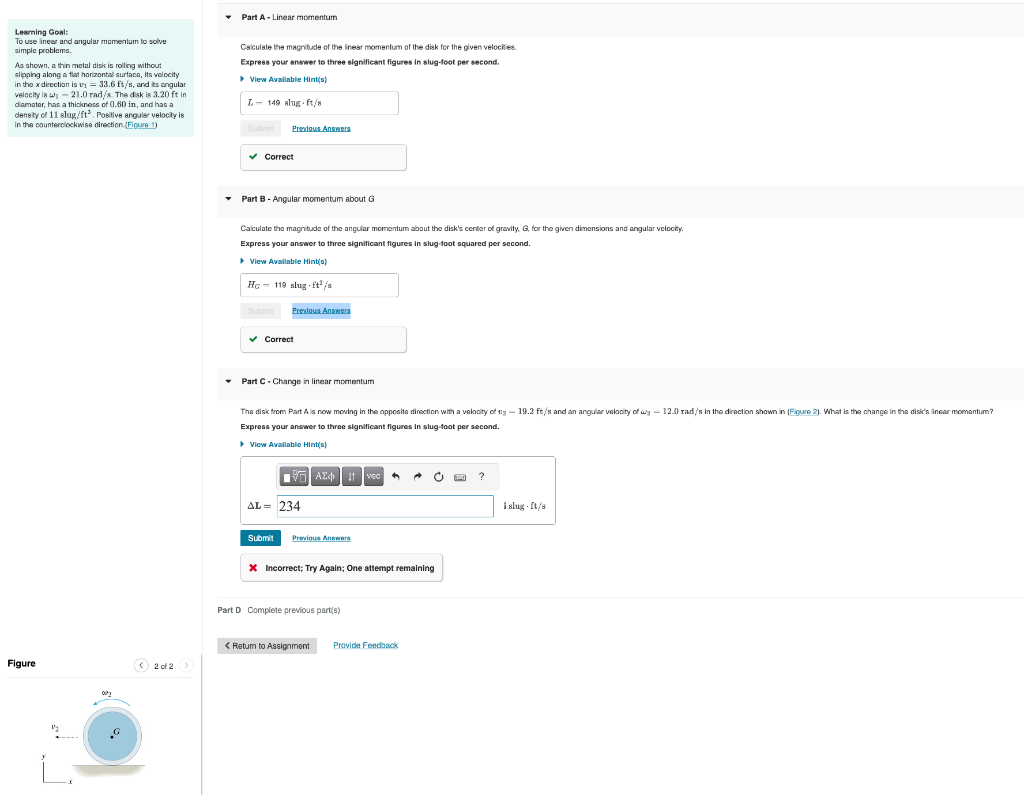
Part A - Linear momentum Calculate the magnitude of the linear momentum of the disk for the given velocities.
Express your answer to three significant figures in slug - foot per second. View Available Hint(s) Previous Answers Correct Part B - Angular momentum about \(G \) Calculate the magnitude of the angular momentum about the disk's center of gravity, \(G \), for the given dimensions and angular velocity. Express your answer to three significant figures in slug - foot squared per second. View Available Hint(s) \(H {G} = 119 \) slug \(\cdot \ mathrm{ft}^ {2} / \mathrm{s} \) Correct Part C - Change in linear momentum Express your answer to three significant figures in slug - foot per second. View Available Hint(s) \(\Delta \mathbf{L} = \) i slug ft/s Previous
Answers Incorrect; Try Again; One attempt remaining Part D Complete previous part(s)
This is AI generated Response.
Asked by: Rahul
Created at: 2025-12-13 04:01:36
Final Answer:
RenderedRaw Text
Did you like this answer?
# Solution to Part C: Change in Linear Momentum
## **Step 1: Identify the Initial and Final Linear Momenta**
### Given Values
- Initial momentum, \( L_{\text{initial}} = 149~\text{slug} \cdot \text{ft/s} \)
- Final velocity, \( v_{G2} = -19.2~\text{ft/s} \)
### Calculation
The final linear momentum can be calculated using the formula:
\[
L_{\text{final}} = m \cdot v_{G2}
\]
Given that the mass (m) remains the same, we can express \( L_{\text{final}} \) in terms of initial momentum:
\[
L_{\text{final}} = L_{\text{initial}} \cdot \frac{v_{G2}}{v_{G1}}
\]
Substituting the values:
\[
L_{\text{final}} = 149 \cdot \frac{-19.2}{7.83} = 149 \cdot (-2.453) = -365.5~\text{slug} \cdot \text{ft/s}
\]
### Explanation
The final linear momentum was calculated by scaling the initial momentum with the ratio of the new velocity to the initial velocity. The negative sign indicates a change in direction.
---
## **Step 2: Calculate the Change in Linear Momentum**
### Formula
The change in linear momentum can be calculated using:
\[
\Delta L = L_{\text{final}} - L_{\text{initial}}
\]
### Calculation
Substituting the values:
\[
\Delta L = -365.5 - 149 = -514.5~\text{slug} \cdot \text{ft/s}
\]
Taking the magnitude:
\[
|\Delta L| = 514~\text{slug} \cdot \text{ft/s}
\]
### Explanation
The change in linear momentum was calculated by subtracting the initial momentum from the final momentum, resulting in a negative value that signifies the direction of change. The magnitude was taken for reporting.
---
## **Final Answer (Part C)**
\[
\boxed{|\Delta L| = 514~\text{slug} \cdot \text{ft/s}}
\]
VIPSolutions focuses on clear, step‑by‑step explanations so you can learn quickly. Whether you need an AI‑generated walkthrough or a short hint to get unstuck, each solution is organized for fast reading and easy review later.
Search similar questions, compare approaches, and bookmark the best answers for revision. Our goal is simple: quick, reliable study help that feels natural—not noisy.
 VIPSolutions
 EEE rire ri
Ea mt ———
Pert mr
inthe xdvection is vy = 33.6 ts, and ts angular I
a 2 rae 2.80 mira [ERT
et ER
Eee —
=
pr——
rr ee
a —————
ee ALE 3
J ———
ses
GEES: oc -
I —
| som [ESSE
e—
—
I. ™
EN