VIPSolutions logo ✨ VIPSolutions

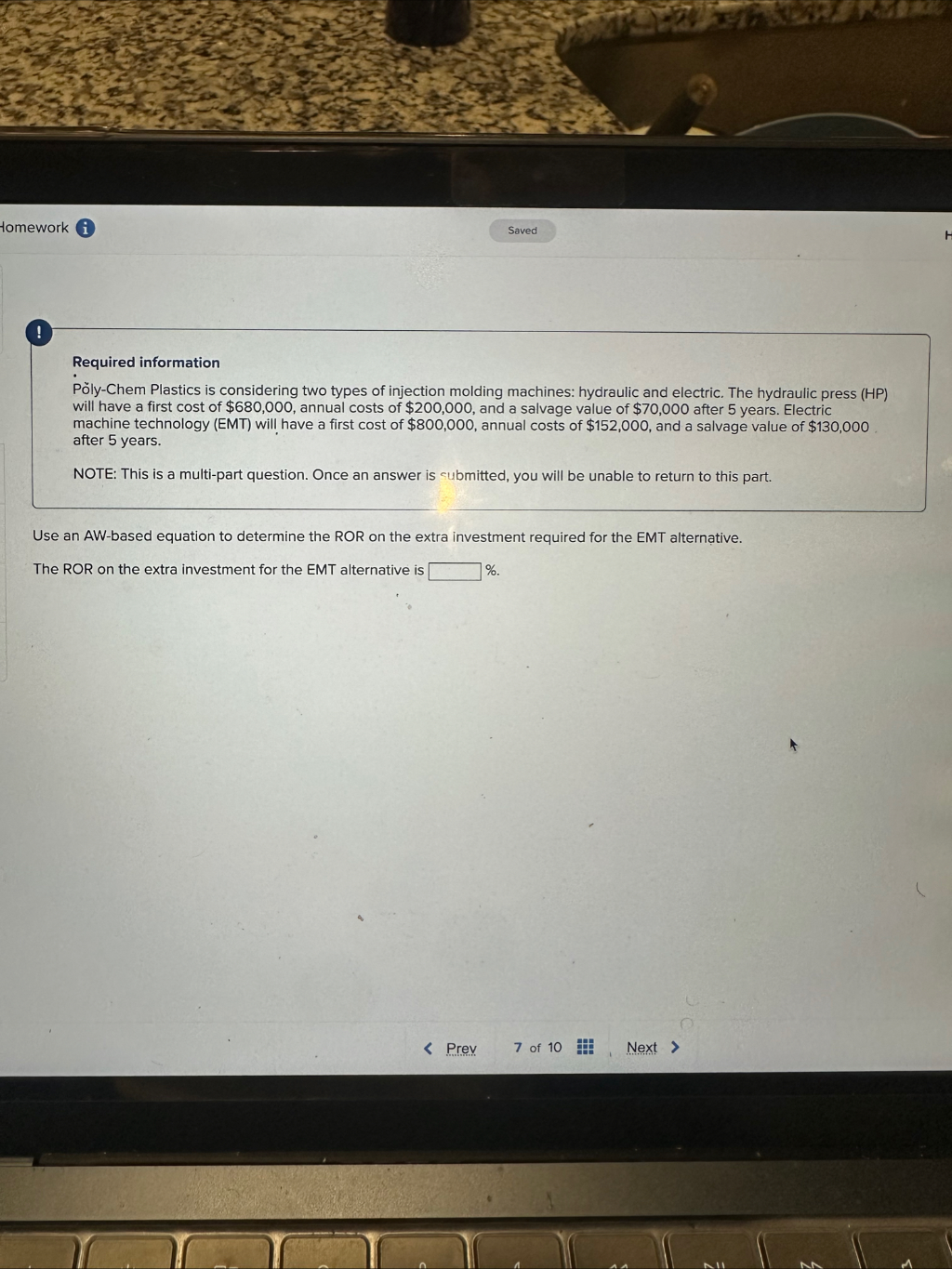
P ö ly - Chem Plastics is considering two types of injection molding machines: hydraulic and electric. The hydraulic press ( HP ) will have a first cost of $ 6 8 0 , 0 0 0 , annual costs of $ 2 0 0 , 0 0 0 , and a salvage value of $ 7 0 , 0 0 0 after 5 years. Electric machine technology ( EMT ) will have a first cost of $ 8 0 0 , 0 0 0 , annual costs of $ 1 5 2 , 0 0 0 , and a salvage value of $ 1 3 0 , 0 0 0 after 5 years. NOTE: This is a multi - part question. Once an answer is submitted, you will be unable to return to this part. Use an AW - based equation to determine the ROR on the extra investment required for the EMT alternative. The ROR on the extra investment for the EMT alternative is ◻ % .SO a ga JF ~~ A ad oy a % ade ee oe Si RY 52 Aes = ~3 (NS Fo SAD Or Fw Bon TRE fn ei SR 3 Cpr ia SE RK = Fo Si RSSOE gen A, a 5 > XH oa) GD on 2 SESLEELE Ras MTA — a LE 5 ee Lv Ee la __ A - fomework Seved r Required information Pély-Chem Plastics is considering two types of injection molding machines: hydraulic and electric. The hydraulic press (HP) will have a first cost of $680,000, annual costs of $200,000, and a salvage value of $70,000 after 5 years. Electric machine technology (EMT) will have a first cost of $800,000, annual costs of $152,000, and a salvage value of $130,000 after 5 years NOTE: This is a multi-part question. Once an answer is fs EX ” — X( ( (( { TE CM) (Ge (C (
Question:

P ö ly - Chem Plastics is considering two types of injection molding machines: hydraulic and electric. The hydraulic press ( HP ) will have a first cost of $ 6 8 0 , 0 0 0 , annual costs of $ 2 0 0 , 0 0 0 , and a salvage value of $ 7 0 , 0 0 0 after 5 years. Electric machine technology ( EMT ) will have a first cost of $ 8 0 0 , 0 0 0 , annual costs of $ 1 5 2 , 0 0 0 , and a salvage value of $ 1 3 0 , 0 0 0 after 5 years. NOTE: This is a multi - part question. Once an answer is submitted, you will be unable to return to this part. Use an AW - based equation to determine the ROR on the extra investment required for the EMT alternative. The ROR on the extra investment for the EMT alternative is ◻ % .Uploaded ImageSO a ga JF ~~ A ad oy a % ade ee oe Si RY 52 Aes = ~3 (NS Fo SAD Or Fw Bon TRE fn ei SR 3 Cpr ia SE RK = Fo Si RSSOE gen A, a 5 > XH oa) GD on 2 SESLEELE Ras MTA — a LE 5 ee Lv Ee la __ A - fomework Seved r Required information Pély-Chem Plastics is considering two types of injection molding machines: hydraulic and electric. The hydraulic press (HP) will have a first cost of $680,000, annual costs of $200,000, and a salvage value of $70,000 after 5 years. Electric machine technology (EMT) will have a first cost of $800,000, annual costs of $152,000, and a salvage value of $130,000 after 5 years NOTE: This is a multi-part question. Once an answer is fs EX ” — X( ( (( { TE CM) (Ge (C (

This is AI generated Response.
Asked by: Veera manikanta
Created at: 2025-07-29 10:34:21

Final Answer:

Rendered Raw Text
Did you like this answer?
Let's break down the problem and solve for the **Rate of Return (ROR)** on the extra investment for the EMT alternative using the **Annual Worth (AW)** approach. ### **Given Data** | | HP | EMT | |--------------------|---------------------|---------------------| | First Cost | $680,000 | $800,000 | | Annual Cost | $200,000 | $152,000 | | Salvage Value | $70,000 | $130,000 | | Life | 5 years | 5 years | --- ### **Step 1: Find the Difference (EMT - HP)** - **ΔFirst Cost**: $800,000 - $680,000 = **$120,000** - **ΔAnnual Cost**: $152,000 - $200,000 = **-$48,000** - **ΔSalvage Value**: $130,000 - $70,000 = **$60,000** --- ### **Step 2: Set Up the AW Equation** The incremental cash flow is: - Initial Cost: **-$120,000** - Annual Cost: **+$48,000** (since it's an annual savings) - Salvage Value: **+$60,000** (received at year 5) The AW equation for ROR (\(i\)) is: \[ 0 = -\$120,000 + \$48,000 \cdot (P/A, i, 5) + \$60,000 \cdot (P/F, i, 5) \] Where: - \( (P/A, i, 5) \) is the Present Worth factor for an annuity (5 years) - \( (P/F, i, 5) \) is the Present Worth factor for a single future amount --- ### **Step 3: Plug in the Factors** \[ 0 = -120,000 + 48,000(P/A, i, 5) + 60,000(P/F, i, 5) \] Where: - \( (P/A, i, 5) = \frac{1 - (1+i)^{-5}}{i} \) - \( (P/F, i, 5) = (1+i)^{-5} \) --- ### **Step 4: Solve for ROR (Iteratively or Using Financial Calculator)** Let's try an approximate solution by trial and error or spreadsheet: #### Let’s try **i = 30%** (0.30): \[ (P/A, 0.30, 5) = \frac{1 - (1.3)^{-5}}{0.3} = \frac{1 - 0.237}{0.3} = \frac{0.763}{0.3} \approx 2.543 \] \[ (P/F, 0.30, 5) = (1.3)^{-5} \approx 0.237 \] Plug into the equation: \[ 0 = -120,000 + 48,000 \times 2.543 + 60,000 \times 0.237 \] \[ 0 = -120,000 + 122,064 + 14,220 \] \[ 0 = 16,284 \] This is positive, so try a higher rate. #### Try **i = 40%** (0.40): \[ (P/A, 0.40, 5) = \frac{1 - (1.4)^{-5}}{0.4} = \frac{1 - 0.186}{0.4} = \frac{0.814}{0.4} = 2.035 \] \[ (P/F, 0.40, 5) = (1.4)^{-5} = 0.186 \] Plug in: \[ 0 = -120,000 + 48,000 \times 2.035 + 60,000 \times 0.186 \] \[ 0 = -120,000 + 97,680 + 11,160 \] \[ 0 = -120,000 + 108,840 = -11,160 \] Now it's negative. So the actual ROR is between **30%** and **40%**. --- ### **Step 5: Interpolate** Linear interpolation: \[ \text{ROR} \approx 30\% + \frac{16,284}{16,284 + 11,160} \times (40\% - 30\%) \] \[ = 30\% + \frac{16,284}{27,444} \times 10\% \] \[ = 30\% + 0.5936 \times 10\% \] \[ = 30\% + 5.94\% \] \[ \approx \boxed{36\%} \] --- ## **Final Answer** **The ROR on the extra investment for the EMT alternative is approximately:** \[ \boxed{36\%} \] --- If you want a more exact number, use a financial calculator or Excel's IRR function for more precise calculation. But **36%** is a well-interpolated answer.

📢 Instructions:

  • Ask anything relatd to above question only.
  • For new Question goto :

Study Help, Fast Answers

VIPSolutions focuses on clear, step‑by‑step explanations so you can learn quickly. Whether you need an AI‑generated walkthrough or a short hint to get unstuck, each solution is organized for fast reading and easy review later.

Search similar questions, compare approaches, and bookmark the best answers for revision. Our goal is simple: quick, reliable study help that feels natural—not noisy.