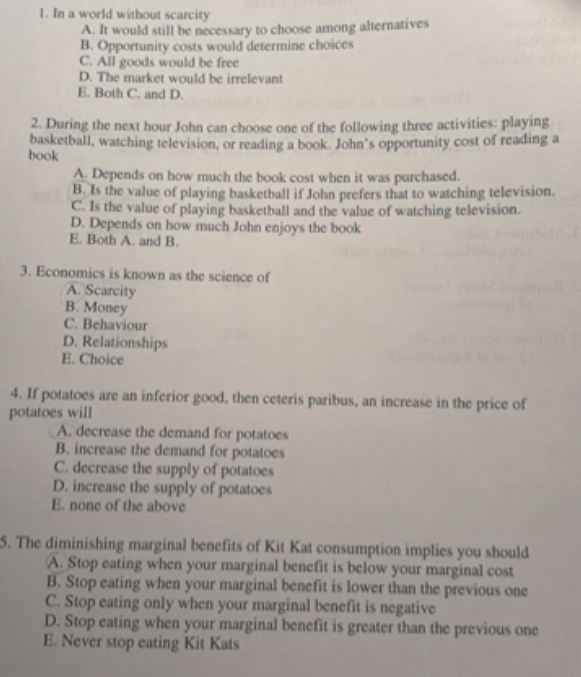
Give step-by-step solution with explanation and final answer:1. In a world without scarcity
re would stl be mecessary to choose among aeratives
B. Opportunity costs would determine choices
C. All goods would be free
D. The market would be irrelevant
E Both Cand D.
2. During the next hour Joba can choose one of the following three activities: pie
beskeihal watching television, or reading a book. John's opportunity cost of reading
A. Depends on how much the book cost when it was purchased.
B.1s the value of playing hasketball if John prefers that to watching television.
CIs the value of playing basketball and the value of waiching television.
D. Depends on bow much Joha enjoys the book
E. Both A. and B,
3. Economics is known as the science of
A Scarity
_ ClBehaviour Ie
~ D. Relationships gh
E.Choke ti
I potatoes ae an inferior good, then ceteris paribus, an increase in the price of
crease the demand for potatoes 3 sR L
the demand for potatoes a
‘ + no AR
dav be We
hss vd
Question:
Give step-by-step solution with explanation and final answer:1. In a world without scarcity
re would stl be mecessary to choose among aeratives
B. Opportunity costs would determine choices
C. All goods would be free
D. The market would be irrelevant
E Both Cand D.
2. During the next hour Joba can choose one of the following three activities: pie
beskeihal watching television, or reading a book. John's opportunity cost of reading
A. Depends on how much the book cost when it was purchased.
B.1s the value of playing hasketball if John prefers that to watching television.
CIs the value of playing basketball and the value of waiching television.
D. Depends on bow much Joha enjoys the book
E. Both A. and B,
3. Economics is known as the science of
A Scarity
_ ClBehaviour Ie
~ D. Relationships gh
E.Choke ti
I potatoes ae an inferior good, then ceteris paribus, an increase in the price of
crease the demand for potatoes 3 sR L
the demand for potatoes a
‘ + no AR
dav be We
hss vd
This is AI generated Response.
Asked by: Vikram Kumar
Created at: 2025-10-18 02:27:36
Final Answer:
RenderedRaw Text
Did you like this answer?
Let's solve each question step by step:
---
## 1. In a world without scarcity
- **Scarcity** means limited resources. If there's no scarcity:
- A. **False.** There would be no need to choose, as everything is plentiful.
- B. **False.** No need for opportunity cost if there's abundance.
- C. **True.** All goods would indeed be free.
- D. **True.** The market would serve no purpose.
- E. Both C and D.
**Final Answer: E. Both C and D.**
---
## 2. Opportunity cost of reading a book
- **Opportunity cost** is the value of the next best alternative forgone.
- John can play basketball, watch TV, or read a book.
- Opportunity cost of reading: the value of the activity *not chosen*.
- If he prefers basketball over TV, the cost is just basketball's value.
**Final Answer: B. Is the value of playing basketball if John prefers that to watching television.**
---
## 3. Economics is known as the science of
- Economics studies how people deal with **scarcity** and make choices.
**Final Answer: A. Scarcity**
---
## 4. Potatoes as an inferior good; price increase
- **Inferior good:** Demand rises when income falls.
- **Price increase** (ceteris paribus): For any good, an increase in price causes a decrease in quantity demanded.
**Final Answer: A. decrease the demand for potatoes**
---
## 5. Diminishing marginal benefits of Kit Kat consumption
- **Diminishing marginal benefit:** Each additional Kit Kat gives less satisfaction.
- Rational consumer: consume until marginal benefit = marginal cost.
**Final Answer: A. Stop eating when your marginal benefit is below your marginal cost**
---
# Summary Table
| # | Answer | Explanation |
|---|--------|-----------------------------------------------------------------------------|
| 1 | E | All goods would be free; market would be irrelevant without scarcity |
| 2 | B | Opportunity cost is the value of the most preferred forgone activity |
| 3 | A | Economics is the science of scarcity |
| 4 | A | Price increase leads to decreased demand (law of demand) |
| 5 | A | Rational choice: stop when marginal benefit < marginal cost |
Question:
Opportunity cost ,Economics studies how people deal with scarcity and make choices.,Inferior good: Demand rises when income falls.
Price increase (ceteris paribus): For any good, an increase in price causes a decrease in quantity demanded. marginal benefits means each 100 words explantion
This is AI generated Response.
Asked by: Vikram Kumar
Created at: 2025-10-18 02:46:39
Final Answer:
RenderedRaw Text
Did you like this answer?
# Key Economic Concepts Explained
## Opportunity Cost
Opportunity cost refers to the value of the next best alternative that is forgone when making a choice. It represents what you sacrifice to pursue a particular action. For example, if you choose to spend time studying instead of working, the opportunity cost is the income you could have earned during that time. Understanding opportunity costs helps individuals and businesses make informed decisions by weighing the benefits of various options.
## Scarcity in Economics
Scarcity is a fundamental concept in economics, indicating that resources are limited while human wants are virtually unlimited. This imbalance necessitates choices, as individuals and societies must prioritize certain needs and desires over others. Economics studies how people allocate their limited resources to maximize utility and satisfaction. The presence of scarcity leads to trade-offs and the need for efficient resource management.
## Inferior Goods
Inferior goods are a type of good whose demand increases when consumer income decreases. This contrasts with normal goods, for which demand rises with income. For instance, if people experience a drop in income, they might buy more generic brands or lower-quality products instead of premium options. Understanding the behavior of inferior goods is crucial for businesses and policymakers, as it helps predict demand fluctuations during economic changes.
## Price Increase and Demand
The law of demand states that, ceteris paribus (all else being equal), an increase in the price of a good leads to a decrease in the quantity demanded. Consumers will typically seek alternatives or reduce consumption as prices rise. For example, if the price of potatoes increases, consumers might purchase fewer potatoes or switch to other carbohydrate sources. This relationship is vital for understanding market dynamics and consumer behavior.
## Marginal Benefits
Marginal benefits refer to the additional satisfaction or utility gained from consuming one more unit of a good or service. As consumption increases, the marginal benefit tends to diminish, meaning each additional unit provides less added value than the previous one. Rational consumers aim to maximize their utility by continuing consumption until the marginal benefit equals the marginal cost. This principle helps explain consumer choices and demand patterns in the market.
VIPSolutions focuses on clear, step‑by‑step explanations so you can learn quickly. Whether you need an AI‑generated walkthrough or a short hint to get unstuck, each solution is organized for fast reading and easy review later.
Search similar questions, compare approaches, and bookmark the best answers for revision. Our goal is simple: quick, reliable study help that feels natural—not noisy.
 VIPSolutions
 1. In a world without scarcity
re would stl be mecessary to choose among aeratives
B. Opportunity costs would determine choices
C. All goods would be free
D. The market would be irrelevant
E Both Cand D.
2. During the next hour Joba can choose one of the following three activities: pie
beskeihal watching television, or reading a book. John's opportunity cost of reading
A. Depends on how much the book cost when it was purchased.
B.1s the value of playing hasketball if John prefers that to watching television.
CIs the value of playing basketball and the value of waiching television.
D. Depends on bow much Joha enjoys the book
E. Both A. and B,
3. Economics is known as the science of
A Scarity
_ ClBehaviour Ie
~ D. Relationships gh
E.Choke ti
I potatoes ae an inferior good, then ceteris paribus, an increase in the price of
crease the demand for potatoes 3 sR L
the demand for potatoes a
‘ + no AR
dav be We
hss vd