 VIPSolutions
only solve question 1 completeleyER ) Tr — 3 KQ of steam at 5 bar, entropy 5.5 ky/(kg K), is heated revers, bly at constant pr ntl the tem nperature is 300°C. Calculate the heat supplied and show on a T-S diagra i rea whic! represents the heat flow. (15 marks) E — b) Explain the application of the first and second laws of thermodynamics in a Rankine ~ cycle-based thermal power plant. (5 marks) Pr.
Question:
only solve question 1 completeley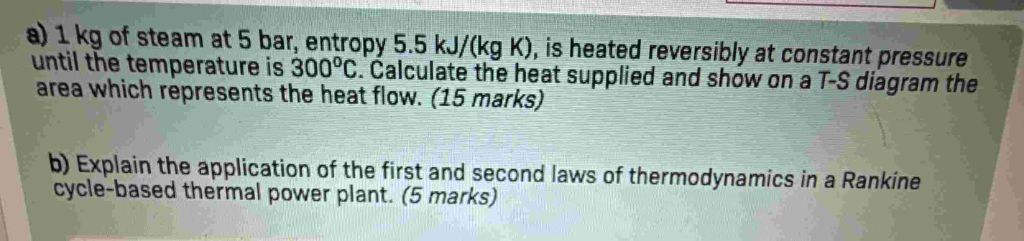 ER
) Tr — 3
KQ of steam at 5 bar, entropy 5.5 ky/(kg K), is heated revers, bly at constant pr
ntl the tem nperature is 300°C. Calculate the heat supplied and show on a T-S diagra i
rea whic! represents the heat flow. (15 marks) E —
b) Explain the application of the first and second laws of thermodynamics in a Rankine
~ cycle-based thermal power plant. (5 marks) Pr.
This is AI generated Response.
Asked by: manish kumar
Created at: 2025-12-03 09:11:03
Asked by: manish kumar
Created at: 2025-12-03 09:11:03
Final Answer:
Rendered
Raw Text
Did you like this answer?
# Solution to Question 1
### Given Data
- **Mass of steam, \( m \) = 1 kg**
**Initial pressure, \( P =5 \)**
- ** entropy, \(_1 =5.5 \) kJ/(kg·K)**
- **Final temperature, \( T_2 = 300^\circ C \)**
- **Process: Reversible, constant pressure**
Let's solve step by step.
---
## Step 1: Find Initial and Final States
### **Initial State (State 1):**
- \( P_1 = 5 \) bar
- \( s_1 = 5.5 \) kJ/(kg·K)
Use steam tables to determine the properties at 5 bar:
- At 5 bar, saturated vapor:
- \( s_g = 6.821 \) kJ/(kg·K)
- \( T_{sat} = 151.86^\circ C \)
Since \( s_1 < s_g \), it is a mixture or subcooled vapor. But \( s_1 \) is quite close to the typical entropy of vapor, so let's check quality:
\[
x_1 = \frac{s_1 - s_f}{s_g - s_f}
\]
Where:
- \( s_f \) at 5 bar = 1.939 kJ/(kg·K)
\[
x_1 = \frac{5.5 - 1.939}{6.821 - 1.939} = \frac{3.561}{4.882} \approx .73
\]
So, the initial state is a mixture with quality \( x_1 = .73 \).
### **Final State (State 2):**
- \( P_2 = 5 \) bar
- \( T_2 = 300^\circ C \)
At 5 bar, the steam is **superheated** at 300°C.
---
## Step 2: Find Enthalpy at States
### **At State 1:**
\[
h_1 = h_f + x_1 (h_g - h_f)
\]
From steam tables at 5 bar:
- \( h_f = 640.09 \) kJ/kg
- \( h_g = 2748.7 \) kJ/kg
\[
h_1 = 640.09 + .73 \times (2748.7 - 640.09)
\]
\[
h_1 = 640.09 + .73 \times 2108.61
\]
\[
h_1 = 640.09 + 1549.29 = 2189.38 \text{ kJ/kg}
\]
### **At State 2:**
From superheated steam tables at \( P=5 \) bar, \( T=300^\circ C \):
- \( h_2 \approx 3045. \) kJ/kg
---
## Step 3: Calculate Heat Supplied
At constant pressure, the heat supplied (\( Q \)) per kg is:
\[
Q = h_2 - h_1
\]
\[
Q = 3045. - 2189.38 = 855.62 \text{ kJ}
\]
---
## Step 4: T-s Diagram
- The area under the curve on a T-s diagram **(between \( s_1 \) and \( s_2 \) at constant pressure)** represents the heat supplied.
#### **Find \( s_2 \):**
From superheated steam tables at \( P=5 \) bar, \( T=300^\circ C \):
- \( s_2 \approx 7.013 \) kJ/(kg·K)
---
## Step 5: Final Answers
### **1. Heat Supplied:**
\[
\boxed{Q = 855.6 \text{ kJ}}
\]
### **2. T-s Diagram (Sketch):**
```
T
|
| /------------------ (State 2: 300°C, s2)
| /
| /
|------/--------------------- (P constant)
| /
| /
|---/----------------------- (State 1: mixture, s1)
|
+----------------------------- s
s1 (5.5) s2 (7.013)
```
- **Area under curve between \( s_1 \) and \( s_2 \) at \( P=5 \) bar represents the heat supplied.**
---
## **Summary Table**
| State | Pressure (bar) | Temperature (°C) | Entropy (kJ/kg·K) | Enthalpy (kJ/kg) |
|-------|----------------|------------------|--------------------|------------------|
| 1 | 5 | ≈152 | 5.5 | 2189.4 |
| 2 | 5 | 300 | 7.013 | 3045. |
---
### **Final Answers**
- **Heat supplied:** \(\boxed{855.6 \text{ kJ}}\)
- **T-s diagram:** *See sketch above; area under the P=constant line from \( s_1 \) to \( s_2 \) represents heat supplied.*
---
If you need a hand-drawn T-s diagram or a more detailed one, let me know!
📢 Instructions:
- Ask anything relatd to above question only.
- For new Question goto :