 VIPSolutions
Obtain the Thevenin and Norton equivalent circuits at terminals a a − b for the circuit shown below. Show your work step - by - step.0.52, 150 © * Oo a Vin ob
Question:
Obtain the Thevenin and Norton equivalent circuits at terminals a a
−
b for the circuit shown below. Show your work step
-
by
-
step.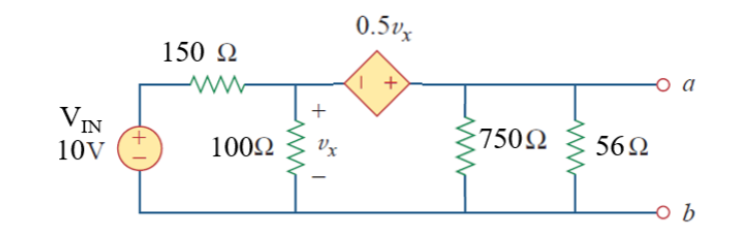 0.52,
150 © *
Oo a
Vin
ob
This is AI generated Response.
Asked by: Vinay Nani
Created at: 2025-09-02 20:59:14
Asked by: Vinay Nani
Created at: 2025-09-02 20:59:14
Final Answer:
Rendered
Raw Text
Did you like this answer?
Let’s find the **Thevenin** and **Norton** equivalents for the circuit at terminals \( a \)--\( b \).
---
## **Step 1: Find \( V_{th} \) (Open-Circuit Voltage)**
Let \( V_{ab} = V_{th} \).
Let the current through \( 150\,\Omega \) be \( I \).
### **Label \( v_x \):**
\[
v_x = \text{Voltage across 100}\,\Omega
\]
### **Node at top of 100, 750, 56, and controlled source:**
Let’s call this node \( V_x \) (with respect to \( b \)), so \( V_x = V_{ab} \).
#### **KCL at node \( V_x \):**
\[
I_{150} + 0.5v_x = I_{750} + I_{56}
\]
But let’s express all currents in terms of node voltages.
\[
\text{From left:}
\]
\[
\frac{10 - V_x}{150} + 0.5v_x = \frac{V_x}{750} + \frac{V_x}{56}
\]
But \( v_x \) is the voltage across \( 100\,\Omega \) resistor. Since its left side is connected to \( 10\,V \), and right side to \( V_x \):
\[
v_x = 10 - V_x
\]
Plug into KCL:
\[
\frac{10 - V_x}{150} + 0.5(10 - V_x) = \frac{V_x}{750} + \frac{V_x}{56}
\]
Expand:
\[
\frac{10 - V_x}{150} + 5 - 0.5V_x = \frac{V_x}{750} + \frac{V_x}{56}
\]
Multiply both sides by common denominator (let’s use 2100, the LCM of 150, 750, and 56 is 2100):
- \( \frac{10 - V_x}{150} \) × 14 = \( \frac{140 - 14V_x}{2100} \)
- \( 5 - 0.5V_x \) × 2100 = \( 10500 - 1050V_x \)
- \( \frac{V_x}{750} \) × 2.8 = \( \frac{2.8V_x}{2100} \)
- \( \frac{V_x}{56} \) × 37.5 = \( \frac{37.5V_x}{2100} \)
But let's clear denominators by multiplying the entire equation by 2100:
\[
14(10 - V_x) + 2100 \times 5 - 2100 \times 0.5 V_x = 2.8 V_x + 37.5 V_x
\]
\[
140 - 14 V_x + 10500 - 1050 V_x = 40.3 V_x
\]
Combine terms:
\[
(140 + 10500) - (14 V_x + 1050 V_x) = 40.3 V_x
\]
\[
10640 - 1064 V_x = 40.3 V_x
\]
\[
10640 = 1104.3 V_x
\]
\[
V_x = \frac{10640}{1104.3} \approx 9.64~V
\]
**So,**
\[
\boxed{V_{th} = 9.64~V}
\]
---
## **Step 2: Find \( R_{th} \) (Thevenin Resistance)**
**Zero the independent voltage source (replace with short circuit):**
Redraw the circuit:
- 150 Ω, 100 Ω, dependent source (0.5\( v_x \)), 750 Ω, 56 Ω.
Let’s apply a test voltage \( V_{test} \) at terminals \( ab \) and find \( I_{test} \).
Let node \( a \) be at \( V_{test} \) (relative to \( b \)).
Let the node between the 150 Ω and 100 Ω (let’s call it node N) be at voltage \( V \).
### **KCL at node N:**
The current through 150 Ω is \( \frac{0 - V}{150} \), through 100 Ω is \( \frac{V - V_{test}}{100} \), and the controlled source injects \( 0.5(V - V_{test}) \) into node a.
At node a (V_{test}):
\[
\text{Sum of currents leaving:}
\]
\[
\frac{V_{test} - V}{100} - 0.5(V - V_{test}) + \frac{V_{test}}{750} + \frac{V_{test}}{56} = I_{test}
\]
But let's solve for \( R_{th} = \frac{V_{test}}{I_{test}} \).
**From the left mesh:**
\[
\frac{0 - V}{150} = \frac{V - V_{test}}{100}
\]
\[
- V/150 = (V - V_{test})/100
\]
\[
- V/150 \times 100 = V - V_{test}
\]
\[
-(2/3) V = V - V_{test}
\]
\[
-(2/3) V - V = - V_{test}
\]
\[
-(5/3) V = - V_{test}
\]
\[
V_{test} = \frac{5}{3} V
\]
\[
V = \frac{3}{5} V_{test}
\]
Now, \( v_x = V - V_{test} = \frac{3}{5}V_{test} - V_{test} = -\frac{2}{5} V_{test} \).
The dependent source injects \( 0.5 v_x = 0.5 \left(-\frac{2}{5} V_{test}\right) = -\frac{1}{5} V_{test} \) into node a.
Now, sum currents leaving node a (\( V_{test} \)):
\[
\text{Through 100 Ω: } \frac{V_{test} - V}{100}
\]
\[
\text{Through 750 Ω: } \frac{V_{test}}{750}
\]
\[
\text{Through 56 Ω: } \frac{V_{test}}{56}
\]
\[
\text{Through dependent source: } -\frac{1}{5} V_{test}
\]
Sum:
\[
I_{test} = \frac{V_{test} - V}{100} + \frac{V_{test}}{750} + \frac{V_{test}}{56} - \frac{1}{5} V_{test}
\]
But \( V = \frac{3}{5} V_{test} \):
\[
I_{test} = \frac{V_{test} - \frac{3}{5} V_{test}}{100} + \frac{V_{test}}{750} + \frac{V_{test}}{56} - \frac{1}{5} V_{test}
\]
\[
= \frac{\frac{2}{5} V_{test}}{100} + \frac{V_{test}}{750} + \frac{V_{test}}{56} - \frac{1}{5} V_{test}
\]
\[
= \frac{2 V_{test}}{500} + \frac{V_{test}}{750} + \frac{V_{test}}{56} - \frac{V_{test}}{5}
\]
Let’s find a common denominator (the LCM of 500, 750, 56, 5):
- \( 500 = 2^2 \times 5^3 \)
- \( 750 = 2 \times 3 \times 5^3 \)
- \( 56 = 2^3 \times 7 \)
- \( 5 \)
LCM is \( 2^3 \times 3 \times 5^3 \times 7 = 8 \times 3 \times 125 \times 7 = 24 \times 125 \times 7 = 3000 \times 7 = 21,000 \)
So:
- \( \frac{2}{500} = \frac{2 \times 42}{21,000} = \frac{84}{21,000} \)
- \( \frac{1}{750} = \frac{1 \times 28}{21,000} = \frac{28}{21,000} \)
- \( \frac{1}{56} = \frac{1 \times 375}{21,000} = \frac{375}{21,000} \)
- \( -\frac{1}{5} = -\frac{1 \times 4,200}{21,000} = -\frac{4,200}{21,000} \)
Sum:
\[
I_{test} = \left( \frac{84 + 28 + 375 - 4,200}{21,000} \right) V_{test}
\]
\[
= \left( \frac{487 - 4,200}{21,000} \right) V_{test}
\]
\[
= \left( \frac{-3,713}{21,000} \right) V_{test}
\]
So,
\[
R_{th} = \frac{V_{test}}{I_{test}} = \frac{V_{test}}{ -\frac{3,713}{21,000} V_{test}}
= -\frac{21,000}{3,713}
\approx -5.66\, \Omega
\]
Negative resistance means that the circuit is **active** (because of the dependent source)! This can happen in circuits with dependent sources.
---
### **Summary:**
#### **Thevenin Equivalent:**
\[
\boxed{
V_{th} = 9.64\,V, \quad
R_{th} = -5.66\,\Omega
}
\]
#### **Norton Equivalent:**
\[
I_N = \frac{V_{th}}{R_{th}} = \frac{9.64}{-5.66} \approx -1.70\,A
\]
\[
\boxed{
I_N = -1.70\,A, \quad
R_N = -5.66\,\Omega
}
\]
---
### **Final Answers:**
- **Thevenin:** \( 9.64\,V \) in series with \( -5.66\,\Omega \)
- **Norton:** \( -1.70\,A \) in parallel with \( -5.66\,\Omega \)
If you'd like a neat summary diagram, let me know!
📢 Instructions:
- Ask anything relatd to above question only.
- For new Question goto :