 VIPSolutions
Now give this answer completely without skipping even a small step of calculation and try not to give answer in long paragraphs and answer the questions by following these instructions: ?Solution should be in proper format. ?A complete answer starts with the problem's objective OR addition of available data/ information Or the right approach. ?Add all necessary steps/supporting explanations until the answer is complete. ?If there are any formulae, you should mention it. ?Write calculations in a format so it can be easily pasted in chegg equation render tool. ?Do not use Python or any code-based for calculations (Important). ?Double check the solution to accomplish the correct concept, explanation, and calculations before submitting. ✅ The Final Answer should be a simple and clear summary of the solution in lucid language. ✅ The Final Answer Step is to include the crux of the entire solution. ✅ The final answer step contains the result of the solution only in a clear & concise manner. ✅ The Final Answer should be a simple and clear summary of the solution in lucid language. ✅ Final Answer Step is to include the crux of the entire solution. ✅Final answer step contains the result of the solution only in clear & concise manner.Tightening Credit Terms Kim Mitchell, the new credit manager of the Vinson Corporation, was alarmed to find that Vinson sells on credit terms of net 90 days while industry-wide credit terms have recently been lowered to net 30 days. On annual credit sales of $2.07 million, Vinson currently averages 95 days of sales in accounts receivable. Mitchell estimates that tightening the credit terms to 30 days would reduce annual sales to $1,945,000, but accounts receivable would drop to 35 days of sales and the savings on investment in them should more than overcome any loss in profit. Vinson's variable cost ratio is 67%, taxes are 40%, and the interest rate on funds invested in receivables is 24%. Assuming a 365-day year, calculate the cost of carrying receivables under the current policy and the new policy. Enter your answers as positive values. Do not round intermediate calculations. Round your answers to the nearest dollar. Current policy: $ New policy: § Should the change in credit terms be made?
Question:
Now give this answer completely without skipping even a small step of calculation and try not to give answer in long paragraphs and answer the questions by following these instructions:
?Solution should be in proper format.
?A complete answer starts with the problem's objective OR addition of available data/ information Or the right approach.
?Add all necessary steps/supporting explanations until the answer is complete.
?If there are any formulae, you should mention it.
?Write calculations in a format so it can be easily pasted in chegg equation render tool.
?Do not use Python or any code-based for calculations (Important).
?Double check the solution to accomplish the correct concept, explanation, and calculations before submitting.
✅ The Final Answer should be a simple and clear summary of the solution in lucid language.
✅ The Final Answer Step is to include the crux of the entire solution.
✅ The final answer step contains the result of the solution only in a clear & concise manner.
✅ The Final Answer should be a simple and clear summary of the solution in lucid language.
✅ Final Answer Step is to include the crux of the entire solution.
✅Final answer step contains the result of the solution only in clear & concise manner.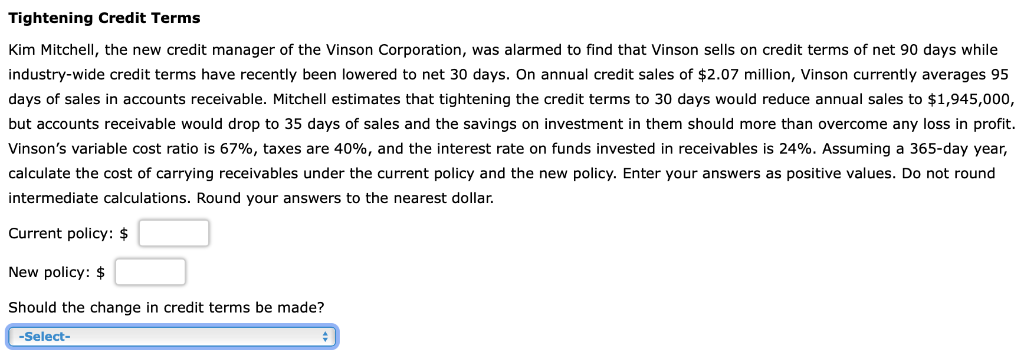 Tightening Credit Terms
Kim Mitchell, the new credit manager of the Vinson Corporation, was alarmed to find that Vinson sells on credit terms of net 90 days while
industry-wide credit terms have recently been lowered to net 30 days. On annual credit sales of $2.07 million, Vinson currently averages 95
days of sales in accounts receivable. Mitchell estimates that tightening the credit terms to 30 days would reduce annual sales to $1,945,000,
but accounts receivable would drop to 35 days of sales and the savings on investment in them should more than overcome any loss in profit.
Vinson's variable cost ratio is 67%, taxes are 40%, and the interest rate on funds invested in receivables is 24%. Assuming a 365-day year,
calculate the cost of carrying receivables under the current policy and the new policy. Enter your answers as positive values. Do not round
intermediate calculations. Round your answers to the nearest dollar.
Current policy: $
New policy: §
Should the change in credit terms be made?
Asked by: JAYANTH POTHALA
Created at: 2025-09-28 09:28:22
Final Answer:
📢 Instructions:
- Ask anything relatd to above question only.
- For new Question goto :