This is AI generated Response.
Asked by: Alok Kumar
Created at: 2026-01-27 08:15:19
Final Answer:
RenderedRaw Text
Did you like this answer?
Let's break down and **explain each part** of the problem step by step.
---
## Given Data
- Magnetic field, \( B = .5 \) T
- Maximum voltage, \( V_{e(max)} = 250 \) V
- Length of conductor, \( l = 1 \) m
- Armature resistance, \( R = 2.5 \) Ω
- Radius, \( r = .5 \) m
- Angular velocity, \( \omega = 500 \) rad/s
---
### a) **Starting the Machine with \( V_B(\text{max}) \)**
**Question:**
If the maximum instantaneous current the rotor can tolerate is 75 A, can we start the machine with \( V_B(\text{max}) \)? Why?
**Explanation:**
When starting, the machine is at rest (\(\omega = \)), so the back EMF (\(V_e\)) is zero.
- The entire applied voltage (\(V_B\)) appears across the armature resistance.
- Starting current: \( I_{start} = \frac{V_B}{R} \)
- Using \( V_B = V_{e(max)} = 250 \) V and \( R = 2.5 \) Ω:
\[
I_{start} = \frac{250}{2.5} = 100 \text{ A}
\]
- **Maximum allowed current = 75 A**, but starting current is **100 A**.
**Conclusion:**
**No, you cannot start the machine with \( V_B(\text{max}) \) because the starting current (100 A) exceeds the maximum allowed (75 A).**
---
### b) **Operating at \( \omega = 500 \) rad/s with \( V_B = V_{e(max)} \)**
**Question:**
Is the machine working as a motor or generator? Why?
**Explanation:**
- Back EMF at \(\omega = 500\) rad/s is \( V_{e(max)} = 250 \) V.
- Applied voltage \( V_B = 250 \) V.
The current in the armature:
\[
I = \frac{V_B - V_e}{R} = \frac{250 - 250}{2.5} = \text{ A}
\]
- **No current flows:** No net force, and the machine neither delivers nor absorbs mechanical energy.
**Conclusion:**
**The machine is neither acting as a motor nor a generator; it is in a "no-load" condition.**
---
### c) **Operating at \( \omega = 550 \) rad/s**
**Find Current and Direction.**
- First, calculate new back EMF:
\[
V_e = V_{e(max)} \times \frac{\omega}{500} = 250 \times \frac{550}{500} = 275 \text{ V}
\]
- Current:
\[
I = \frac{V_B - V_e}{R} = \frac{250 - 275}{2.5} = \frac{-25}{2.5} = -10 \text{ A}
\]
- **Negative current**: Means current flows from the machine to the battery (generator action).
**Conclusion:**
**The machine is acting as a generator; current flows out of the armature to the battery.**
---
### d) **Operating at \( \omega = 450 \) rad/s**
**Find Current and Direction.**
- New back EMF:
\[
V_e = 250 \times \frac{450}{500} = 225 \text{ V}
\]
- Current:
\[
I = \frac{250 - 225}{2.5} = \frac{25}{2.5} = 10 \text{ A}
\]
- **Positive current**: Current flows from battery to machine (motor action).
**Conclusion:**
**The machine is acting as a motor; current flows into the armature from the battery.**
---
### e) **At \( \omega = 600 \) rad/s: Charging Current, Power Dissipated in R, Shaft Torque**
#### **Step 1: Find Back EMF**
\[
V_e = 250 \times \frac{600}{500} = 300 \text{ V}
\]
#### **Step 2: Charging Current**
\[
I = \frac{V_B - V_e}{R} = \frac{250 - 300}{2.5} = \frac{-50}{2.5} = -20 \text{ A}
\]
- The negative sign means the current is charging the battery (generator mode).
#### **Step 3: Power Dissipated in \( R \)**
\[
P_R = I^2 R = (20)^2 \times 2.5 = 400 \times 2.5 = 100 \text{ W}
\]
#### **Step 4: Shaft Torque**
- Power delivered by the shaft: \( P_{shaft} = V_e \times I \)
- \( P_{shaft} = 300 \times 20 = 600 \) W (use absolute value of \( I \) for power calculation)
- Torque:
\[
P = \tau \omega \implies \tau = \frac{P}{\omega} = \frac{600}{600} = 10 \text{ Nm}
\]
---
## **Summary Table**
| Condition | \( V_e \) (V) | Current | Mode | Current Direction | \( P_R \) (W) | Torque (Nm) |
|------------------|:------------:|:-------:|:----------|:-------------------|:-------------:|:-----------:|
| Start | | 100 A | Motor | Into machine | 25,000 | N/A |
| 500 rad/s (b) | 250 | A | None | None | | |
| 550 rad/s (c) | 275 | -10 A | Generator | Out of machine | 250 | 5.5 |
| 450 rad/s (d) | 225 | 10 A | Motor | Into machine | 250 | 4.5 |
| 600 rad/s (e) | 300 | -20 A | Generator | Out of machine | 100 | 10 |
---
## **Key Points**
- At rest, starting current is dangerously high—**never start with full voltage**.
- If \( V_B = V_e \), no current flows.
- If \( V_e > V_B \), the machine acts as a **generator**.
- If \( V_B > V_e \), the machine acts as a **motor**.
- The direction of current tells you the mode of operation.
---
If you need further clarification on any step or formula, let me know!
Question:
not in tabular form pls
This is AI generated Response.
Asked by: Alok Kumar
Created at: 2026-01-27 08:17:11
Final Answer:
RenderedRaw Text
Did you like this answer?
# Explanation of Permanent Magnet DC Machine
## Given Data
- **Magnetic field (B)**: 0.5 T
- **Maximum voltage (V_{e(max)})**: 250 V
- **Length of conductor (l)**: 1 m
- **Armature resistance (R)**: 2.5 Ω
- **Radius (r)**: 0.5 m
- **Angular velocity (ω)**: 500 rad/s
---
## Part a: Starting the Machine with \( V_B(\text{max}) \)
### Question
If the maximum instantaneous current the rotor can tolerate is 75 A, can we start the machine with \( V_B(\text{max}) \)? Why?
### Explanation
1. At start, the machine is at rest (\(\omega = 0\)), so back EMF (\(V_e\)) is zero.
2. The entire applied voltage \(V_B\) appears across the armature resistance.
Calculating starting current:
\[
I_{start} = \frac{V_B}{R} = \frac{250}{2.5} = 100 \text{ A}
\]
### Conclusion
**No**, you cannot start the machine with \( V_B(\text{max}) \) because the starting current (100 A) exceeds the maximum allowed (75 A).
---
## Part b: Operating at \( \omega = 500 \) rad/s
### Question
Is the machine working as a motor or generator? Why?
### Explanation
- Back EMF at \(\omega = 500\) rad/s is \( V_e = 250 \) V.
- Applied voltage \( V_B = 250 \) V.
Calculating current:
\[
I = \frac{V_B - V_e}{R} = \frac{250 - 250}{2.5} = 0 \text{ A}
\]
### Conclusion
**The machine is in a "no-load" condition; it is neither acting as a motor nor a generator.**
---
## Part c: Operating at \( \omega = 550 \) rad/s
### Calculation of Current and Direction
1. New back EMF:
\[
V_e = 250 \times \frac{550}{500} = 275 \text{ V}
\]
2. Current:
\[
I = \frac{V_B - V_e}{R} = \frac{250 - 275}{2.5} = -10 \text{ A}
\]
### Conclusion
**The machine is acting as a generator; current flows out of the armature to the battery.**
---
## Part d: Operating at \( \omega = 450 \) rad/s
### Calculation of Current and Direction
1. New back EMF:
\[
V_e = 250 \times \frac{450}{500} = 225 \text{ V}
\]
2. Current:
\[
I = \frac{V_B - V_e}{R} = \frac{250 - 225}{2.5} = 10 \text{ A}
\]
### Conclusion
**The machine is acting as a motor; current flows into the armature from the battery.**
---
## Part e: At \( \omega = 600 \) rad/s
### Step 1: Find Back EMF
\[
V_e = 250 \times \frac{600}{500} = 300 \text{ V}
\]
### Step 2: Charging Current
\[
I = \frac{V_B - V_e}{R} = \frac{250 - 300}{2.5} = -20 \text{ A}
\]
- The negative sign indicates the current is charging the battery.
### Step 3: Power Dissipated in \( R \)
\[
P_R = I^2 R = (20)^2 \times 2.5 = 400 \times 2.5 = 100 \text{ W}
\]
### Step 4: Shaft Torque
- Power delivered by the shaft:
\[
P_{shaft} = V_e \times I = 300 \times 20 = 600 \text{ W}
\]
- Torque:
\[
\tau = \frac{P}{\omega} = \frac{600}{600} = 10 \text{ Nm}
\]
---
## Summary of Findings
1. **Starting Condition:** Cannot start with maximum voltage (exceeds current limit).
2. **Operating at 500 rad/s:** No current (no-load condition).
3. **Operating at 550 rad/s:** Acts as a generator with current flowing out.
4. **Operating at 450 rad/s:** Acts as a motor with current flowing in.
5. **At 600 rad/s:** Charges the battery with a current of -20 A, dissipates 100 W, and produces 10 Nm of torque.
---
If you have more questions or need further clarification, feel free to ask!
VIPSolutions focuses on clear, step‑by‑step explanations so you can learn quickly. Whether you need an AI‑generated walkthrough or a short hint to get unstuck, each solution is organized for fast reading and easy review later.
Search similar questions, compare approaches, and bookmark the best answers for revision. Our goal is simple: quick, reliable study help that feels natural—not noisy.
 VIPSolutions
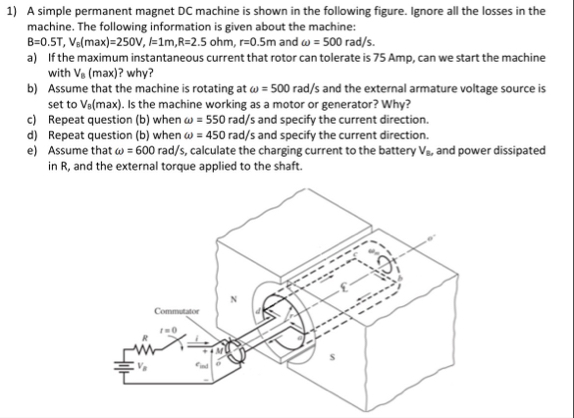 1) A simple permanent magnet DC machine is shown in the following figure. Ignore all the losses in the
‘machine. The following information is given about the machine:
B=0.5T, V(max)=250V, /=1m,R=2.5 ohm, r=0.5m and w = 500 rad/s.
a) Ifthe maximum instantaneous current that rotor can tolerate is 75 Amp, can we start the machine
with Vy (max)? why?
b) Assume that the machine is rotating at w = 500 rad/s and the external armature voltage source is.
eva. he machine worn mtr ger Wh)
©) Repeat question (b) when w = 550 rad/s and specify the current direction.
d) Repeat question (b) when w = 450 rad/s and specify the current direction.
€) Assume that w = 600 rad/s, calculate the charging current to the battery Vs, and power dissipated
Io dn sats so oer
A]
TRE |