 VIPSolutions
Act like a helpful tutor and exlain me :4. (Markov Chains - Tough) A Markov chain has transition matrix 0 1 0 1 1 P=|4 0} 010 1. Is the chain irreducible? 2. Find the stationary distribution, f it exists. 3. Is the chain ergodic?
Question:
Act like a helpful tutor and exlain me :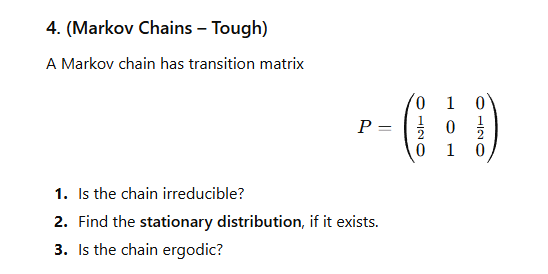 4. (Markov Chains - Tough)
A Markov chain has transition matrix
0 1 0
1 1
P=|4 0}
010
1. Is the chain irreducible?
2. Find the stationary distribution, f it exists.
3. Is the chain ergodic?
This is AI generated Response.
Asked by: Alok Kumar
Created at: 2026-01-31 07:03:50
Asked by: Alok Kumar
Created at: 2026-01-31 07:03:50
Final Answer:
Rendered
Raw Text
Did you like this answer?
Let's tackle each question step by step.
---
## 1. **Is the chain irreducible?**
A **Markov chain** is **irreducible** if you can get from any state to any other state (possibly in multiple steps).
Given the transition matrix:
\[
P = \begin{pmatrix}
& 1 & \\
\frac{1}{2} & & \frac{1}{2} \\
& 1 &
\end{pmatrix}
\]
Let's label the states as 1, 2, and 3.
- **From state 1:**
- Can go to 2 in one step (since \( P_{1,2} = 1 \))
- **From state 2:**
- Can go to 1 or 3 in one step (\( P_{2,1} = \frac{1}{2} \), \( P_{2,3} = \frac{1}{2} \))
- **From state 3:**
- Can go to 2 in one step (\( P_{3,2} = 1 \))
Let's check connectivity:
- From 1 → 2 → 3 (in 2 steps: 1→2, 2→3)
- From 3 → 2 → 1 (in 2 steps: 3→2, 2→1)
- And so on.
**Conclusion:**
**Yes, the chain is irreducible** because you can get from any state to any other state.
---
## 2. **Find the stationary distribution \(\pi\), if it exists.**
The **stationary distribution** \(\pi = (\pi_1, \pi_2, \pi_3)\) satisfies:
\[
\pi P = \pi, \quad \text{and} \quad \pi_1 + \pi_2 + \pi_3 = 1
\]
Write the equations:
\[
\begin{align*}
\pi_1 &= \cdot \pi_1 + \frac{1}{2} \pi_2 + \cdot \pi_3 \\
\pi_2 &= 1 \cdot \pi_1 + \cdot \pi_2 + 1 \cdot \pi_3 \\
\pi_3 &= \cdot \pi_1 + \frac{1}{2} \pi_2 + \cdot \pi_3
\end{align*}
\]
Which simplifies to:
\[
\begin{align*}
\pi_1 &= \frac{1}{2} \pi_2 \\
\pi_2 &= \pi_1 + \pi_3 \\
\pi_3 &= \frac{1}{2} \pi_2 \\
\pi_1 + \pi_2 + \pi_3 &= 1
\end{align*}
\]
But \(\pi_1 = \pi_3 = \frac{1}{2}\pi_2\), so:
\[
\pi_2 = \pi_1 + \pi_3 = 2 \cdot \pi_1
\]
But also, from above, \(\pi_1 + \pi_2 + \pi_3 = 1\):
\[
\pi_1 + \pi_2 + \pi_3 = \pi_1 + 2\pi_1 + \pi_1 = 4\pi_1 = 1 \implies \pi_1 = \frac{1}{4}
\]
\[
\pi_2 = 2\pi_1 = \frac{1}{2}
\]
\[
\pi_3 = \pi_1 = \frac{1}{4}
\]
**Stationary distribution:**
\[
\boxed{
\pi = \left( \frac{1}{4}, \frac{1}{2}, \frac{1}{4} \right)
}
\]
---
## 3. **Is the chain ergodic?**
A Markov chain is **ergodic** if it is:
- **Irreducible** (which we've shown)
- **Aperiodic** (the system does not get trapped in cycles of fixed length)
Let's check **aperiodicity**:
- From state 1, you can only go to 2 in one step.
- From state 2, you can go to 1 or 3 in one step.
- From state 3, you can only go to 2 in one step.
However:
- From 1, you can only return to 1 in an even number of steps (since you must go 1→2→1, which takes 2 steps, or 1→2→3→2→1, which takes 4 steps, etc.).
- Similarly for state 3.
Thus, the **period** of state 1 is 2 (since you can return only in even steps).
Likewise, for state 3.
**Conclusion:**
**The chain is not aperiodic, so it is not ergodic.**
---
## **Summary Table**
| Property | Result |
|--------------------|------------------------------------------------|
| Irreducible? | Yes |
| Stationary Dist.? | \( \left( \frac{1}{4}, \frac{1}{2}, \frac{1}{4} \right) \) |
| Ergodic? | **No** (it is periodic, not aperiodic) |
---
If you have questions about any of the steps, let me know!
Question:
not in tabular form
This is AI generated Response.
Asked by: Alok Kumar
Created at: 2026-01-31 07:10:20
Asked by: Alok Kumar
Created at: 2026-01-31 07:10:20
Final Answer:
Rendered
Raw Text
Did you like this answer?
# Markov Chains Analysis
Let's break down the analysis of the given Markov chain step by step.
## Transition Matrix
The transition matrix is given as:
\[
P = \begin{pmatrix}
0 & 1 & 0 \\
\frac{1}{2} & 0 & \frac{1}{2} \\
0 & 1 & 0
\end{pmatrix}
\]
## 1. Is the Chain Irreducible?
A Markov chain is **irreducible** if it is possible to reach any state from any other state.
### Connectivity Check:
- **From State 1:**
- Can move to State 2.
- **From State 2:**
- Can move to State 1 or State 3.
- **From State 3:**
- Can move to State 2.
### Conclusion:
You can reach any state from any other state. Therefore, **the chain is irreducible**.
---
## 2. Find the Stationary Distribution
The stationary distribution \(\pi = (\pi_1, \pi_2, \pi_3)\) satisfies:
\[
\pi P = \pi \quad \text{and} \quad \pi_1 + \pi_2 + \pi_3 = 1
\]
### Setting Up Equations:
From \(\pi P = \pi\):
1. \(\pi_1 = \frac{1}{2} \pi_2\)
2. \(\pi_2 = \pi_1 + \pi_3\)
3. \(\pi_3 = \frac{1}{2} \pi_2\)
### Normalization Condition:
\[
\pi_1 + \pi_2 + \pi_3 = 1
\]
### Solving the Equations:
Substituting \(\pi_1\) and \(\pi_3\) in terms of \(\pi_2\):
- From (1): \(\pi_1 = \frac{1}{2} \pi_2\)
- From (3): \(\pi_3 = \frac{1}{2} \pi_2\)
Substituting into the normalization condition:
\[
\frac{1}{2} \pi_2 + \pi_2 + \frac{1}{2} \pi_2 = 1
\]
\[
2 \pi_2 = 1 \implies \pi_2 = \frac{1}{2}
\]
Then, substituting back to find \(\pi_1\) and \(\pi_3\):
- \(\pi_1 = \frac{1}{2} \cdot \frac{1}{2} = \frac{1}{4}\)
- \(\pi_3 = \frac{1}{2} \cdot \frac{1}{2} = \frac{1}{4}\)
### Stationary Distribution:
\[
\boxed{\pi = \left( \frac{1}{4}, \frac{1}{2}, \frac{1}{4} \right)}
\]
---
## 3. Is the Chain Ergodic?
A Markov chain is **ergodic** if it is irreducible and **aperiodic**.
### Checking Aperiodicity:
- From State 1, you can return to State 1 in 2 steps (1→2→1).
- From State 3, you can return to State 3 in 2 steps (3→2→3).
Since the only returns to State 1 and State 3 occur in even steps, the period is 2.
### Conclusion:
The chain is not aperiodic because it cycles between states in fixed intervals of 2. Thus, **the chain is not ergodic**.
---
## Summary
- **Irreducible:** Yes
- **Stationary Distribution:** \( \left( \frac{1}{4}, \frac{1}{2}, \frac{1}{4} \right) \)
- **Ergodic:** No (it is periodic)
If further clarification on any part is needed, feel free to ask!
📢 Instructions:
- Ask anything relatd to above question only.
- For new Question goto :