Act like a helpful tutor and exlain me :
I need complete answer clearly and accuratelyConsider the simple model of a building subject to ground motion due to an
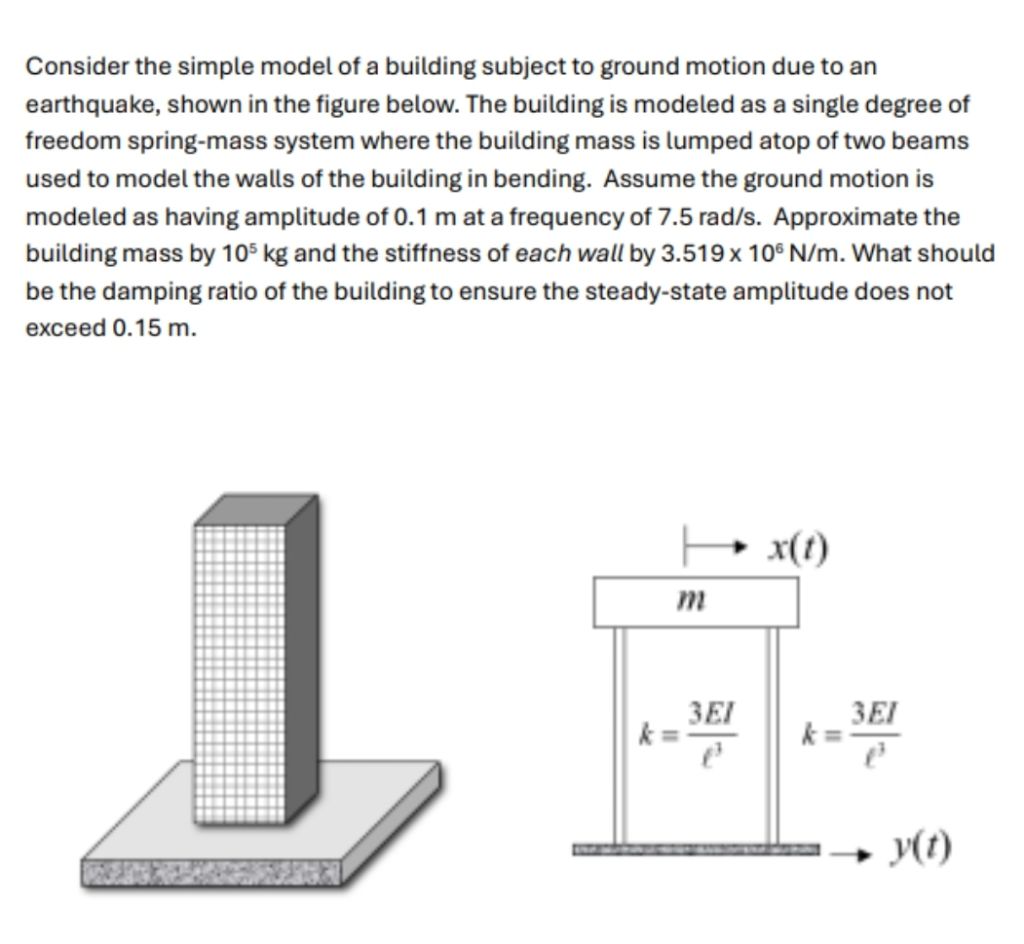
earthquake, shown in the figure below. The building is modeled as a single degree of
freedom spring-mass system where the building mass is lumped atop of two beams
used to model the walls of the building in bending. Assume the ground motion is
modeled as having amplitude of 0.1 m at a frequency of 7.5 rad/s. Approximate the
building mass by 10° kg and the stiffness of each wall by 3.519 x 10° N/m. What should
be the damping ratio of the building to ensure the steady-state amplitude does not
exceed 0.15 m.
iid > x(1)
a 3EI 3EI
EHH k= || b=
a 4 hile, (1)
Question:
Act like a helpful tutor and exlain me :
I need complete answer clearly and accuratelyConsider the simple model of a building subject to ground motion due to an
earthquake, shown in the figure below. The building is modeled as a single degree of
freedom spring-mass system where the building mass is lumped atop of two beams
used to model the walls of the building in bending. Assume the ground motion is
modeled as having amplitude of 0.1 m at a frequency of 7.5 rad/s. Approximate the
building mass by 10° kg and the stiffness of each wall by 3.519 x 10° N/m. What should
be the damping ratio of the building to ensure the steady-state amplitude does not
exceed 0.15 m.
iid > x(1)
a 3EI 3EI
EHH k= || b=
a 4 hile, (1)
This is AI generated Response.
Asked by: Jack
Created at: 2025-10-16 10:37:24
Final Answer:
RenderedRaw Text
Did you like this answer?
Let's break down the problem step-by-step.
---
## **1. System Parameters**
- **Building mass, \( m = 10^5 \) kg**
- **Stiffness of each wall, \( k_{\text{each}} = 3.519 \times 10^6 \) N/m**
- **Total stiffness, \( k = 2 \times k_{\text{each}} = 7.038 \times 10^6 \) N/m**
- **Ground motion amplitude, \( Y_ = .1 \) m**
- **Ground motion frequency, \( \omega = 7.5 \) rad/s**
- **Maximum allowed steady-state amplitude, \( X_{\text{max}} = .15 \) m**
---
## **2. Equation of Motion**
The building acts as a **single degree of freedom (SDOF) system** subject to a base excitation:
\[
m\ddot{x} + c\dot{x} + kx = k y(t)
\]
where \( y(t) \) is the ground displacement.
Let:
- \( x(t) \): relative displacement of mass wrt ground
- \( y(t) = Y_ \sin(\omega t) \): ground displacement
The steady-state amplitude of the relative displacement is given by:
\[
X = \frac{Y_}{\sqrt{\left[1 - \left(\frac{\omega}{\omega_n}\right)^2\right]^2 + \left[2\zeta \left(\frac{\omega}{\omega_n}\right)\right]^2}}
\]
Where:
- \( \omega_n = \sqrt{\frac{k}{m}} \): natural frequency
- \( \zeta \): damping ratio
---
## **3. Calculate System Frequencies**
\[
\omega_n = \sqrt{\frac{k}{m}} = \sqrt{\frac{7.038 \times 10^6}{10^5}} = \sqrt{70.38} \approx 8.397 \, \text{rad/s}
\]
\[
r = \frac{\omega}{\omega_n} = \frac{7.5}{8.397} \approx .893
\]
---
## **4. Steady-State Amplitude Equation**
\[
X = \frac{Y_}{\sqrt{(1 - r^2)^2 + (2 \zeta r)^2}}
\]
Plug in the numbers:
- \( Y_ = .1 \) m
- \( X_{\text{max}} = .15 \) m
- \( r = .893 \)
Set \( X \leq .15 \):
\[
.15 = \frac{.1}{\sqrt{(1 - .893^2)^2 + [2 \zeta (.893)]^2}}
\]
---
## **5. Solve for Damping Ratio \( \zeta \)**
First, calculate \( .893^2 = .797 \):
\[
1 - .797 = .203
\]
\[
(.203)^2 = .0412
\]
\[
.15 = \frac{.1}{\sqrt{.0412 + (2 \zeta \times .893)^2}}
\]
\[
.15 = \frac{.1}{\sqrt{.0412 + (1.786 \zeta)^2}}
\]
\[
\sqrt{.0412 + (1.786 \zeta)^2} = \frac{.1}{.15} = .6667
\]
\[
.0412 + (1.786 \zeta)^2 = (.6667)^2 = .4444
\]
\[
(1.786 \zeta)^2 = .4444 - .0412 = .4032
\]
\[
1.786 \zeta = \sqrt{.4032} = .6352
\]
\[
\zeta = \frac{.6352}{1.786} \approx .356
\]
---
## **6. **Final Answer**
### **The damping ratio required is:**
\[
\boxed{.36}
\]
(Rounded to two decimal places)
---
## **7. **Summary Table**
| Parameter | Value |
|-------------------|-------------------------------|
| Mass, \( m \) | \( 10^5 \) kg |
| Stiffness, \( k \)| \( 7.038 \times 10^6 \) N/m |
| Natural freq., \( \omega_n \) | \( 8.40 \) rad/s |
| Ground amp., \( Y_ \) | .1 m |
| Ground freq., \( \omega \) | \( 7.5 \) rad/s |
| Max allowed amp., \( X \) | .15 m |
| Required damping ratio, \( \zeta \) | **.36** |
---
## **Key Steps Recap**
1. Calculate total stiffness and natural frequency.
2. Use the forced vibration formula for base excitation.
3. Substitute values and solve for the damping ratio.
If you need further clarification or steps, let me know!
Question:
Nice, you showed your work clearly — nice job laying it out. One important mistake changed the result: the steady-state **relative** amplitude formula you used is missing the (r^2) factor. That factor comes from the inertial term when you write the EOM for base excitation (see short derivation below). Using the correct formula gives a different (and lower) damping ratio than your (;0.36).
Below I show the correction and the arithmetic step-by-step.
---
## Why the formula you used is missing a term
Equation of motion for relative displacement (x(t)) with base displacement (y(t)):
[
m\ddot x + c\dot x + kx = -,m\ddot y(t).
]
For harmonic base motion (y=Y\sin(\omega t)) the steady-state relative amplitude (X) is
[
X ;=; \frac{(\omega/\omega_n)^2}{\sqrt{(1-(\omega/\omega_n)^2)^2 + (2\zeta(\omega/\omega_n))^2}};Y
;=; \frac{r^2}{\sqrt{(1-r^2)^2+(2\zeta r)^2}};Y,
]
where (r=\omega/\omega_n).
(So the numerator (r^2) **must** appear.)
---
## Numeric steps (digit-by-digit)
Given:
(m=1.0\times10^5) kg, (k_{\text{each}}=3.519\times10^6) N/m (\Rightarrow k=2k_{\text{each}}=7.038\times10^6) N/m.
Ground: (Y=0.10) m, (\omega=7.5) rad/s, allowable (X=0.15) m.
1. Natural frequency:
[
\omega_n=\sqrt{\frac{k}{m}}=\sqrt{\frac{7.038\times10^6}{1.0\times10^5}}
=\sqrt{70.38}=8.389278872\ \text{rad/s} \ (\approx 8.39).
]
2. Frequency ratio:
[
r=\frac{\omega}{\omega_n}=\frac{7.5}{8.389278872}=0.8939981748\ (\approx0.894).
]
[
r^2=0.8939981748^2=0.7992327366.
]
3. Use correct steady-state relation
[
X = \frac{r^2}{\sqrt{(1-r^2)^2+(2\zeta r)^2}},Y.
]
Rearrange for the denominator:
[
\sqrt{(1-r^2)^2+(2\zeta r)^2} = \frac{r^2,Y}{X}.
]
Compute the right side:
[
\frac{r^2,Y}{X}=\frac{0.7992327366\times 0.10}{0.15}=0.5328218244.
]
Square both sides:
[
(1-r^2)^2+(2\zeta r)^2 = 0.5328218244^2 = 0.2838990965.
]
Compute ((1-r^2)^2):
[
1-r^2=1-0.7992327366=0.2007672634,
]
[
(1-r^2)^2=(0.2007672634)^2=0.04030749406.
]
Thus
[
(2\zeta r)^2 = 0.2838990965 - 0.04030749406 = 0.2435916024.
]
Take square root:
[
2\zeta r = \sqrt{0.2435916024} = 0.4935344783.
]
Finally solve for (\zeta):
[
\zeta = \frac{0.4935344783}{2r} = \frac{0.4935344783}{2\times0.8939981748} = 0.2760352392.
]
---
## Final result
[
\boxed{\zeta \approx 0.276\quad\text{(i.e. }27.6%\text{)}}
]
So your arithmetic after that mistaken formula was consistent, but the correct required damping ratio is about **0.276** (≈0.28), **not** 0.36.
If you want, I can also show a quick plot of the transfer function vs frequency for a few damping ratios so you can see how the response changes.
This is AI generated Response.
Asked by: Jack
Created at: 2025-10-16 10:39:32
Final Answer:
RenderedRaw Text
Did you like this answer?
# Explanation of Damping Ratio Calculation for Building Model
## 1. System Parameters
- **Building mass, \( m = 10^5 \) kg**
- **Stiffness of each wall, \( k_{\text{each}} = 3.519 \times 10^6 \) N/m**
- **Total stiffness, \( k = 2 \times k_{\text{each}} = 7.038 \times 10^6 \) N/m**
- **Ground motion amplitude, \( Y = 0.1 \) m**
- **Ground motion frequency, \( \omega = 7.5 \) rad/s**
- **Maximum allowed steady-state amplitude, \( X_{\text{max}} = 0.15 \) m**
## 2. Equation of Motion
The equation of motion for the system is:
\[
m\ddot{x} + c\dot{x} + kx = -m\ddot{y(t)}
\]
where \( y(t) \) is the ground displacement, modeled as:
\[
y(t) = Y \sin(\omega t)
\]
The steady-state relative amplitude \( X \) can be expressed as:
\[
X = \frac{r^2}{\sqrt{(1 - r^2)^2 + (2\zeta r)^2}} Y
\]
where \( r = \frac{\omega}{\omega_n} \).
## 3. Calculate Natural Frequency
The natural frequency \( \omega_n \) is calculated as follows:
\[
\omega_n = \sqrt{\frac{k}{m}} = \sqrt{\frac{7.038 \times 10^6}{10^5}} = \sqrt{70.38} \approx 8.39 \, \text{rad/s}
\]
## 4. Frequency Ratio
Calculate the frequency ratio:
\[
r = \frac{\omega}{\omega_n} = \frac{7.5}{8.39} \approx 0.894
\]
Now, compute \( r^2 \):
\[
r^2 = (0.894)^2 \approx 0.799
\]
## 5. Steady-State Amplitude Equation
Rearranging the steady-state amplitude equation for \( \zeta \):
\[
\sqrt{(1 - r^2)^2 + (2\zeta r)^2} = \frac{r^2 Y}{X}
\]
Substituting the values:
1. Calculate \( (1 - r^2) \):
\[
1 - r^2 = 1 - 0.799 \approx 0.201
\]
\[
(1 - r^2)^2 = (0.201)^2 \approx 0.0404
\]
2. Compute the right-hand side:
\[
\frac{r^2 Y}{X} = \frac{0.799 \times 0.1}{0.15} \approx 0.5327
\]
3. Square both sides:
\[
(1 - r^2)^2 + (2\zeta r)^2 = (0.5327)^2 \approx 0.2845
\]
4. Solve for \( (2\zeta r)^2 \):
\[
(2\zeta r)^2 = 0.2845 - 0.0404 \approx 0.2441
\]
5. Take the square root:
\[
2\zeta r = \sqrt{0.2441} \approx 0.4941
\]
## 6. Solve for Damping Ratio \( \zeta \)
Now, solve for \( \zeta \):
\[
\zeta = \frac{0.4941}{2r} = \frac{0.4941}{2 \times 0.894} \approx 0.276
\]
---
## Final Answer
### The required damping ratio is:
\[
\boxed{0.276}
\]
---
## Summary Table
| Parameter | Value |
|-------------------|-------------------------------|
| Mass, \( m \) | \( 10^5 \) kg |
| Stiffness, \( k \)| \( 7.038 \times 10^6 \) N/m |
| Natural freq., \( \omega_n \) | \( 8.39 \) rad/s |
| Ground amp., \( Y \) | 0.1 m |
| Ground freq., \( \omega \) | \( 7.5 \) rad/s |
| Max allowed amp., \( X \) | 0.15 m |
| Required damping ratio, \( \zeta \) | **0.276** |
---
## Key Steps Recap
1. Calculate total stiffness and natural frequency.
2. Use the correct steady-state amplitude formula.
3. Substitute values and solve for the damping ratio.
If you need further assistance or clarification, feel free to ask!
VIPSolutions focuses on clear, step‑by‑step explanations so you can learn quickly. Whether you need an AI‑generated walkthrough or a short hint to get unstuck, each solution is organized for fast reading and easy review later.
Search similar questions, compare approaches, and bookmark the best answers for revision. Our goal is simple: quick, reliable study help that feels natural—not noisy.
 VIPSolutions
 Consider the simple model of a building subject to ground motion due to an
earthquake, shown in the figure below. The building is modeled as a single degree of
freedom spring-mass system where the building mass is lumped atop of two beams
used to model the walls of the building in bending. Assume the ground motion is
modeled as having amplitude of 0.1 m at a frequency of 7.5 rad/s. Approximate the
building mass by 10° kg and the stiffness of each wall by 3.519 x 10° N/m. What should
be the damping ratio of the building to ensure the steady-state amplitude does not
exceed 0.15 m.
iid > x(1)
a 3EI 3EI
EHH k= || b=
a 4 hile, (1)