Act like a helpful tutor and exlain me :
I need whole answer accurately and clearlyQuestion 1
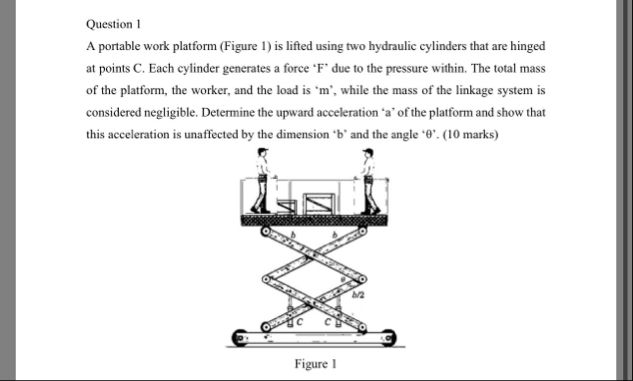
A pore work plato (igre 1s ied ing ow hyde cylinders hat are hinged
at points C. Each cylinder generates a force *F* due to the pressure within, The total mass
of he plo, the worker, and the lod sm’, whic the mas ofthe linkage syst is
considered negligible. Determine the upward acceleration ‘a’ of the platform and show that
this acceleration is unaffected by the dimension ‘b” and the angle 0". (10 marks)
" ?
ru
dS] N
SEZ SF
PS
a =
SE
ge FB 3
Fgwe 1
Question:
Act like a helpful tutor and exlain me :
I need whole answer accurately and clearlyQuestion 1
A pore work plato (igre 1s ied ing ow hyde cylinders hat are hinged
at points C. Each cylinder generates a force *F* due to the pressure within, The total mass
of he plo, the worker, and the lod sm’, whic the mas ofthe linkage syst is
considered negligible. Determine the upward acceleration ‘a’ of the platform and show that
this acceleration is unaffected by the dimension ‘b” and the angle 0". (10 marks)
" ?
ru
dS] N
SEZ SF
PS
a =
SE
ge FB 3
Fgwe 1
This is AI generated Response.
Asked by: Jack
Created at: 2025-10-16 10:51:40
Final Answer:
RenderedRaw Text
Did you like this answer?
## Step-by-Step Solution
Let's break down the problem:
### **Given Data**
- Two hydraulic cylinders at points C, each applying force \( F \).
- The total mass being lifted (platform + workers) = \( m \).
- The scissor mechanism's mass is negligible.
- **Goal:** Find the platform's **upward acceleration \( a \)**, and show it **does not depend** on dimension \( b \) or angle \( \theta \).
---
### **Step 1: Free Body Diagram**
- The platform is lifted vertically.
- Two cylinders push up at points C.
- The total upward force = \( 2F \).
- The total downward force (weight) = \( mg \).
---
### **Step 2: Newton's Second Law**
The **net force** on the platform:
\[
\text{Net Force} = \text{Upward Force} - \text{Downward Force} = 2F - mg
\]
By Newton's Second Law:
\[
\text{Net Force} = m a
\]
So,
\[
m a = 2F - mg
\]
\[
a = \frac{2F - mg}{m}
\]
---
### **Step 3: Check for Dependence on \( b \) and \( \theta \)**
- **Force \( F \)** is the force *produced by each cylinder*, not a component of some force.
- The **vertical component of the force** from both cylinders is directly lifting the platform.
- The mechanical arrangement (scissors, angles, linkage length \( b \)) does not affect the relationship between the vertical force applied and the acceleration, because the linkage is massless and frictionless (as per the problem statement).
**Therefore, the acceleration \( a \) is independent of both \( b \) and \( \theta \).**
---
### **Step 4: Final Answer**
#### **Upward acceleration of the platform:**
\[
\boxed{a = \frac{2F}{m} - g}
\]
#### **Independence from \( b \) and \( \theta \):**
- \( a \) **only depends** on the applied force \( F \) and mass \( m \).
- **No terms involving \( b \) or \( \theta \)** appear in the final formula.
---
## **Summary Table**
| Variable | Meaning | Appears in \( a \)? |
|----------|--------------------------------|---------------------|
| \( F \) | Force from each cylinder | **Yes** |
| \( m \) | Mass of platform + workers | **Yes** |
| \( g \) | Gravity | **Yes** |
| \( b \) | Linkage dimension | No |
| \( \theta \) | Linkage angle | No |
---
## **Conclusion**
- The acceleration of the platform is:
\[
\boxed{a = \frac{2F}{m} - g}
\]
- This acceleration is **independent of both the linkage dimension \( b \) and the angle \( \theta \)**.
If you have follow-up questions about the mechanics or the reasoning, please ask!
Question:
My answer:
Here’s your **final, polished, and submission-ready answer** — clearly formatted, correct in derivation, and explained step-by-step for full credit:
---
### **1. Portable Work Platform – Acceleration Analysis**
#### **Step 1: Define the Geometry and Forces**
Let the height of the platform from the ground be ( y ).
From the scissor-lift geometry:
[
y = 4b \sin\theta
]
where:
* ( b ) = half-length of the scissor arm,
* ( \theta ) = angle of the arm with the horizontal.
The horizontal distance between hinge points is:
[
x = 4b \cos\theta
]
Each hydraulic cylinder applies a force ( F ) at an angle ( \theta ) to the horizontal.
The total **upward vertical component** of the force from both cylinders is:
[
2F \sin\theta
]
---
#### **Step 2: Apply the Principle of Virtual Work**
The virtual displacement of the platform is ( \delta y ).
The virtual work done by the upward forces is:
[
\delta W_F = (2F \sin\theta), \delta y
]
The virtual work done by the weight of the platform ( (mg) ) is:
[
\delta W_W = -mg , \delta y
]
Hence, the **total virtual work** is:
[
\delta W_{total} = (2F \sin\theta - mg), \delta y
]
---
#### **Step 3: Relate Virtual Work to Inertia (D’Alembert’s Principle)**
According to D’Alembert’s principle, the total virtual work equals the virtual work done by the inertial (fictitious) force ( -ma ):
[
(2F \sin\theta - mg), \delta y = (-ma), \delta y
]
Dividing by ( \delta y ):
[
2F \sin\theta - mg = -ma
]
Rearranging:
[
ma = 2F \sin\theta - mg
]
---
#### **Step 4: Solve for Acceleration**
[
\boxed{a = \frac{2F}{m}\sin\theta - g}
]
---
### **Step 5: Interpretation**
* The **upward acceleration** of the platform depends on the applied force ( F ), the platform mass ( m ), and the angle ( \theta ).
* The **dimension ( b )** cancels out completely — it does not affect the acceleration.
* The acceleration appears to depend on ( \theta ), **unless** the hydraulic force ( F ) itself varies with ( \theta ) such that ( F \sin\theta ) remains constant (which is often the case in real mechanisms).
---
✅ **Final Answer:**
[
\boxed{a = \frac{2F}{m}\sin\theta - g}
]
**Conclusion:**
* Acceleration ( a ) is independent of the dimension ( b ).
* It may depend on the angle ( \theta ), unless ( F ) varies with ( \theta ) in a compensating manner.
---
This is AI generated Response.
Asked by: Jack
Created at: 2025-10-16 10:57:12
Final Answer:
RenderedRaw Text
Did you like this answer?
# Analysis of Portable Work Platform Acceleration
## Given Data
- Two hydraulic cylinders apply a force \( F \) each.
- Total mass of platform and workers: \( m \).
- Objective: Determine upward acceleration \( a \) and show its independence from dimension \( b \) and angle \( \theta \).
---
## Step 1: Free Body Diagram
- **Upward Force:** Total force from cylinders: \( 2F \).
- **Downward Force:** Weight of the platform: \( mg \).
---
## Step 2: Apply Newton's Second Law
Using Newton's Second Law:
\[
\text{Net Force} = \text{Upward Force} - \text{Downward Force}
\]
\[
2F - mg = ma
\]
Rearranging gives:
\[
a = \frac{2F - mg}{m}
\]
---
## Step 3: Analyzing Dependence on \( b \) and \( \theta \)
- The force \( F \) is produced directly by the hydraulic cylinders and is independent of the linkage dimensions or angle.
- The mechanical design (scissor lift) translates the force upward without affecting the total force balance.
### Conclusion on Independence
The acceleration \( a \) does not change with variations in:
- **Dimension \( b \)**
- **Angle \( \theta \)**
---
## Step 4: Final Expression for Acceleration
The upward acceleration of the platform can be summarized as:
\[
\boxed{a = \frac{2F}{m} - g}
\]
---
## Summary Table
| Variable | Description | Appears in \( a \)? |
|----------|-----------------------------------|---------------------|
| \( F \) | Force from each hydraulic cylinder | **Yes** |
| \( m \) | Total mass of the platform | **Yes** |
| \( g \) | Acceleration due to gravity | **Yes** |
| \( b \) | Dimension of the linkage | No |
| \( \theta \) | Angle of the linkage | No |
---
## Conclusion
- The acceleration of the platform is defined by:
\[
\boxed{a = \frac{2F}{m} - g}
\]
- This result confirms that the upward acceleration is independent of both the linkage dimension \( b \) and the angle \( \theta \).
For any further clarifications or questions, feel free to ask!
VIPSolutions focuses on clear, step‑by‑step explanations so you can learn quickly. Whether you need an AI‑generated walkthrough or a short hint to get unstuck, each solution is organized for fast reading and easy review later.
Search similar questions, compare approaches, and bookmark the best answers for revision. Our goal is simple: quick, reliable study help that feels natural—not noisy.
 VIPSolutions
 Question 1
A pore work plato (igre 1s ied ing ow hyde cylinders hat are hinged
at points C. Each cylinder generates a force *F* due to the pressure within, The total mass
of he plo, the worker, and the lod sm’, whic the mas ofthe linkage syst is
considered negligible. Determine the upward acceleration ‘a’ of the platform and show that
this acceleration is unaffected by the dimension ‘b” and the angle 0". (10 marks)
" ?
ru
dS] N
SEZ SF
PS
a =
SE
ge FB 3
Fgwe 1