 VIPSolutions
Act like a helpful tutor and exlain me : Give step-by-step solution with explanation and final answer:=
Question:
Act like a helpful tutor and exlain me :
Give step-by-step solution with explanation and final answer: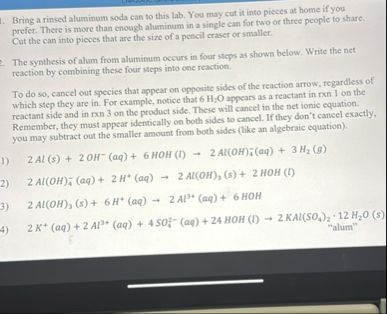 =
This is AI generated Response.
Asked by: Edu
Created at: 2025-10-17 04:03:51
Asked by: Edu
Created at: 2025-10-17 04:03:51
Final Answer:
Rendered
Raw Text
Did you like this answer?
Let's work through the step by step:
---
## **Step 1: Write All Four Reactions**
Given reactions:
1. \( 2\text{Al}(s) + 2\text{OH}^-(aq) + 6\text{HOH}(l) \rightarrow 2\text{Al(OH)}_4^-(aq) + 3\text{H}_2(g) \)
2. \( 2\text{Al(OH)}_4^-(aq) + 2\text{H}^+(aq) \rightarrow 2\text{Al(OH)}_3(s) + 4\text{HOH}(l) \)
3. \( 2\text{Al(OH)}_3(s) + 6\text{H}^+(aq) \rightarrow 2\text{Al}^{3+}(aq) + 6\text{HOH}(l) \)
4. \( 2\text{K}^+(aq) + 2\text{Al}^{3+}(aq) + 4\text{SO}_4^{2-}(aq) + 24\text{HOH}(l) \rightarrow 2\text{KAl(SO}_4)_2 \cdot 12\text{H}_2\text{O}(s) \) ("alum")
---
## **Step 2: Add All Equations Together**
Let’s write all reactants on one side and all products on the other:
**Reactants:**
- \( 2\text{Al}(s) \)
- \( 2\text{OH}^-(aq) \)
- \( 6\text{HOH}(l) \)
- \( 2\text{H}^+(aq) \)
- \( 6\text{H}^+(aq) \)
- \( 2\text{K}^+(aq) \)
- \( 4\text{SO}_4^{2-}(aq) \)
- \( 24\text{HOH}(l) \)
**Products:**
- \( 2\text{Al(OH)}_4^-(aq) \)
- \( 3\text{H}_2(g) \)
- \( 2\text{Al(OH)}_3(s) \)
- \( 4\text{HOH}(l) \)
- \( 2\text{Al}^{3+}(aq) \)
- \( 6\text{HOH}(l) \)
- \( 2\text{KAl(SO}_4)_2 \cdot 12\text{H}_2\text{O}(s) \)
---
## **Step 3: Cancel Species That Appear on Both Sides**
Let’s look for species that appear on both sides:
- \( 2\text{Al(OH)}_4^-(aq) \): produced in step 1, consumed in step 2 → **cancel**
- \( 2\text{Al(OH)}_3(s) \): produced in step 2, consumed in step 3 → **cancel**
- \( 2\text{Al}^{3+}(aq) \): produced in step 3, consumed in step 4 → **cancel**
- \( 6\text{HOH}(l) \): reactant in step 1, product in step 3 → **cancel**
- \( 24\text{HOH}(l) \): reactant in step 4 only, keep
- \( 4\text{HOH}(l) \): product in step 2 only, keep
Now, let's be careful with water (\(\text{HOH}\)) since it appears in multiple steps:
- Added up, total water on reactant side: \(6\) (step 1) + \(24\) (step 4) = \(30\)
- On product side: \(4\) (step 2) + \(6\) (step 3) = \(10\)
So, net water: \(30 - 10 = 20\) on the reactant side.
---
## **Step 4: Write the Net Ionic Equation**
After cancellation:
**Reactants:**
- \( 2\text{Al}(s) \)
- \( 2\text{OH}^-(aq) \)
- \( 8\text{H}^+(aq) \)
- \( 2\text{K}^+(aq) \)
- \( 4\text{SO}_4^{2-}(aq) \)
- \( 20\text{HOH}(l) \)
**Products:**
- \( 3\text{H}_2(g) \)
- \( 2\text{KAl(SO}_4)_2 \cdot 12\text{H}_2\text{O}(s) \)
---
### **Final Net Ionic Equation**
\[
2\text{Al}(s) + 2\text{OH}^-(aq) + 8\text{H}^+(aq) + 2\text{K}^+(aq) + 4\text{SO}_4^{2-}(aq) + 20\text{H}_2\text{O}(l) \rightarrow 3\text{H}_2(g) + 2\text{KAl(SO}_4)_2 \cdot 12\text{H}_2\text{O}(s)
\]
---
## **Summary Table**
| Species | Reactant Side | Product Side | Net (Reactant - Product) |
|----------------------------|:------------:|:------------:|:------------------------:|
| \( \text{Al}(s) \) | 2 | | 2 |
| \( \text{OH}^-(aq) \) | 2 | | 2 |
| \( \text{H}^+(aq) \) | 8 | | 8 |
| \( \text{K}^+(aq) \) | 2 | | 2 |
| \( \text{SO}_4^{2-}(aq) \) | 4 | | 4 |
| \( \text{HOH}(l) \) | 30 | 10 | 20 |
| \( \text{H}_2(g) \) | | 3 | 3 |
| Alum | | 2 | 2 |
---
## **Final Answer**
\[
\boxed{
2\text{Al}(s) + 2\text{OH}^-(aq) + 8\text{H}^+(aq) + 2\text{K}^+(aq) + 4\text{SO}_4^{2-}(aq) + 20\text{H}_2\text{O}(l) \rightarrow 3\text{H}_2(g) + 2\text{KAl(SO}_4)_2 \cdot 12\text{H}_2\text{O}(s)
}
\]
Question:
More detail answer
This is AI generated Response.
Asked by: Edu
Created at: 2025-10-17 04:06:19
Asked by: Edu
Created at: 2025-10-17 04:06:19
Final Answer:
Rendered
Raw Text
Did you like this answer?
## Step-by-Step Solution: Chemical Reactions
To solve the problem, we will analyze the given reactions, add them together, cancel common species, and derive the net ionic equation.
---
## Step 1: Write All Four Reactions
The reactions provided are as follows:
1. **Aluminum Reaction:**
\[
2\text{Al}(s) + 2\text{OH}^-(aq) + 6\text{H}_2\text{O}(l) \rightarrow 2\text{Al(OH)}_4^-(aq) + 3\text{H}_2(g)
\]
2. **Formation of Aluminum Hydroxide:**
\[
2\text{Al(OH)}_4^-(aq) + 2\text{H}^+(aq) \rightarrow 2\text{Al(OH)}_3(s) + 4\text{H}_2\text{O}(l)
\]
3. **Dissociation of Aluminum Hydroxide:**
\[
2\text{Al(OH)}_3(s) + 6\text{H}^+(aq) \rightarrow 2\text{Al}^{3+}(aq) + 6\text{H}_2\text{O}(l)
\]
4. **Formation of Alum:**
\[
2\text{K}^+(aq) + 2\text{Al}^{3+}(aq) + 4\text{SO}_4^{2-}(aq) + 24\text{H}_2\text{O}(l) \rightarrow 2\text{KAl(SO}_4)_2 \cdot 12\text{H}_2\text{O}(s)
\]
---
## Step 2: Combine All Equations
### Reactants & Products
**Reactants:**
- From reaction 1: \(2\text{Al}(s)\), \(2\text{OH}^-(aq)\), \(6\text{H}_2\text{O}(l)\)
- From reaction 2: \(2\text{H}^+(aq)\)
- From reaction 3: \(6\text{H}^+(aq)\)
- From reaction 4: \(2\text{K}^+(aq)\), \(4\text{SO}_4^{2-}(aq)\), \(24\text{H}_2\text{O}(l)\)
**Products:**
- From reaction 1: \(2\text{Al(OH)}_4^-(aq)\), \(3\text{H}_2(g)\)
- From reaction 2: \(2\text{Al(OH)}_3(s)\), \(4\text{H}_2\text{O}(l)\)
- From reaction 3: \(2\text{Al}^{3+}(aq)\), \(6\text{H}_2\text{O}(l)\)
- From reaction 4: \(2\text{KAl(SO}_4)_2 \cdot 12\text{H}_2\text{O}(s)\)
---
## Step 3: Cancel Common Species
### Identify Common Species
- **Cancel \(2\text{Al(OH)}_4^-(aq)\)**: produced in step 1, consumed in step 2
- **Cancel \(2\text{Al(OH)}_3(s)\)**: produced in step 2, consumed in step 3
- **Cancel \(2\text{Al}^{3+}(aq)\)**: produced in step 3, consumed in step 4
- **Water (\(\text{H}_2\text{O}\))**:
- Reactant side: \(6 + 24 = 30\)
- Product side: \(4 + 6 = 10\)
- Net water: \(30 - 10 = 20\) on the reactant side
### Remaining Components
After canceling out, we are left with:
**Reactants:**
- \(2\text{Al}(s)\)
- \(2\text{OH}^-(aq)\)
- \(8\text{H}^+(aq)\) (from \(2 + 6\))
- \(2\text{K}^+(aq)\)
- \(4\text{SO}_4^{2-}(aq)\)
- \(20\text{H}_2\text{O}(l)\)
**Products:**
- \(3\text{H}_2(g)\)
- \(2\text{KAl(SO}_4)_2 \cdot 12\text{H}_2\text{O}(s)\)
---
## Step 4: Write the Net Ionic Equation
### Final Form
The net ionic equation is:
\[
2\text{Al}(s) + 2\text{OH}^-(aq) + 8\text{H}^+(aq) + 2\text{K}^+(aq) + 4\text{SO}_4^{2-}(aq) + 20\text{H}_2\text{O}(l) \rightarrow 3\text{H}_2(g) + 2\text{KAl(SO}_4)_2 \cdot 12\text{H}_2\text{O}(s)
\]
---
## Summary Table
| Species | Reactant Side | Product Side | Net (Reactant - Product) |
|----------------------------|:-------------:|:------------:|:------------------------:|
| \( \text{Al}(s) \) | 2 | | 2 |
| \( \text{OH}^-(aq) \) | 2 | | 2 |
| \( \text{H}^+(aq) \) | 8 | | 8 |
| \( \text{K}^+(aq) \) | 2 | | 2 |
| \( \text{SO}_4^{2-}(aq) \) | 4 | | 4 |
| \( \text{H}_2\text{O}(l) \) | 30 | 10 | 20 |
| \( \text{H}_2(g) \) | | 3 | 3 |
| **Alum** | | 2 | 2 |
---
## Final Answer
\[
\boxed{
2\text{Al}(s) + 2\text{OH}^-(aq) + 8\text{H}^+(aq) + 2\text{K}^+(aq) + 4\text{SO}_4^{2-}(aq) + 20\text{H}_2\text{O}(l) \rightarrow 3\text{H}_2(g) + 2\text{KAl(SO}_4)_2 \cdot 12\text{H}_2\text{O}(s)
}
\]
📢 Instructions:
- Ask anything relatd to above question only.
- For new Question goto :