 VIPSolutions
FIRST WRITE GIVENINFORMATION THENWHAT HAVE TO FIND AND THEN DEFINATION ORCONCEPT USED AND THEN STEP BY STEPSOLUTION WITHOUT MENTIONING STEP NUMBER AND AT LAST WRITE FINALANSWERS ONLY AS SUMMARY . ALSO MAKE SOLUTION WELL STRUCTUREDLet X and Y be discrete random variables with joint probability mass function P(X=z,Y=y)=k(z+y), z=012y=012 and P(X = 2,Y = y) = 0 otherwise. 1. Determine the value of k. 2. Find the marginal probability mass functions of X and Y. 3. Determine whether X and Y’ are independent. 4. compute P(X +Y
Question:
FIRST WRITE GIVENINFORMATION THENWHAT HAVE TO FIND AND THEN DEFINATION ORCONCEPT USED AND THEN STEP BY STEPSOLUTION WITHOUT MENTIONING STEP NUMBER AND AT LAST WRITE FINALANSWERS ONLY AS SUMMARY . ALSO MAKE SOLUTION WELL STRUCTURED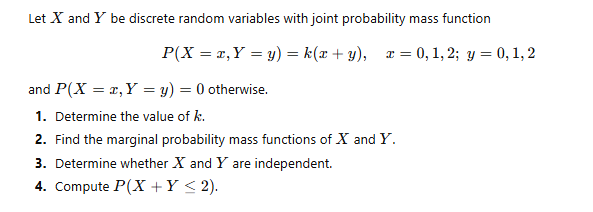 Let X and Y be discrete random variables with joint probability mass function
P(X=z,Y=y)=k(z+y), z=012y=012
and P(X = 2,Y = y) = 0 otherwise.
1. Determine the value of k.
2. Find the marginal probability mass functions of X and Y.
3. Determine whether X and Y’ are independent.
4. compute P(X +Y
This is AI generated Response.
Asked by: nayan
Created at: 2026-03-07 09:43:01
Asked by: nayan
Created at: 2026-03-07 09:43:01
Final Answer:
Rendered
Raw Text
Did you like this answer?
# Given Information
- \(X\) and \(Y\) are discrete random variables.
- Joint probability mass function:
\(P(X = x, Y = y) = k(x + y)\), where \(x = , 1, 2\) and \(y = , 1, 2\).
- \(P(X = x, Y = y) = \) otherwise.
# What to Find
1. The value of \(k\).
2. Marginal probability mass functions of \(X\) and \(Y\).
3. Whether \(X\) and \(Y\) are independent.
4. \(P(X + Y \leq 2)\).
# Definition or Concept Used
- **Joint PMF**: The probability that \(X = x\) and \(Y = y\) together.
- **Marginal PMF**: Probability of one variable regardless of the other, obtained by summing the joint PMF over the other variable.
- **Independence**: \(X\) and \(Y\) are independent if \(P(X=x, Y=y) = P(X=x)P(Y=y)\) for all \(x, y\).
- **Probability Calculation**: For any event, sum the joint probabilities over all outcomes in that event.
# Step by Step Solution
**Finding the value of \(k\):**
The total probability must sum to 1.
Sum over all \(x, y\) values:
\[
\sum_{x=}^2 \sum_{y=}^2 k(x+y) = 1
\]
Calculate each \(x+y\) for all combinations (\(3 \times 3\) grid):
\[
\begin{align*}
x=: &\ y=,1,2 \implies +, +1, +2 = ,1,2 \\
x=1: &\ y=,1,2 \implies 1+, 1+1, 1+2 = 1,2,3 \\
x=2: &\ y=,1,2 \implies 2+, 2+1, 2+2 = 2,3,4 \\
\end{align*}
\]
Sum: \(+1+2+1+2+3+2+3+4 = 18\)
So,
\[
k (+1+2+1+2+3+2+3+4) = k \times 18 = 1 \implies k = \frac{1}{18}
\]
**Marginal PMF of \(X\):**
\[
P(X = x) = \sum_{y=}^2 P(X = x, Y = y) = \frac{1}{18} \sum_{y=}^2 (x + y)
\]
Calculate for each \(x\):
- \(x=\): \(\frac{1}{18}(+ + +1 + +2) = \frac{1}{18}(+1+2) = \frac{3}{18} = \frac{1}{6}\)
- \(x=1\): \(\frac{1}{18}(1+ + 1+1 + 1+2) = \frac{1}{18}(1+2+3) = \frac{6}{18} = \frac{1}{3}\)
- \(x=2\): \(\frac{1}{18}(2+ + 2+1 + 2+2) = \frac{1}{18}(2+3+4) = \frac{9}{18} = \frac{1}{2}\)
So,
\[
P(X=) = \frac{1}{6},\quad P(X=1) = \frac{1}{3},\quad P(X=2) = \frac{1}{2}
\]
**Marginal PMF of \(Y\):**
\[
P(Y = y) = \sum_{x=}^2 P(X = x, Y = y) = \frac{1}{18} \sum_{x=}^2 (x + y)
\]
Calculate for each \(y\):
- \(y=\): \(\frac{1}{18}(+ + 1+ + 2+) = \frac{1}{18}(+1+2) = \frac{3}{18} = \frac{1}{6}\)
- \(y=1\): \(\frac{1}{18}(+1 + 1+1 + 2+1) = \frac{1}{18}(1+2+3) = \frac{6}{18} = \frac{1}{3}\)
- \(y=2\): \(\frac{1}{18}(+2 + 1+2 + 2+2) = \frac{1}{18}(2+3+4) = \frac{9}{18} = \frac{1}{2}\)
So,
\[
P(Y=) = \frac{1}{6},\quad P(Y=1) = \frac{1}{3},\quad P(Y=2) = \frac{1}{2}
\]
**Are \(X\) and \(Y\) independent?**
If independent, \(P(X=x, Y=y) = P(X=x)P(Y=y)\) for all \(x, y\).
Check for \(x=, y=\):
\(P(X=, Y=) = \frac{1}{18}(+)=\),
\(P(X=)P(Y=) = \frac{1}{6} \times \frac{1}{6} = \frac{1}{36} \neq \)
So, \(X\) and \(Y\) are **not independent**.
**Compute \(P(X + Y \leq 2)\):**
Possible \((x, y)\) pairs:
- \((,): \)
- \((,1): 1\)
- \((,2): 2\)
- \((1,): 1\)
- \((1,1): 2\)
- \((2,): 2\)
Sum their probabilities:
\[
\begin{align*}
P(,) &= \frac{1}{18} \times = \\
P(,1) &= \frac{1}{18} \times 1 = \frac{1}{18} \\
P(,2) &= \frac{1}{18} \times 2 = \frac{2}{18} \\
P(1,) &= \frac{1}{18} \times 1 = \frac{1}{18} \\
P(1,1) &= \frac{1}{18} \times 2 = \frac{2}{18} \\
P(2,) &= \frac{1}{18} \times 2 = \frac{2}{18} \\
\end{align*}
\]
Total: \(\frac{1+2+1+2+2}{18} = \frac{8}{18} = \frac{4}{9}\)
# Final Answers
- \(k = \frac{1}{18}\)
- Marginal PMF:
- \(P(X=) = \frac{1}{6},\ P(X=1) = \frac{1}{3},\ P(X=2) = \frac{1}{2}\)
- \(P(Y=) = \frac{1}{6},\ P(Y=1) = \frac{1}{3},\ P(Y=2) = \frac{1}{2}\)
- \(X\) and \(Y\) are **not independent**.
- \(P(X + Y \leq 2) = \frac{4}{9}\)
Question:
make solution well structured
This is AI generated Response.
Asked by: nayan
Created at: 2026-03-07 09:44:38
Asked by: nayan
Created at: 2026-03-07 09:44:38
Final Answer:
Rendered
Raw Text
Did you like this answer?
# Given Information
- \(X\) and \(Y\) are discrete random variables.
- Joint probability mass function:
\(P(X = z, Y = y) = k(z + y)\) for \(z = 0, 1, 2\) and \(y = 0, 1, 2\).
- \(P(X = z, Y = y) = 0\) otherwise.
# What to Find
1. The value of \(k\).
2. Marginal probability mass functions of \(X\) and \(Y\).
3. Whether \(X\) and \(Y\) are independent.
4. Compute \(P(X + Y \leq 2)\).
# Definitions or Concepts Used
- **Joint PMF**: Probability that \(X = z\) and \(Y = y\) occur simultaneously.
- **Marginal PMF**: Probability of one variable irrespective of the other, calculated by summing the joint PMF over the other variable.
- **Independence**: \(X\) and \(Y\) are independent if \(P(X=z, Y=y) = P(X=z)P(Y=y)\) for all values of \(z\) and \(y\).
- **Probability Calculation**: The total probability must sum to 1 across all possible outcomes.
# Step-by-Step Solution
**Finding the Value of \(k\):**
The total probability must sum to 1. We compute:
\[
\sum_{z=0}^2 \sum_{y=0}^2 P(X=z, Y=y) = 1
\]
Calculating the joint probabilities for all combinations:
\[
\begin{align*}
P(X=0, Y=0) &= k(0+0) = 0 \\
P(X=0, Y=1) &= k(0+1) = k \\
P(X=0, Y=2) &= k(0+2) = 2k \\
P(X=1, Y=0) &= k(1+0) = k \\
P(X=1, Y=1) &= k(1+1) = 2k \\
P(X=1, Y=2) &= k(1+2) = 3k \\
P(X=2, Y=0) &= k(2+0) = 2k \\
P(X=2, Y=1) &= k(2+1) = 3k \\
P(X=2, Y=2) &= k(2+2) = 4k \\
\end{align*}
\]
Summing these:
\[
0 + k + 2k + k + 2k + 3k + 2k + 3k + 4k = 18k = 1 \implies k = \frac{1}{18}
\]
**Marginal PMF of \(X\):**
\[
P(X=z) = \sum_{y=0}^2 P(X=z, Y=y) = k \sum_{y=0}^2 (z + y)
\]
Calculating for each \(z\):
- For \(z=0\):
\[
P(X=0) = k(0 + 0 + 1 + 2) = k(3) = \frac{1}{18} \cdot 3 = \frac{1}{6}
\]
- For \(z=1\):
\[
P(X=1) = k(1 + 0 + 1 + 2) = k(4) = \frac{1}{18} \cdot 4 = \frac{2}{9}
\]
- For \(z=2\):
\[
P(X=2) = k(2 + 0 + 1 + 2) = k(5) = \frac{1}{18} \cdot 5 = \frac{5}{18}
\]
**Marginal PMF of \(Y\):**
\[
P(Y=y) = \sum_{z=0}^2 P(X=z, Y=y) = k \sum_{z=0}^2 (z + y)
\]
Calculating for each \(y\):
- For \(y=0\):
\[
P(Y=0) = k(0 + 0 + 1 + 2) = k(3) = \frac{1}{6}
\]
- For \(y=1\):
\[
P(Y=1) = k(0 + 1 + 1 + 2) = k(4) = \frac{2}{9}
\]
- For \(y=2\):
\[
P(Y=2) = k(0 + 2 + 1 + 2) = k(5) = \frac{5}{18}
\]
**Checking Independence of \(X\) and \(Y\):**
We check if \(P(X=z, Y=y) = P(X=z)P(Y=y)\):
- For \(z=0, y=0\):
\[
P(X=0, Y=0) = 0 \quad \text{and} \quad P(X=0)P(Y=0) = \frac{1}{6} \cdot \frac{1}{6} = \frac{1}{36} \neq 0
\]
Thus, \(X\) and \(Y\) are **not independent**.
**Computing \(P(X + Y \leq 2)\):**
Identify pairs \((X, Y)\) such that \(X + Y \leq 2\):
- \((0, 0)\) → \(P(X=0, Y=0) = 0\)
- \((0, 1)\) → \(P(X=0, Y=1) = k = \frac{1}{18}\)
- \((0, 2)\) → \(P(X=0, Y=2) = 2k = \frac{2}{18} = \frac{1}{9}\)
- \((1, 0)\) → \(P(X=1, Y=0) = k = \frac{1}{18}\)
- \((1, 1)\) → \(P(X=1, Y=1) = 2k = \frac{2}{18} = \frac{1}{9}\)
Sum their probabilities:
\[
P(X + Y \leq 2) = P(0, 0) + P(0, 1) + P(0, 2) + P(1, 0) + P(1, 1) = 0 + \frac{1}{18} + \frac{1}{9} + \frac{1}{18} + \frac{1}{9}
\]
Calculating:
\[
= 0 + \frac{1}{18} + \frac{2}{18} + \frac{1}{18} + \frac{2}{18} = \frac{6}{18} = \frac{1}{3}
\]
# Final Answers
- \(k = \frac{1}{18}\)
- Marginal PMF:
- \(P(X=0) = \frac{1}{6},\ P(X=1) = \frac{2}{9},\ P(X=2) = \frac{5}{18}\)
- \(P(Y=0) = \frac{1}{6},\ P(Y=1) = \frac{2}{9},\ P(Y=2) = \frac{5}{18}\)
- \(X\) and \(Y\) are **not independent**.
- \(P(X + Y \leq 2) = \frac{1}{3}\)
📢 Instructions:
- Ask anything relatd to above question only.
- For new Question goto :