 VIPSolutions
FIRST WRITE GIVENINFORMATION THENWHAT HAVE TO FIND AND THEN DEFINATION ORCONCEPT USED AND THEN STEP BY STEPSOLUTION WITHOUT MENTIONING STEP NUMBER AND AT LAST WRITE FINALANSWERS ONLY AS SUMMARY . ALSO MAKE SOLUTION WELL STRUCTUREDLet Xy,..., X,, ~ Uniform(0, 1). 2) Find the PDF of the maximum X(). b) Find E[X (x). © Find P(X(n) — X(1) < 0.5).
Question:
FIRST WRITE GIVENINFORMATION THENWHAT HAVE TO FIND AND THEN DEFINATION ORCONCEPT USED AND THEN STEP BY STEPSOLUTION WITHOUT MENTIONING STEP NUMBER AND AT LAST WRITE FINALANSWERS ONLY AS SUMMARY . ALSO MAKE SOLUTION WELL STRUCTURED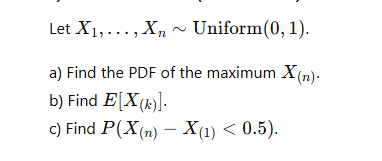 Let Xy,..., X,, ~ Uniform(0, 1).
2) Find the PDF of the maximum X().
b) Find E[X (x).
© Find P(X(n) — X(1) < 0.5).
This is AI generated Response.
Asked by: nayan
Created at: 2026-02-14 06:56:28
Asked by: nayan
Created at: 2026-02-14 06:56:28
Final Answer:
Rendered
Raw Text
Did you like this answer?
# Given Information
- \( X_1, X_2, \ldots, X_n \) are independent and identically distributed random variables.
- Each \( X_i \sim \text{Uniform}(,1) \).
# What to Find
a) PDF of the maximum \( X_{(n)} \) (where \( X_{(n)} = \max(X_1, \ldots, X_n) \)).
b) \( E[X_{(k)}] \) — the expected value of the \( k \)-th order statistic.
c) \( P(X_{(n)} - X_{(1)} < .5) \) — the probability that the range is less than .5.
# Definitions/Concepts Used
- **Order Statistics**: For i.i.d. random variables, \( X_{(1)} \leq X_{(2)} \leq \cdots \leq X_{(n)} \).
- **PDF of Maximum**: The CDF of the maximum is \( F_{X_{(n)}}(x) = [F_X(x)]^n \), and the PDF is its derivative.
- **Expected Value of Order Statistics**: The expected value of the \( k \)-th order statistic for Uniform(,1) is \( \frac{k}{n+1} \).
- **Probability involving order statistics**: For range, use joint PDF and integrate over the region where \( X_{(n)} - X_{(1)} < .5 \).
---
## Solution
### a) PDF of the Maximum \( X_{(n)} \)
The CDF of \( X_{(n)} \) is \( F_{X_{(n)}}(x) = [F_X(x)]^n = x^n \) for \( x \in [,1] \).
The PDF is the derivative:
\[
f_{X_{(n)}}(x) = \frac{d}{dx} x^n = n x^{n-1}, \quad x \in [,1]
\]
---
### b) \( E[X_{(k)}] \), the Expected Value of the \( k \)-th Order Statistic
The expected value of the \( k \)-th order statistic for \( n \) i.i.d. Uniform(,1) variables is:
\[
E[X_{(k)}] = \frac{k}{n+1}
\]
---
### c) \( P(X_{(n)} - X_{(1)} < .5) \)
Let \( R = X_{(n)} - X_{(1)} \).
We want \( P(R < .5) \).
The joint PDF of \( X_{(1)} = u \), \( X_{(n)} = v \) (for \( < u < v < 1 \)) is:
\[
f_{X_{(1)}, X_{(n)}}(u, v) = n(n-1)(v-u)^{n-2}
\]
The probability is:
\[
P(X_{(n)} - X_{(1)} < .5) = \int_^1 \int_u^{\min(u+.5,1)} n(n-1)(v-u)^{n-2} \, dv \, du
\]
Change variable \( t = v-u \), so \( v = u+t \) and \( t \in (, \min(.5, 1-u)) \):
\[
= \int_^1 \int_^{\min(.5, 1-u)} n(n-1) t^{n-2} \, dt \, du
\]
Split the integration limits:
- For \( u \in [, .5] \), upper limit is .5.
- For \( u \in [.5, 1] \), upper limit is \( 1-u \).
So,
\[
= \int_^{.5} \int_^{.5} n(n-1)t^{n-2} \, dt \, du + \int_{.5}^1 \int_^{1-u} n(n-1)t^{n-2} \, dt \, du
\]
Calculate the inner integrals:
\[
\int_^{a} t^{n-2} dt = \frac{a^{n-1}}{n-1}
\]
So,
\[
= \int_^{.5} n \cdot (.5)^{n-1} du + \int_{.5}^1 n (1-u)^{n-1} du
\]
\[
= n(.5)^{n-1} \cdot .5 + n \int_{.5}^1 (1-u)^{n-1} du
\]
\[
= n(.5)^{n} + n \left[ -\frac{(1-u)^n}{n} \right]_{u=.5}^{u=1}
\]
\[
= n(.5)^n + \left[ (1-.5)^n - (1-1)^n \right]
\]
\[
= n(.5)^n + (.5)^n -
\]
\[
= (n+1)(.5)^n
\]
---
## Summary
- **PDF of the maximum:** \( f_{X_{(n)}}(x) = n x^{n-1} \) for \( x \in [,1] \)
- **Expected value of \( k \)-th order statistic:** \( E[X_{(k)}] = \frac{k}{n+1} \)
- **Probability that range < .5:** \( P(X_{(n)} - X_{(1)} < .5) = (n+1)(.5)^n \)
Question:
make answwer well l structured
This is AI generated Response.
Asked by: nayan
Created at: 2026-02-14 06:58:31
Asked by: nayan
Created at: 2026-02-14 06:58:31
Final Answer:
Rendered
Raw Text
Did you like this answer?
# Given Information
- \( X_1, X_2, \ldots, X_n \) are independent and identically distributed random variables.
- Each \( X_i \sim \text{Uniform}(0, 1) \).
# What to Find
1. PDF of the maximum \( X_{(n)} = \max(X_1, \ldots, X_n) \).
2. \( E[X_{(k)}] \) — the expected value of the \( k \)-th order statistic.
3. \( P(X_{(n)} - X_{(1)} < 0.5) \) — the probability that the range is less than 0.5.
# Definitions/Concepts Used
- **Order Statistics**: For i.i.d. random variables, \( X_{(1)} \leq X_{(2)} \leq \cdots \leq X_{(n)} \).
- **PDF of Maximum**: The cumulative distribution function (CDF) of the maximum is \( F_{X_{(n)}}(x) = [F_X(x)]^n \), where \( F_X(x) \) is the CDF of the uniform distribution.
- **Expected Value of Order Statistics**: The expected value of the \( k \)-th order statistic for Uniform(0,1) is \( E[X_{(k)}] = \frac{k}{n+1} \).
- **Probability involving Order Statistics**: For the range, use the joint PDF and integrate over the defined region.
---
## Solution
### a) PDF of the Maximum \( X_{(n)} \)
1. The CDF of \( X_{(n)} \) is given by:
\[
F_{X_{(n)}}(x) = [F_X(x)]^n = x^n \quad \text{for } x \in [0, 1].
\]
2. The PDF is the derivative of the CDF:
\[
f_{X_{(n)}}(x) = \frac{d}{dx} x^n = n x^{n-1}, \quad x \in [0, 1].
\]
---
### b) Expected Value of the \( k \)-th Order Statistic
The expected value of the \( k \)-th order statistic for \( n \) i.i.d. Uniform(0,1) variables is:
\[
E[X_{(k)}] = \frac{k}{n+1}.
\]
---
### c) Probability \( P(X_{(n)} - X_{(1)} < 0.5) \)
1. Let \( R = X_{(n)} - X_{(1)} \). We want:
\[
P(R < 0.5).
\]
2. The joint PDF of \( X_{(1)} = u \) and \( X_{(n)} = v \) (for \( 0 < u < v < 1 \)) is:
\[
f_{X_{(1)}, X_{(n)}}(u, v) = n(n-1)(v-u)^{n-2}.
\]
3. The probability can be expressed as:
\[
P(X_{(n)} - X_{(1)} < 0.5) = \int_0^1 \int_u^{\min(u+0.5, 1)} n(n-1)(v-u)^{n-2} \, dv \, du.
\]
4. Change variables with \( t = v-u \):
\[
= \int_0^1 \int_0^{\min(0.5, 1-u)} n(n-1) t^{n-2} \, dt \, du.
\]
5. Split the integration limits based on \( u \):
- For \( u \in [0, 0.5] \): upper limit is \( 0.5 \).
- For \( u \in [0.5, 1] \): upper limit is \( 1-u \).
6. Calculate the inner integrals:
\[
\int_0^a t^{n-2} dt = \frac{a^{n-1}}{n-1}.
\]
7. Combine the results:
\[
= \int_0^{0.5} n \cdot (0.5)^{n-1} \, du + \int_{0.5}^1 n (1-u)^{n-1} \, du.
\]
8. Final simplification yields:
\[
= n(0.5)^n + (0.5)^n = (n+1)(0.5)^n.
\]
---
## Summary
- **PDF of the maximum**: \( f_{X_{(n)}}(x) = n x^{n-1} \) for \( x \in [0, 1] \)
- **Expected value of \( k \)-th order statistic**: \( E[X_{(k)}] = \frac{k}{n+1} \)
- **Probability that range < 0.5**: \( P(X_{(n)} - X_{(1)} < 0.5) = (n+1)(0.5)^n \)
📢 Instructions:
- Ask anything relatd to above question only.
- For new Question goto :