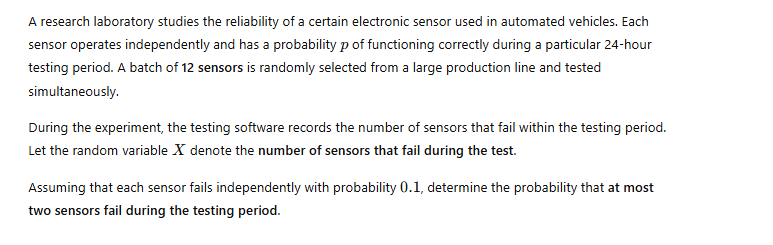
FIRST WRITE GIVENINFORMATION THENWHAT HAVE TO FIND AND THEN DEFINATION ORCONCEPT USED AND THEN STEP BY STEPSOLUTION WITHOUT MENTIONING STEP NUMBER AND AT LAST WRITE FINALANSWERS ONLY AS SUMMARY . ALSO MAKE SOLUTION WELL STRUCTUREDA research laboratory studies the reliability of a certain electronic sensor used in automated vehicles. Each
sensor operates independently and has 2 probability p of functioning correctly during a particular 24-hour
testing period. A batch of 12 sensors is randomly selected from a large production line and tested
simultaneously.
During the experiment, the testing software records the number of sensors that fail within the testing period.
Let the random variable X denote the number of sensors that fail during the test.
‘Assuming that each sensor fails independently with probability 0.1, determine the probability that at most
two sensors fail during the testing period.
Question:
FIRST WRITE GIVENINFORMATION THENWHAT HAVE TO FIND AND THEN DEFINATION ORCONCEPT USED AND THEN STEP BY STEPSOLUTION WITHOUT MENTIONING STEP NUMBER AND AT LAST WRITE FINALANSWERS ONLY AS SUMMARY . ALSO MAKE SOLUTION WELL STRUCTUREDA research laboratory studies the reliability of a certain electronic sensor used in automated vehicles. Each
sensor operates independently and has 2 probability p of functioning correctly during a particular 24-hour
testing period. A batch of 12 sensors is randomly selected from a large production line and tested
simultaneously.
During the experiment, the testing software records the number of sensors that fail within the testing period.
Let the random variable X denote the number of sensors that fail during the test.
‘Assuming that each sensor fails independently with probability 0.1, determine the probability that at most
two sensors fail during the testing period.
This is AI generated Response.
Asked by: nayan
Created at: 2026-03-07 09:47:27
Final Answer:
RenderedRaw Text
Did you like this answer?
# Given Information
- There are **12 sensors** tested simultaneously.
- Each sensor fails independently with probability **.1**.
- Let \( X \) = number of sensors that fail during the test.
# What We Have to Find
- Probability that **at most two sensors fail** during the testing period, i.e., \( P(X \leq 2) \).
# Definition or Concept Used
- This is a **binomial probability problem**.
- The random variable \( X \) (number of failing sensors) follows a **Binomial distribution**:
\[
X \sim \text{Binomial}(n=12, p=.1)
\]
- The probability mass function for the binomial distribution:
\[
P(X = k) = \binom{n}{k} p^k (1-p)^{n-k}
\]
# Step-by-Step Solution
Calculate \( P(X \leq 2) = P(X=) + P(X=1) + P(X=2) \).
\[
P(X=) = \binom{12}{} (.1)^ (.9)^{12} = 1 \times 1 \times .9^{12}
\]
\[
P(X=) = .2824
\]
\[
P(X=1) = \binom{12}{1} (.1)^1 (.9)^{11} = 12 \times .1 \times .9^{11}
\]
\[
P(X=1) = 12 \times .1 \times .3138 = .3766
\]
\[
P(X=2) = \binom{12}{2} (.1)^2 (.9)^{10} = 66 \times .01 \times .3487
\]
\[
P(X=2) = 66 \times .01 \times .3487 = .2301
\]
Sum the probabilities:
\[
P(X \leq 2) = .2824 + .3766 + .2301 = .8891
\]
# Summary
The probability that **at most two sensors fail during the testing period** is **.8891**.
Question:
make answer well structured
This is AI generated Response.
Asked by: nayan
Created at: 2026-03-07 09:48:01
Final Answer:
RenderedRaw Text
Did you like this answer?
# Given Information
- Number of sensors tested: **12**
- Probability of a sensor failing: **0.1**
- Let \( X \) = number of sensors that fail during the testing period.
# What We Have to Find
- Probability that **at most two sensors fail** during the testing period, i.e., \( P(X \leq 2) \).
# Definition or Concept Used
- The scenario follows a **binomial probability distribution**:
\[
X \sim \text{Binomial}(n=12, p=0.1)
\]
- The probability mass function for a binomial distribution is given by:
\[
P(X = k) = \binom{n}{k} p^k (1-p)^{n-k}
\]
# Step-by-Step Solution
Calculate \( P(X \leq 2) \) by finding \( P(X=0) \), \( P(X=1) \), and \( P(X=2) \):
1. **Calculate \( P(X=0) \)**:
\[
P(X=0) = \binom{12}{0} (0.1)^0 (0.9)^{12}
\]
\[
P(X=0) = 1 \times 1 \times (0.9)^{12} \approx 0.2824
\]
2. **Calculate \( P(X=1) \)**:
\[
P(X=1) = \binom{12}{1} (0.1)^1 (0.9)^{11}
\]
\[
P(X=1) = 12 \times 0.1 \times (0.9)^{11} \approx 12 \times 0.1 \times 0.3138 \approx 0.3766
\]
3. **Calculate \( P(X=2) \)**:
\[
P(X=2) = \binom{12}{2} (0.1)^2 (0.9)^{10}
\]
\[
P(X=2) = 66 \times 0.01 \times (0.9)^{10} \approx 66 \times 0.01 \times 0.3487 \approx 0.2301
\]
4. **Sum the probabilities**:
\[
P(X \leq 2) = P(X=0) + P(X=1) + P(X=2) \approx 0.2824 + 0.3766 + 0.2301 = 0.8891
\]
# Summary
The probability that **at most two sensors fail during the testing period** is **0.8891**.
VIPSolutions focuses on clear, step‑by‑step explanations so you can learn quickly. Whether you need an AI‑generated walkthrough or a short hint to get unstuck, each solution is organized for fast reading and easy review later.
Search similar questions, compare approaches, and bookmark the best answers for revision. Our goal is simple: quick, reliable study help that feels natural—not noisy.
 VIPSolutions
 A research laboratory studies the reliability of a certain electronic sensor used in automated vehicles. Each
sensor operates independently and has 2 probability p of functioning correctly during a particular 24-hour
testing period. A batch of 12 sensors is randomly selected from a large production line and tested
simultaneously.
During the experiment, the testing software records the number of sensors that fail within the testing period.
Let the random variable X denote the number of sensors that fail during the test.
‘Assuming that each sensor fails independently with probability 0.1, determine the probability that at most
two sensors fail during the testing period.