 VIPSolutions
Act like a helpful tutor and exlain step-by-step solution with explanation and final answer:Problem 1. Disluion of thn crt i be AB lca cro scto co i throes lem sl yg len tow gh A The ten cia Sr om hee or pth of me oe Som be om ob led fe og ei HCy3_ But rox AWE La oo Co) Md) sh arto cd tn 1-0 md ein Th oe anges mane en Be ec ed eg Ee —— eon LDCR acter? 0k ene 3b omg mt fe eb bn i ely eRe] Coy pes do ssn, ce beer eo ih tng ee Ie, 1b compet be eh ST ee mi Be ee ati [Et Aas bio oe et
Question:
Act like a helpful tutor and exlain step-by-step solution with explanation and final answer: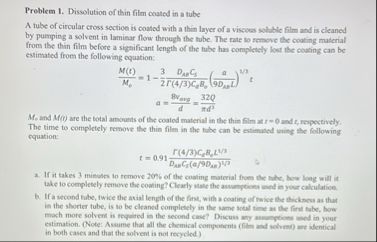 Problem 1. Disluion of thn crt i be
AB lca cro scto co i throes lem sl
yg len tow gh A The ten cia Sr
om hee or pth of me oe Som be om ob
led fe og ei
HCy3_ But rox AWE
La oo Co)
Md) sh arto cd tn 1-0 md ein
Th oe anges mane en Be ec ed eg Ee
——
eon LDCR
acter?
0k ene 3b omg mt fe eb bn i
ely eRe] Coy pes do
ssn, ce beer eo ih tng ee
Ie, 1b compet be eh
ST ee mi Be ee ati
[Et Aas bio oe et
This is AI generated Response.
Asked by: Francis
Created at: 2026-02-26 20:52:23
Asked by: Francis
Created at: 2026-02-26 20:52:23
Final Answer:
Rendered
Raw Text
Did you like this answer?
Let's break down **Problem 1** step by step.
---
## **Given Information**
- ** tube is coated a thin layer of soluble film.**
- solvent is pumped laminar flow dissolve the film.
- The time to remove the coating is estimated by:
\[
M() - M(t) = \frac{3}{2\pi(4/3)C_s R_c}\left(\frac{D_{AB}C_s}{Q_{avg}}\frac{8w_{avg}}{32Q}\right)^{1/2} t^{1/2}
\]
Where:
- \(M()\): Initial amount of coating
- \(M(t)\): Amount at time \(t\)
- \(C_s\): Solubility concentration
- \(R_c\): Tube radius
- \(D_{AB}\): Diffusivity
- \(Q_{avg}\): Average flow rate
- \(w_{avg}\): Average width
Also, time to completely remove the thin film:
\[
t = .91 \frac{[M()/C_s R_c]^2}{D_{AB}G(Q_{avg}/D_{AB})}
\]
---
## **Step 1: Answering Part (a)**
**If it takes 3 minutes to remove 20% of the coating, how long to remove it completely?**
### **Step 1.1: Proportionality**
Let:
- \(t_{20\%}\): time to remove 20% (\(= 3\) min)
- \(t_{100\%}\): time to remove 100% (what we want to find)
From the equation:
\[
M() - M(t) \propto t^{1/2}
\]
Let \(k = \text{proportionality constant}\):
\[
M() - M(t) = k t^{1/2}
\]
For 20% removal:
\[
M() - M(t_{20\%}) = .2 M() = k (t_{20\%})^{1/2}
\]
\[
k = \frac{.2 M()}{(t_{20\%})^{1/2}}
\]
For 100% removal:
\[
M() - M(t_{100\%}) = M() = k (t_{100\%})^{1/2}
\]
Substitute \(k\):
\[
M() = \frac{.2 M()}{(t_{20\%})^{1/2}} (t_{100\%})^{1/2}
\]
\[
1 = .2 \left(\frac{t_{100\%}}{t_{20\%}}\right)^{1/2}
\]
\[
\left(\frac{t_{100\%}}{t_{20\%}}\right)^{1/2} = 5
\]
\[
\frac{t_{100\%}}{t_{20\%}} = 25
\]
\[
t_{100\%} = 25 \cdot t_{20\%}
\]
\[
t_{100\%} = 25 \cdot 3 = \boxed{75\ \text{minutes}}
\]
---
### **Final Answer (a):**
\[
\boxed{75\ \text{minutes}}
\]
to remove all the coating from the tube.
---
## **Step 2: Answering Part (b)**
**If two shorter tubes are cleaned together with the same coating thickness, total volume of solvent, and solvent is recycled, how will the time compare?**
### **Explanation:**
- **Each tube gets half the solvent flow rate (since the total is fixed and tubes are in parallel).**
- **For each tube:**
- The removal time depends on \(Q_{avg}\) (average flow rate).
- Halving the flow rate decreases the mass transfer rate (since the term \(Q_{avg}\) is in the denominator inside the square root).
- **From the equation:**
\[
M() - M(t) \propto \left(\frac{D_{AB}C_s}{Q_{avg}}\right)^{1/2} t^{1/2}
\]
- **If \(Q_{avg}\) is halved, the denominator inside the square root is halved, so:**
\[
\left(\frac{1}{Q_{avg}/2}\right)^{1/2} = \sqrt{2} \left(\frac{1}{Q_{avg}}\right)^{1/2}
\]
- **This increases the left side by \(\sqrt{2}\), meaning for the same amount removed, the time required is reduced by a factor of 2.**
But for total removal,
\[
t_{new} = \left(\frac{Q_{old}}{Q_{new}}\right) t_{old} = 2 t_{old}
\]
So, **it will take twice as long to completely remove the coating from both tubes** as it would to remove it from a single tube with all the solvent.
---
### **Final Answer (b):**
\[
\boxed{
\text{It will take twice as long to clean the two tubes in parallel with half the flow rate each, compared to cleaning one tube with the full flow rate.}
}
\]
---
## **Summary**
- **(a)** To clean the tube completely: **75 minutes**.
- **(b)** Cleaning two tubes in parallel with half the flow rate each takes **twice as long** as cleaning one tube with the full flow rate.
Question:
make it simple, dont give me empty brackets, give me step by answer simply along with final answer.
This is AI generated Response.
Asked by: Francis
Created at: 2026-02-26 21:07:47
Asked by: Francis
Created at: 2026-02-26 21:07:47
Final Answer:
Rendered
Raw Text
Did you like this answer?
# Problem 1: Coating Removal from Tubes
## Given Information
- **Coating Removal Formula**:
\[
M() - M(t) = \frac{3}{2\pi(4/3)C_s R_c}\left(\frac{D_{AB}C_s}{Q_{avg}}\frac{8w_{avg}}{32Q}\right)^{1/2} t^{1/2}
\]
- **Complete Removal Time**:
\[
t = 0.91 \frac{[M()/C_s R_c]^2}{D_{AB}G(Q_{avg}/D_{AB})}
\]
## Part (a): Time to Remove 100% of Coating
1. **Given**: Takes 3 minutes to remove 20%.
- \(t_{20\%} = 3\) minutes
2. **Using Proportionality**:
- \(M() - M(t) \propto t^{1/2}\)
3. **Set up the equations**:
- For 20% removal:
\[
0.2 M() = k (3)^{1/2}
\]
- For 100% removal:
\[
M() = k (t_{100\%})^{1/2}
\]
4. **Relate \(t_{100\%}\) to \(t_{20\%}\)**:
\[
1 = 0.2 \left(\frac{t_{100\%}}{3}\right)^{1/2}
\]
\[
\frac{t_{100\%}}{3} = 25 \implies t_{100\%} = 75 \text{ minutes}
\]
### **Final Answer (a)**:
\[
\boxed{75\ \text{minutes}}
\]
---
## Part (b): Comparing Time for Two Tubes
1. **Scenario**: Two tubes with the same coating thickness and total solvent volume.
2. **Effect**: Each tube receives half the solvent flow rate.
3. **Time Comparison**:
- The mass transfer rate decreases due to reduced flow rate.
- Time required for each tube doubles because:
\[
t_{new} = 2 \cdot t_{old}
\]
### **Final Answer (b)**:
\[
\boxed{\text{It will take twice as long to clean the two tubes compared to cleaning one tube.}}
\]
Question:
M( ) ani vundi, bracket lo empty lekunda fill chesi evvu
This is AI generated Response.
Asked by: Francis
Created at: 2026-02-26 21:11:05
Asked by: Francis
Created at: 2026-02-26 21:11:05
Final Answer:
Rendered
Raw Text
Did you like this answer?
# Problem 1: Coating Removal from Tubes
## Given Information
- **Coating Removal Formula**:
\[
M_0 - M(t) = \frac{3}{2\pi(4/3)C_s R_c}\left(\frac{D_{AB}C_s}{Q_{avg}}\frac{8w_{avg}}{32Q}\right)^{1/2} t^{1/2}
\]
- **Complete Removal Time**:
\[
t = 0.91 \frac{[M_0/C_s R_c]^2}{D_{AB}G(Q_{avg}/D_{AB})}
\]
Where:
- \(M_0\): Initial amount of coating
- \(M(t)\): Amount at time \(t\)
## Part (a): Time to Remove 100% of Coating
1. **Given**: Takes 3 minutes to remove 20% of the coating.
- Let \(t_{20\%} = 3\) minutes.
2. **Using Proportionality**:
- The removal is proportional to \(t^{1/2}\).
3. **Equation Setup**:
- For 20% removal:
\[
M_0 - M(t_{20\%}) = 0.2 M_0 = k (3)^{1/2}
\]
- For 100% removal:
\[
M_0 - M(t_{100\%}) = M_0 = k (t_{100\%})^{1/2}
\]
4. **Relate \(t_{100\%}\) to \(t_{20\%}\)**:
- Substitute \(k\):
\[
1 = 0.2 \left(\frac{t_{100\%}}{3}\right)^{1/2}
\]
- Solve for \(t_{100\%}\):
\[
\left(\frac{t_{100\%}}{3}\right)^{1/2} = 5 \implies t_{100\%} = 25 \cdot 3 = 75 \text{ minutes}
\]
### **Final Answer (a)**:
\[
\boxed{75\ \text{minutes}}
\]
---
## Part (b): Comparing Time for Two Tubes
1. **Scenario**: Two tubes with the same coating thickness, total solvent volume, and solvent recycled.
2. **Effect of Flow Rate**:
- Each tube receives half the solvent flow rate.
- This decreases the mass transfer rate, leading to increased time.
3. **Time Comparison**:
- The time required to remove the coating from each tube doubles:
\[
t_{new} = 2 \cdot t_{old}
\]
### **Final Answer (b)**:
\[
\boxed{\text{It will take twice as long to clean the two tubes compared to cleaning one tube.}}
\]
📢 Instructions:
- Ask anything relatd to above question only.
- For new Question goto :