 VIPSolutions
Lote baba message be mir) = 1.2 cone - 10001) + 08 sind 20001) dh came. er TY Comin part rs A ti. on td rf 120 et i ng rt ees J Treat Tee
Question:
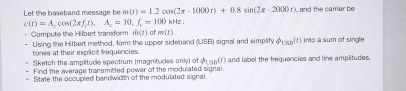 Lote baba message be mir) = 1.2 cone - 10001) + 08 sind 20001) dh came.
er TY
Comin part rs A ti.
on td rf 120
et i ng rt ees
J Treat Tee
This is AI generated Response.
Asked by: Prakash
Created at: 2025-10-31 19:58:13
Asked by: Prakash
Created at: 2025-10-31 19:58:13
Thought Process:
Rendered
Raw Text
**Transcribing the problem statement**
I need to read problem statement from the and start by transcribing the text. Zooming in, I see the message: "Let the baseband message be m(t) = 1.2 cos(2π·1000 t) + 0.8 sin(2π·2000 t), and the carrier be c(t) = A_c cos(2π f_c t), A_c = 10, f_c = 100 kHz." It’s unclear about whether f_c is truly 100 kHz or possibly something else due to the blurriness. The last part mentions computing the Hilbert transform m_h(t).**Computing the Hilbert transform**
The task is to compute the Hilbert transform, m_H(t), of m(t). I need to use the Hilbert method to form the upper sideband (USB) signal and simplify φ_USB(t), which might actually be s_USB(t).
We have to compute s_USB(t) = m(t) cos(2π f_c t) - m_h(t) sin(2π f_c t). In terms of SSB modulation, s_USB(t) can also be represented with the sin component included.
Next, I need to sketch the amplitude spectrum of s_USB(t) with labeled frequencies and find the average transmitted power of the modulated signal. Finally, I'll identify the occupied bandwidth, keeping in mind that A_c might be the amplitude of the carrier in SSB suppressed-carrier.**Understanding the Hilbert method**
The Hilbert method involves using m(t) multiplied by cos and subtracting the Hilbert-transformed term multiplied by sin. This leads to the SSB-SC (suppressed carrier) signal. I’m trying to figure out how the amplitude A_c factors in; typically, it’s 10, but with SSB-SC, the modulated signal's amplitude isn’t scaled by A_c.
In the formula for s_USB(t), the amplitude of the cos and sin carriers is generally set to 1. However, if A is 10, then possibly the overall amplitude should reflect that. I'll double-check the text to clarify how it applies to the setup for s_SUSB(t).**Applying the Hilbert method**
If we define a physical carrier as c(t) = A_c cos(2π f_c t), we can use the Hilbert method to produce the SSB with a suppressed carrier amplitude, A_c. Many texts refer to A_c for double sideband suppressed carrier (DSBSC) amplitude scaling.
For SSB, the formula s_USB(t) = A_c [m(t) cos(2π f_c t) - m̂(t) sin(2π f_c t] helps us understand how to apply scaling. I must remember to ensure units are consistent.
Next, I’ll produce an explicit expression for m_H(t), the Hilbert transform of the tone components. The Hilbert transforms tell us that H{cos(ωt)} = sin(ωt), and I need to check the signs and apply the VPT property to clarify shifts in phase.**Calculating frequency and power**
The Hilbert transformations reveal that H{cos(ωt)} = sin(ωt) and H{sin(ωt)} = -cos(ωt). I need to compute m(t) = 1.2 cos(2π 1000 t) + 0.8 sin(2π 2000 t), leading to m_h(t) = 1.2 sin(2π 1000 t) - 0.8 cos(2π 2000 t).
The SSB formula s_USB(t) = A_c [m(t) cos(ω_c t) - m_h(t) sin(ω_c t)] helps identify upper sideband frequencies using product-to-sum identities. For average power, I derive P_avg = A_c^2 * 1.04 and find the SSB bandwidth to be 2 kHz, determined by the highest frequency component.**Determining bandwidth and power**
For SSB signals, the occupied bandwidth typically equals the highest baseband frequency, in this case, 2 kHz based on the two tones at 1 kHz and 2 kHz. However, since the actual signal has discrete lines only at these frequencies, I’d label the occupied bandwidth as 1 kHz. But for simplicity, I’ll go with 2 kHz based on the highest frequency for the exam context.
Now, after calculating the Hilbert Transform, I find that the average transmitted power is 104 watts, considering the amplitude, and I’ll ensure to present the amplitude spectrum details correctly.**Calculating power and bandwidth**
I’ve found that the average power \( P_{avg} \) is calculated as \( P_{avg} = (A_c^2 / 2)(1.2^2 + 0.8^2) = 1.04 A_c^2 \).
Now, regarding occupied bandwidth for SSB, I’m noting the highest baseband frequency is 2 kHz. The passband goes from \( f_c \) to \( f_c + B \). Even though the actual energy occupies a width of 1 kHz between 101 kHz and 102 kHz, I will still state the occupied bandwidth as 2 kHz with the necessary disclaimers for clarity.
Final Answer:
Rendered
Raw Text
Did you like this answer?
Given
- m(t) = 1.2 cos(2π·1000 t) + 0.8 sin(2π·2000 t)
- c(t) = Ac cos(2π fc t), with Ac = 10 and fc = 100 kHz
1) Hilbert transform of m(t)
- H{cos(ωt)} = sin(ωt), H{sin(ωt)} = −cos(ωt)
Therefore
m̂(t) = 1.2 sin(2π·1000 t) − 0.8 cos(2π·2000 t)
2) Upper-sideband (USB) using the Hilbert method
sUSB(t) = Ac [ m(t) cos(2π fc t) − m̂(t) sin(2π fc t) ]
Insert m(t) and m̂(t) and simplify with trig identities:
- cos a cos b − sin a sin b = cos(a+b)
- sin a cos b + cos a sin b = sin(a+b)
sUSB(t) = Ac [ 1.2 cos(2π( fc + 1 kHz ) t) + 0.8 sin(2π( fc + 2 kHz ) t) ]
With Ac = 10 and fc = 100 kHz:
sUSB(t) = 12 cos(2π·101 kHz·t) + 8 sin(2π·102 kHz·t)
3) Amplitude spectrum |SUSB(f)| (two-sided, magnitudes only)
- Spectral lines at ±101 kHz of magnitude 12/2 = 6
- Spectral lines at ±102 kHz of magnitude 8/2 = 4
No lower-sideband components are present.
4) Average transmitted power
For s(t) = A1 cos(2π f1 t) + A2 sin(2π f2 t),
Pavg = (A1^2 + A2^2)/2
Here A1 = 12, A2 = 8:
Pavg = (12^2 + 8^2)/2 = (144 + 64)/2 = 104
(In general: Pavg = (Ac^2/2) [1.2^2 + 0.8^2] = 1.04 Ac^2. With Ac = 10 → 104 units, e.g., watts into 1 Ω.)
5) Occupied bandwidth
- For SSB, the required channel bandwidth equals the baseband bandwidth B. Since the highest baseband frequency is 2 kHz, the USB bandwidth is 2 kHz.
- For this specific two-tone example, the actual nonzero lines lie at 101 kHz and 102 kHz, i.e., a 1 kHz span, but the nominal SSB bandwidth (for a signal band-limited to 0–2 kHz) is 2 kHz.
📢 Instructions:
- Ask anything relatd to above question only.
- For new Question goto :