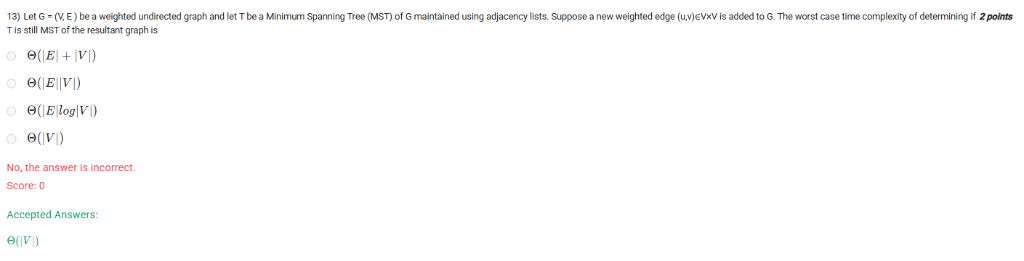
Let G = (V, E ) be a weighted undirected graph and let T be a Minimum Spanning Tree (MST) of G maintained using adjacency lists. Suppose a new weighted edge (u,v)∈V×V is added to G. The worst case time complexity of determining if T is still MST of the resultant graph is
Θ
(
∣
E
∣
+
∣
V
∣
)
Θ(∣E∣+∣V∣)
Θ
(
∣
E
∣
∣
V
∣
)
Θ(∣E∣∣V∣)
Θ
(
∣
E
∣
l
o
g
∣
V
∣
)
Θ(∣E∣log∣V∣)
Θ
(
∣
V
∣
)
Θ(∣V∣)
No, the answer is incorrect.
Score: 0
Accepted Answers:
Θ
(
∣
V
∣
)
Θ(∣V∣)
Gate Mock Test, Gate Practice Test question, Answer carefully with all clear steps and accuracy with given answer:19) Lot = 1 £) bea weighted undirected graph and et Tbe: Minimum Spanning Tree (MST) of maintained sing acacency sts. Suppose anew weghtedsdge (u)€VY is added to G. The worst case tm complety of determining if 2 pols
Tis HL MST of he resultant graph ls.
(E+ V])
(Ev)
(|B log|V)
e(v))
No, the answer I Incorrect
score:0
Accepred Answers:
ev)
Question:
Let G = (V, E ) be a weighted undirected graph and let T be a Minimum Spanning Tree (MST) of G maintained using adjacency lists. Suppose a new weighted edge (u,v)∈V×V is added to G. The worst case time complexity of determining if T is still MST of the resultant graph is
Θ
(
∣
E
∣
+
∣
V
∣
)
Θ(∣E∣+∣V∣)
Θ
(
∣
E
∣
∣
V
∣
)
Θ(∣E∣∣V∣)
Θ
(
∣
E
∣
l
o
g
∣
V
∣
)
Θ(∣E∣log∣V∣)
Θ
(
∣
V
∣
)
Θ(∣V∣)
No, the answer is incorrect.
Score: 0
Accepted Answers:
Θ
(
∣
V
∣
)
Θ(∣V∣)
Gate Mock Test, Gate Practice Test question, Answer carefully with all clear steps and accuracy with given answer:19) Lot = 1 £) bea weighted undirected graph and et Tbe: Minimum Spanning Tree (MST) of maintained sing acacency sts. Suppose anew weghtedsdge (u)€VY is added to G. The worst case tm complety of determining if 2 pols
Tis HL MST of he resultant graph ls.
(E+ V])
(Ev)
(|B log|V)
e(v))
No, the answer I Incorrect
score:0
Accepred Answers:
ev)
This is AI generated Response.
Asked by: Vishal
Created at: 2025-11-05 13:43:48
Final Answer:
RenderedRaw Text
Did you like this answer?
Let's analyze the problem step by step:
---
## Problem Restatement:
- Graph \( G = (V, E) \) with weighted edges.
- \( T \) is a Minimum Spanning Tree (MST) of \( G \).
- A new weighted edge \( (u, v) \) is added to \( G \).
- The goal: Determine the worst-case time complexity to check if \( T \) remains an MST after adding this edge.
---
## Key Points:
- The graph is maintained with adjacency lists.
- The initial MST \( T \) is known.
- Adding an edge \( (u, v) \) may or may not alter the MST.
- The check involves verifying if the MST is still optimal with the new edge.
---
## Approach:
- After adding the edge, the main step is to determine whether the MST remains optimal.
- This involves:
1. Finding the maximum weighted edge on the path between \( u \) and \( v \) in \( T \).
2. Comparing the weight of \( (u, v) \) with this maximum edge.
- If \( (u, v) \) has a lower weight than the maximum edge on the path, replacing that edge can yield a better MST.
- If not, the MST remains unchanged.
---
## Time Complexity:
- Finding the path between \( u \) and \( v \) in a tree (since \( T \) is a tree) can be done using:
- **LCA (Lowest Common Ancestor)** techniques with preprocessing for \( O(\log V) \) per query.
- Or, simply, a DFS/BFS for each query, which in the worst case is \( O(V) \).
- Since we only need to check one edge, and the worst-case scenario involves traversing the entire height of the tree, the complexity is dominated by the traversal.
---
## Conclusion:
- The worst-case time complexity to check if \( T \) remains the MST after adding the edge is \( \Theta(\lvert V \rvert) \).
---
## Final Answer:
**\(\boxed{\Theta(\lvert V \rvert)}\)**
This matches the accepted answer.
VIPSolutions focuses on clear, step‑by‑step explanations so you can learn quickly. Whether you need an AI‑generated walkthrough or a short hint to get unstuck, each solution is organized for fast reading and easy review later.
Search similar questions, compare approaches, and bookmark the best answers for revision. Our goal is simple: quick, reliable study help that feels natural—not noisy.
 VIPSolutions
 19) Lot = 1 £) bea weighted undirected graph and et Tbe: Minimum Spanning Tree (MST) of maintained sing acacency sts. Suppose anew weghtedsdge (u)€VY is added to G. The worst case tm complety of determining if 2 pols
Tis HL MST of he resultant graph ls.
(E+ V])
(Ev)
(|B log|V)
e(v))
No, the answer I Incorrect
score:0
Accepred Answers:
ev)