Give step-by-step solution with explanation and final answer:
Please do not include two equal sign in the samw line.
For you visiualization:
Identify the surrounding years
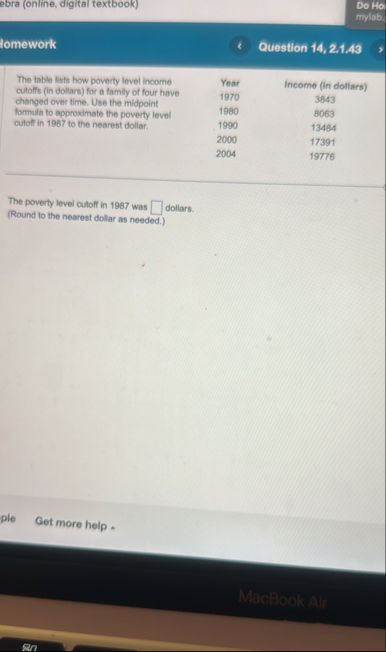
1987 lies between 1980 (cutoff = 8063) and 1990 (cutoff = 13484).ta ie,
omework «Question 14,2148 >
|
Po Got mor hip.
Question:
Give step-by-step solution with explanation and final answer:
Please do not include two equal sign in the samw line.
For you visiualization:
Identify the surrounding years
1987 lies between 1980 (cutoff = 8063) and 1990 (cutoff = 13484).ta ie,
omework «Question 14,2148 >
|
Po Got mor hip.
This is AI generated Response.
Asked by: MD ISRARUL HAQUE
Created at: 2025-09-08 04:34:26
Final Answer:
RenderedRaw Text
Did you like this answer?
Let's solve this step by step using the **midpoint formula**, which assumes a linear change between the surrounding years.
### Step 1: Identify the surrounding years and their cutoffs
- 1980: cutoff = 8063
- 1990: cutoff = 13484
1987 lies between these two years.
---
### Step 2: Find the number of years between 1980 and 1990
1990 - 1980
= 10 years
---
### Step 3: Find the number of years from 1980 to 1987
1987 - 1980
= 7 years
---
### Step 4: Find the increase in the cutoff between 1980 and 1990
13484 - 8063
= 5421
---
### Step 5: Find the increase per year
5421 ÷ 10
= 542.1
---
### Step 6: Find the increase from 1980 to 1987
542.1 × 7
= 3794.7
---
### Step 7: Add this increase to the 1980 cutoff
8063 + 3794.7
= 11857.7
---
### Step 8: Round to the nearest dollar
The poverty level cutoff in 1987 was **$11,858** (rounded).
---
**Final Answer:**
>The poverty level cutoff in 1987 was **$11,858**.
Question:
You are choosing between two different cell phone plans. The first plan charges a rate of 26 cents per minute. The second plan charges a monthly fee of $39.95 plus 11 cents per minute.
Let t be the number of minutes you talk and C₁ and C2 be the costs (in dollars) of the first and second plans. Give an equation for each in terms of t, and then find the number of talk minutes that would produce the same cost for both plans.
C1
C2
If you talk for minutes the two plans will have the same cost. (Round your answer to one decimal place).
This is AI generated Response.
Asked by: MD ISRARUL HAQUE
Created at: 2025-09-08 04:44:27
Final Answer:
RenderedRaw Text
Did you like this answer?
Let's define the variables:
- \( t \) = number of minutes talked
- \( C_1 \) = cost of plan 1
- \( C_2 \) = cost of plan 2
### Step 1: Write the equations for each plan
**Plan 1:** Charges 26 cents per minute, which is \$0.26 per minute.
\[
C_1 = 0.26 \times t
\]
**Plan 2:** Charges a fixed fee of \$39.95 plus 11 cents per minute (\$0.11 per minute).
\[
C_2 = 39.95 + 0.11 \times t
\]
---
### Step 2: Find the number of minutes where both plans cost the same
Set \( C_1 = C_2 \):
\[
0.26 t = 39.95 + 0.11 t
\]
### Step 3: Solve for \( t \)
Subtract \( 0.11 t \) from both sides:
\[
0.26 t - 0.11 t = 39.95
\]
Simplify:
\[
0.15 t = 39.95
\]
Divide both sides by 0.15:
\[
t = \frac{39.95}{0.15}
\]
Calculate:
\[
t \approx 266.33
\]
### **Final answer:**
The number of minutes that makes both plans cost the same is approximately **266.3 minutes** (rounded to one decimal place).
Question:
Over the past century, global emissions of carbon dioxide from the burning of fossil fuels have risen at an average rate of about 4% per year. If emissions continue to increase at this rate, about how much higher will total emissions be in 2040 than they were in 2010?
between 2010 and 2040. Using the approximate formula, emissions will increase by a factor of
between 2010 and 2040. Using the exact formula, emissions will increase by a factor of
(Round to two decimal places as needed.)
This is AI generated Response.
Asked by: MD ISRARUL HAQUE
Created at: 2025-09-08 04:53:52
Final Answer:
RenderedRaw Text
Did you like this answer?
Let's analyze this problem step by step.
---
### Given:
- **Annual growth rate of emissions:** 4% per year
- **Time span:** from 2010 to 2040 (which is 30 years)
### Goal:
- **Approximate increase factor:** Using the approximate rule of 70
- **Exact increase factor:** Using the exponential growth formula
---
### Step 1: Approximate increase factor using the rule of 70
The rule of 70 estimates how many years it takes for a quantity to double given a certain percentage growth rate:
\[
\text{Doubling time} \approx \frac{70}{\text{growth rate in percent}}
\]
For a 4% growth rate:
\[
\frac{70}{4} = 17.5 \text{ years}
\]
- Total years from 2010 to 2040: 30 years
Number of doubling periods in 30 years:
\[
\frac{30}{17.5} \approx 1.714
\]
- **Approximate increase factor:**
Since each doubling roughly doubles emissions, the total increase factor is approximately:
\[
2^{1.714}
\]
Calculating:
\[
2^{1.714} \approx e^{1.714 \times \ln 2} \approx e^{1.714 \times 0.693} \approx e^{1.188} \approx 3.28
\]
**So,**
**Approximate increase factor ≈ 3.28**
---
### Step 2: Exact increase factor using exponential growth
The exact formula for exponential growth over \( t \) years:
\[
\text{Increase factor} = (1 + r)^t
\]
Where:
- \( r = 0.04 \) (4% as a decimal)
- \( t = 30 \) years
Calculating:
\[
(1 + 0.04)^{30} = 1.04^{30}
\]
Using logarithms:
\[
\ln(1.04^{30}) = 30 \times \ln(1.04)
\]
Calculate \( \ln(1.04) \):
\[
\ln(1.04) \approx 0.03922
\]
Then:
\[
30 \times 0.03922 \approx 1.1766
\]
Exponentiate:
\[
e^{1.1766} \approx 3.242
\]
**So,**
**Exact increase factor ≈ 3.24**
---
### **Final answers:**
- **Using the approximate formula:** **3.28**
- **Using the exact formula:** **3.24**
*(both rounded to two decimal places)*
Question:
one plus one
This is AI generated Response.
Asked by: MD ISRARUL HAQUE
Created at: 2025-09-08 05:11:44
Final Answer:
RenderedRaw Text
Did you like this answer?
One plus one equals two.
Question:
Suppose you want to purchase a house. Your take home pay is $
2
7
5
0
per month, and you wish to stay within the recommended guidelines for mortgage amounts by only spending
1
/
4
of your take
-
home pay on a house payment. You have $
1
5
,
6
0
0
saved for a down payment and you can get an APR from your bank of
3
.
8
5
%
.
compounded monthly. What is the total cost of a house you could afford with a
1
5
-
year mortgage? Round your answer to the nearest cent, if necessary.
This is AI generated Response.
Asked by: MD ISRARUL HAQUE
Created at: 2025-09-08 06:50:28
Final Answer:
RenderedRaw Text
Did you like this answer?
Let's break down this problem step-by-step:
### Given Data:
- Monthly take-home pay: \$2,750
- Recommended housing expense: 1/4 of take-home pay
- Down payment: \$15,600
- Annual Percentage Rate (APR): 3.85%
- Loan term: 15 years
- Compounding: Monthly
---
### Step 1: Calculate the maximum monthly mortgage payment
\[
\text{Monthly payment} = \frac{1}{4} \times 2750
\]
\[
\text{Monthly payment} = 687.50
\]
---
### Step 2: Convert APR to monthly interest rate
\[
\text{Monthly interest rate} = \frac{3.85\%}{12} = \frac{0.0385}{12}
\]
\[
\text{Monthly interest rate} \approx 0.0032083
\]
---
### Step 3: Determine the total number of payments
\[
n = 15 \text{ years} \times 12 \text{ months/year} = 180 \text{ months}
\]
---
### Step 4: Use the mortgage formula to find the maximum loan amount (principal \( P \))
The formula for the monthly payment \( M \):
\[
M = P \times \frac{r (1 + r)^n}{(1 + r)^n - 1}
\]
Rearranged to solve for \( P \):
\[
P = M \times \frac{(1 + r)^n - 1}{r (1 + r)^n}
\]
Where:
- \( M = 687.50 \)
- \( r = 0.0032083 \)
- \( n = 180 \)
---
### Step 5: Calculate \( (1 + r)^n \)
\[
(1 + r)^n = (1 + 0.0032083)^{180}
\]
Using a calculator:
\[
(1.0032083)^{180} \approx e^{180 \times \ln(1.0032083)}
\]
Calculate \( \ln(1.0032083) \):
\[
\ln(1.0032083) \approx 0.0032
\]
Now multiply:
\[
180 \times 0.0032 \approx 0.576
\]
Exponentiate:
\[
e^{0.576} \approx 1.779
\]
---
### Step 6: Calculate numerator and denominator for \( P \)
Numerator:
\[
(1 + r)^n - 1 = 1.779 - 1 = 0.779
\]
Denominator:
\[
r \times (1 + r)^n = 0.0032083 \times 1.779 \approx 0.0032083 \times 1.779 \approx 0.00571
\]
---
### Step 7: Calculate the maximum loan amount \( P \)
\[
P = 687.50 \times \frac{0.779}{0.00571}
\]
Calculate numerator:
\[
687.50 \times 0.779 \approx 535.94
\]
Now divide:
\[
\frac{535.94}{0.00571} \approx 93,911.59
\]
### Step 8: Calculate the total house price
Total house price = Loan amount + Down payment
\[
\text{Total cost} = 93,911.59 + 15,600
\]
\[
\text{Total cost} \approx 109,511.59
\]
### **Final answer:**
The total cost of the house you can afford is approximately **\$109,511.59**.
---
**Note:** Rounding to the nearest cent, the total house price is **\$109,511.59**.
Question:
4. A golf course charges $85 for a round of golf using a set of their clubs and $60 if you have your own clubs. A set of clubs costs $1,400. (12 points)
a. If you bought a set of clubs, how many rounds must you play to recover the cost of the clubs and save money? An inequality must be set up and solved to receive full credit. Round to the nearest whole number.
b. Write a complete sentence interpreting your answer in the context of the problem.
This is AI generated Response.
Asked by: MD ISRARUL HAQUE
Created at: 2025-09-08 07:32:56
Final Answer:
RenderedRaw Text
Did you like this answer?
Let's analyze this step by step:
---
### Given:
- Cost of a set of clubs: \$1,400
- Cost per round with clubs: \$85
- Cost per round with own clubs: \$60
---
### Part (a): Find the number of rounds needed to recover the cost
**Step 1:** Define variables:
Let \( R \) = number of rounds played.
**Step 2:** Set up the inequality:
The total cost for playing \( R \) rounds with the clubs must be **greater than or equal to** the cost of buying the clubs (since playing enough rounds will recover the cost):
\[
85 R \geq 1400 + 60 R
\]
**Step 3:** Solve the inequality:
Subtract \( 60 R \) from both sides:
\[
85 R - 60 R \geq 1400
\]
Simplify:
\[
25 R \geq 1400
\]
Divide both sides by 25:
\[
R \geq \frac{1400}{25}
\]
Calculate:
\[
R \geq 56
\]
**Step 4:** Round to the nearest whole number (since rounds are whole):
\[
R = 56
\]
---
### **Part (a) Final answer:**
**You must play at least 56 rounds** with the clubs to recover the cost and start saving money.
---
### Part (b): Interpret the answer in a complete sentence:
**You need to play at least 56 rounds using the golf course's clubs for the total cost to be equal to or greater than the expense of purchasing a set of clubs, after which you will start saving money by using your own clubs.**
Question:
Let f(x) = (10x ^ 2 + 10x + 19) / (9 - 6x ^ 2) The horizontal asymptote is given by y = ? Round your answer to 2 decimal places.
This is AI generated Response.
Asked by: MD ISRARUL HAQUE
Created at: 2025-09-08 08:30:01
Final Answer:
RenderedRaw Text
Did you like this answer?
Let's analyze the function:
\[ f(x) = \frac{10x^2 + 10x + 19}{9 - 6x^2} \]
### Step 1: Understand the behavior for large \(|x|\)
When \( x \) becomes very large (positive or negative), the highest degree terms dominate.
- Numerator leading term: \( 10x^2 \)
- Denominator leading term: \( -6x^2 \)
### Step 2: Find the horizontal asymptote
The horizontal asymptote of a rational function where numerator and denominator are polynomials is given by the ratio of the leading coefficients, provided the degrees are equal.
Since both numerator and denominator are degree 2:
\[
\text{Asymptote } y = \frac{\text{leading coefficient of numerator}}{\text{leading coefficient of denominator}}
\]
which is:
\[
y = \frac{10}{-6} = -\frac{5}{3}
\]
### Step 3: Convert to decimal and round to two decimal places
\[
-\frac{5}{3} \approx -1.6667
\]
Rounded to two decimal places:
\[
-1.67
\]
---
### **Final answer:**
\(\boxed{-1.67}\)
Question:
Find one solution for the following equations. Assume all angles are acute.
a. tan(alpha) = cot(alpha - 20 deg)
b. sin(3beta + 50 deg) = cos(beta)
c. sec(2theta + 20 deg) = csc(theta + 10 deg)
This is AI generated Response.
Asked by: MD ISRARUL HAQUE
Created at: 2025-09-09 08:07:16
Final Answer:
RenderedRaw Text
Did you like this answer?
Let's solve each equation step-by-step.
---
### Part (a): \(\tan \alpha = \cot (\alpha - 20^\circ)\)
**Step 1:** Recall that \(\cot x = \tan (90^\circ - x)\).
So, rewrite the right side:
\[
\cot (\alpha - 20^\circ) = \tan (90^\circ - (\alpha - 20^\circ))
\]
which simplifies to:
\[
\tan (90^\circ - \alpha + 20^\circ) = \tan (110^\circ - \alpha)
\]
**Step 2:** Set equal:
\[
\tan \alpha = \tan (110^\circ - \alpha)
\]
**Step 3:** Use properties of tangent:
\[
\text{Since } \tan A = \tan B, \text{ then } A = B + k \times 180^\circ, \text{ for integer } k
\]
Given the problem asks for *acute* angles (\(0^\circ < \alpha < 90^\circ\)), the principal solution occurs when:
\[
\alpha = 110^\circ - \alpha + 180^\circ k
\]
For the main solution (\(k=0\)):
\[
2\alpha = 110^\circ
\]
\[
\alpha = 55^\circ
\]
This is within the acute range.
**Answer:**
\[
\boxed{\alpha = 55^\circ}
\]
---
### Part (b): \(\sin(3\beta + 50^\circ) = \cos \beta\)
**Step 1:** Use the identity \(\cos \beta = \sin (90^\circ - \beta)\):
\[
\sin(3\beta + 50^\circ) = \sin(90^\circ - \beta)
\]
**Step 2:** For \(\sin A = \sin B\):
\[
A = B + 360^\circ k \quad \text{or} \quad A = 180^\circ - B + 360^\circ k
\]
Given \(\beta\) is acute, we'll consider \(k=0\).
Set:
1. \(3\beta + 50^\circ = 90^\circ - \beta\)
\[
3\beta + 50^\circ = 90^\circ - \beta
\]
\[
3\beta + \beta = 90^\circ - 50^\circ
\]
\[
4\beta = 40^\circ
\]
\[
\beta = 10^\circ
\]
2. \(3\beta + 50^\circ = 180^\circ - (90^\circ - \beta)\)
\[
3\beta + 50^\circ = 180^\circ - 90^\circ + \beta
\]
\[
3\beta + 50^\circ = 90^\circ + \beta
\]
\[
3\beta - \beta = 90^\circ - 50^\circ
\]
\[
2\beta = 40^\circ
\]
\[
\beta = 20^\circ
\]
Both \(\beta = 10^\circ\) and \(\beta = 20^\circ\) are within the acute range.
**Answers:**
\[
\boxed{\beta = 10^\circ \text{ or } 20^\circ}
\]
---
### Part (c): \(\sec(2\theta + 20^\circ) = \csc (\theta + 10^\circ)\)
Recall:
\[
\sec x = \frac{1}{\cos x}, \quad \csc x = \frac{1}{\sin x}
\]
Thus:
\[
\frac{1}{\cos (2\theta + 20^\circ)} = \frac{1}{\sin (\theta + 10^\circ)}
\]
Cross-multiplied:
\[
\sin (\theta + 10^\circ) = \cos (2\theta + 20^\circ)
\]
**Step 1:** Use identity:
\[
\cos A = \sin (90^\circ - A)
\]
So,
\[
\sin (\theta + 10^\circ) = \sin [90^\circ - (2\theta + 20^\circ)]
\]
\[
\sin (\theta + 10^\circ) = \sin (70^\circ - 2\theta)
\]
**Step 2:** Set equal:
\[
\theta + 10^\circ = 70^\circ - 2\theta + 360^\circ k
\]
or
\[
\theta + 10^\circ = 180^\circ - (70^\circ - 2\theta) + 360^\circ k
\]
Calculate each:
**First:**
\[
\theta + 10^\circ = 70^\circ - 2\theta
\]
\[
\theta + 2\theta = 70^\circ - 10^\circ
\]
\[
3\theta = 60^\circ
\]
\[
\theta = 20^\circ
\]
**Second:**
\[
\theta + 10^\circ = 180^\circ - 70^\circ + 2\theta
\]
\[
\theta + 10^\circ = 110^\circ + 2\theta
\]
\[
\theta - 2\theta = 110^\circ - 10^\circ
\]
\[
- \theta = 100^\circ
\]
\[
\theta = -100^\circ
\]
Given the problem probably expects a positive acute solution, the relevant solution is:
\[
\boxed{\theta = 20^\circ}
\]
---
### **Final answers:**
- **(a):** \(\boxed{55^\circ}\)
- **(b):** \(\boxed{\beta = 10^\circ \text{ or } 20^\circ}\)
- **(c):** \(\boxed{\theta = 20^\circ}\)
VIPSolutions focuses on clear, step‑by‑step explanations so you can learn quickly. Whether you need an AI‑generated walkthrough or a short hint to get unstuck, each solution is organized for fast reading and easy review later.
Search similar questions, compare approaches, and bookmark the best answers for revision. Our goal is simple: quick, reliable study help that feels natural—not noisy.
 VIPSolutions
 ta ie,
omework «Question 14,2148 >
|
Po Got mor hip.