 VIPSolutions
[OCR failed for this image]
Question:
 [OCR failed for this image]
This is AI generated Response.
Asked by: Nadeem
Created at: 2026-01-15 16:02:09
Asked by: Nadeem
Created at: 2026-01-15 16:02:09
Final Answer:
Rendered
Raw Text
Did you like this answer?
## Problem Restatement
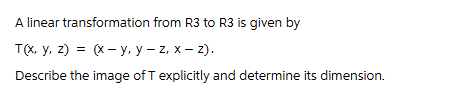
Given the linear transformation \( T : \mathbb{R}^3 \to \mathbb{R}^3 \) defined by:
\[
T(x, y, z) = (x - y, y - z, x - z)
\]
Describe the image of \( T \) explicitly and determine its dimension.
---
## Step 1: Write the Output as a Vector
Let \((a, b, c) = (x - y, y - z, x - z)\).
---
## Step 2: Find Relationships
From the transformation:
- \( a = x - y \)
- \( b = y - z \)
- \( c = x - z \)
Notice that:
\[
a + b = (x - y) + (y - z) = x - z = c
\]
So every vector in the image satisfies \( a + b = c \).
---
## Step 3: Explicit Description of the Image
Thus, the image of \( T \) is:
\[
\text{Im}(T) = \left\{ (a, b, c) \in \mathbb{R}^3 \mid c = a + b \right\}
\]
This is a plane in \(\mathbb{R}^3\).
---
## Step 4: Dimension of the Image
The equation \( c = a + b \) defines a plane, which is **2-dimensional**.
---
## Step 5: Basis for the Image (Optional)
To find a basis, set \( a \) and \( b \) as free variables:
\[
(a, b, a + b) = a(1, , 1) + b(, 1, 1)
\]
So a basis is \( \{ (1, , 1), (, 1, 1) \} \).
---
## Final Answers
### **Explicit Description**
\[
\boxed{
\text{Im}(T) = \left\{ (a, b, c) \in \mathbb{R}^3 \mid c = a + b \right\}
}
\]
### **Dimension**
\[
\boxed{2}
\]
Question:
is this correct?
This is AI generated Response.
Asked by: Nadeem
Created at: 2026-01-15 16:03:01
Asked by: Nadeem
Created at: 2026-01-15 16:03:01
Final Answer:
Rendered
Raw Text
Did you like this answer?
# Verification of the Solution
## Problem Summary
We are given a linear transformation \( T : \mathbb{R}^3 \to \mathbb{R}^3 \) defined by:
\[
T(x, y, z) = (x - y, y - z, x - z)
\]
and need to describe the image of \( T \) and determine its dimension.
## Step-by-Step Analysis
### Step 1: Define the Output
Let \((a, b, c) = (x - y, y - z, x - z)\).
### Step 2: Establish Relationships
From the transformation, we have:
- \( a = x - y \)
- \( b = y - z \)
- \( c = x - z \)
We can derive the following relationship:
\[
a + b = c
\]
This indicates that any vector in the image of \( T \) must satisfy this equation.
### Step 3: Explicit Description of the Image
The image of \( T \) can thus be expressed as:
\[
\text{Im}(T) = \left\{ (a, b, c) \in \mathbb{R}^3 \mid c = a + b \right\}
\]
This represents a plane in \(\mathbb{R}^3\).
### Step 4: Determine the Dimension
The equation \( c = a + b \) describes a plane, which is 2-dimensional.
### Step 5: Basis for the Image
To find a basis for this image, we can select \( a \) and \( b \) as free variables:
- Let \( a = 1 \) and \( b = 0 \) gives the vector \( (1, 0, 1) \).
- Let \( a = 0 \) and \( b = 1 \) gives the vector \( (0, 1, 1) \).
Thus, a basis for the image is:
\[
\{ (1, 0, 1), (0, 1, 1) \}
\]
## Final Results
### Explicit Description of the Image
\[
\boxed{
\text{Im}(T) = \left\{ (a, b, c) \in \mathbb{R}^3 \mid c = a + b \right\}
}
\]
### Dimension of the Image
\[
\boxed{2}
\]
## Conclusion
The initial analysis and conclusions are correct. The image of the transformation \( T \) is a plane in \(\mathbb{R}^3\) with a dimension of 2.
📢 Instructions:
- Ask anything relatd to above question only.
- For new Question goto :